Happy Dad Net Worth 2026: Owners, Revenue, Valuation & Growth
Happy Dad has grown from a creator-backed hard seltzer brand into one of the most talked-about names in the beverage space.
That growth has led many people to search for one question:
What is Happy Dad net worth in 2026?
Because Happy Dad is a privately held company, its exact valuation is not publicly disclosed.
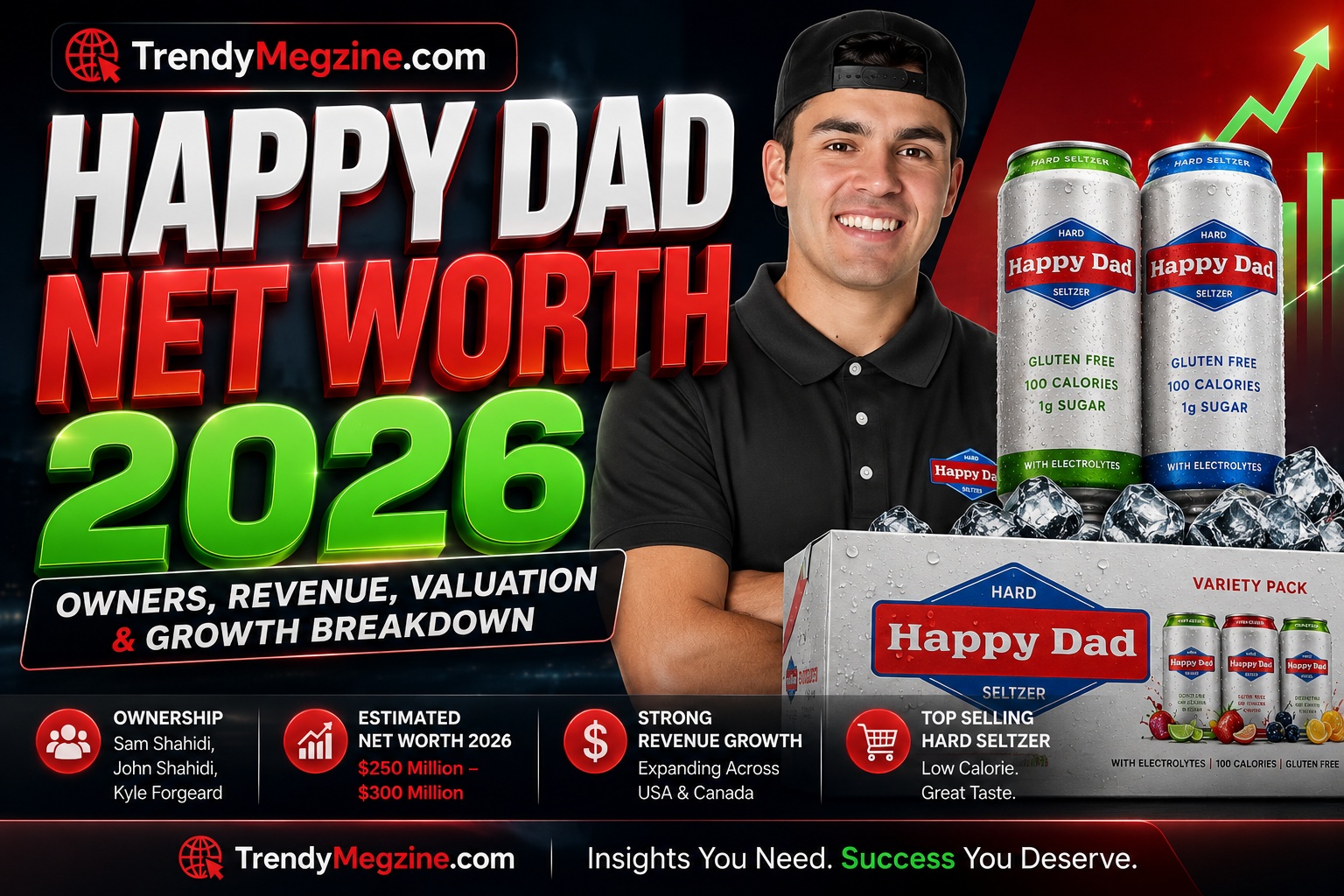
However, based on third-party estimates, recent sales growth, distribution expansion, and brand momentum, Happy Dad is often estimated to be worth somewhere in the $250 million to $300 million range in 2026.
That figure should be treated as an estimate rather than a confirmed company valuation.
In this guide, we break down Happy Dad net worth, owners, revenue, business model, founders, growth, and future potential.
Happy Dad Net Worth 2026: Quick Answer
The estimated Happy Dad net worth in 2026 is around $250 million to $300 million, according to commonly cited third-party estimates.
Because the company is private, there is no official public market valuation.
Its actual worth could be higher or lower depending on revenue, profitability, investor terms, distribution contracts, debt, and brand value.
Happy Dad Quick Facts
| Detail | Information |
|---|---|
| Brand Name | Happy Dad |
| Founded | 2021 |
| Founders | Sam Shahidi, John Shahidi, Kyle Forgeard |
| CEO | Sam Shahidi |
| Industry | Alcoholic Beverages |
| Main Product | Hard Seltzer |
| Connected Brand | NELK / Full Send |
| Estimated Net Worth 2026 | $250M–$300M |
| Public Company? | No |
| Headquarters | United States |
What Is Happy Dad?
Happy Dad is a hard seltzer brand founded in 2021.
The company was created by Sam Shahidi, John Shahidi, and Kyle Forgeard.
It became closely associated with the NELK and Full Send audience, which gave the brand a large built-in customer base from the beginning.
Unlike many traditional beverage companies, Happy Dad grew heavily through social media, creator marketing, online communities, events, and direct fan engagement.
That marketing advantage helped the company stand out in an already crowded hard seltzer market.
Who Owns Happy Dad?
Happy Dad was co-founded by:
- Sam Shahidi
- John Shahidi
- Kyle Forgeard
Sam Shahidi serves as CEO.
The exact ownership percentages are not publicly disclosed.
Because Happy Dad is privately held, the company does not publish a detailed public cap table showing how much equity each founder or investor owns.
This means claims about exact ownership percentages should be treated carefully unless confirmed directly by the company.
Is Happy Dad Owned by NELK?
Happy Dad is strongly connected to the NELK and Full Send ecosystem.
Kyle Forgeard is one of the founders of Happy Dad and is also closely associated with NELK.
This relationship played a major role in the brand’s early growth.
NELK already had a large online audience before Happy Dad launched.
That gave the company something most beverage startups do not have:
millions of potential customers who already knew the founders.
This built-in audience reduced the need for traditional advertising during the early stages of the brand.
Happy Dad Net Worth in 2026
The estimated Happy Dad net worth in 2026 is between $250 million and $300 million.
However, it is important to understand what this number means.
Happy Dad is not publicly traded.
There is no daily share price.
There is also no official public company filing showing the total value of the business.
That means any net worth or valuation figure online is based on estimates.
These estimates may consider:
- Revenue
- Sales growth
- Distribution
- Brand strength
- Retail presence
- Investor interest
- Social media reach
- Future growth potential
For that reason, it is better to describe $250M–$300M as an estimated valuation range, not a confirmed net worth.
How Much Revenue Does Happy Dad Make?
Happy Dad does not publicly release full audited annual revenue figures.
Some third-party estimates place annual revenue in the range of tens of millions of dollars.
One industry estimate has placed annual revenue around $67 million, while other online sources suggest higher figures.
Since those numbers are not directly confirmed by the company, they should be treated as estimates.
What is more useful is the company’s documented retail growth.
Industry data reported in 2025 showed Happy Dad posting double-digit sales growth in key retail channels.
That suggests the brand was still expanding rather than slowing down.
Happy Dad Sales Growth
Happy Dad has shown strong momentum in retail.
Industry reporting in 2025 showed the company growing sales in grocery and convenience channels.
That is important because beverage brands often depend heavily on retail shelf space.
More store locations can lead to:
- Higher sales volume
- More brand awareness
- More repeat buyers
- Better distributor relationships
- Stronger negotiating power
Retail growth can also improve a company’s valuation if investors believe the brand can continue scaling.
How Happy Dad Became So Popular
Happy Dad did not grow in the same way as a traditional beverage company.
Its founders already had access to a massive online audience.
That changed everything.
Instead of spending heavily on traditional television or billboard advertising, Happy Dad could reach customers through content.
The brand used:
- YouTube
- TikTok
- Creator partnerships
- Events
- Limited drops
- Influencer promotion
- Community marketing
This helped Happy Dad turn attention into sales.
The NELK and Full Send Effect
The NELK audience played a major role in Happy Dad’s early success.
NELK had already built a strong online community.
When Happy Dad launched, the brand did not need to start from zero.
It already had:
- Recognition
- Trust
- Reach
- Social proof
- A loyal fanbase
That type of audience can be extremely valuable.
Traditional beverage startups often spend millions of dollars trying to build the same awareness.
Happy Dad had a major advantage from day one.
Happy Dad Business Model
Happy Dad makes most of its money through beverage sales.
Its business model depends on producing, marketing, distributing, and selling hard seltzer and related products.
Key revenue channels include:
Retail Sales
Happy Dad products are sold through retailers and convenience stores.
Retail remains one of the biggest drivers of beverage revenue.
Distribution
The company works with distributors to reach larger geographic markets.
Distribution expansion can dramatically increase sales.
Brand Partnerships
Happy Dad has used partnerships to increase visibility and reach new audiences.
Merchandise and Lifestyle Branding
The brand also benefits from its connection to the wider Full Send lifestyle ecosystem.
This helps Happy Dad function as more than just a drink.
It becomes part of a wider entertainment and creator brand.
What Makes Happy Dad Different?
The hard seltzer market is competitive.
Happy Dad needed a clear identity.
The brand emphasizes:
- Low carbonation
- Simple flavors
- 100 calories per can
- 1 gram of sugar
- Gluten-free positioning
- Lifestyle-focused branding
The official brand also markets its drinks as having smoother carbonation and no artificial sweeteners.
These features help differentiate Happy Dad from larger competitors.
Happy Dad Product Line
Happy Dad originally became known for hard seltzer.
Over time, the brand expanded into more beverage categories.
Its product range has included:
- Hard Seltzer
- Fruit flavors
- Hard Tea
- Lemonade-style products
- Limited-edition releases
Product expansion helps reduce reliance on a single category.
That can be especially important when consumer trends change.
Happy Dad and the Hard Seltzer Market
Hard seltzer became one of the fastest-growing alcoholic beverage categories in the late 2010s and early 2020s.
Brands such as White Claw and Truly became dominant names.
Happy Dad entered later.
Instead of trying to compete only on product features, it leaned heavily into creator culture.
That helped the brand build a different identity.
Its customer base often overlaps with people who follow online creators, sports personalities, podcasts, and entertainment brands.
Happy Dad vs White Claw
White Claw is much larger and more established.
Happy Dad is a younger challenger brand.
The biggest difference is marketing style.
White Claw grew as a mainstream consumer beverage brand.
Happy Dad grew through creator-led marketing and online communities.
That gives Happy Dad a more personality-driven identity.
However, White Claw still has much greater scale and distribution.
Happy Dad vs Truly
Truly is another major hard seltzer brand.
It benefits from large-scale distribution and corporate backing.
Happy Dad competes differently.
Instead of relying only on traditional beverage marketing, it uses internet culture, creator partnerships, and community engagement.
That strategy can help a smaller brand remain visible even when competing against much larger companies.
Is Happy Dad a Successful Company?
By most visible measures, Happy Dad has become a successful beverage startup.
It launched in 2021 and expanded rapidly.
The brand has achieved national recognition, retail growth, partnerships, and strong online engagement.
Industry reporting has also shown continued sales growth.
That does not automatically tell us the company’s profitability.
Revenue and profit are not the same thing.
A company can generate strong sales and still have high expenses.
Because Happy Dad is private, detailed profitability figures are not publicly available.
How Much Is the Happy Dad Brand Worth?
The estimated brand valuation is often placed in the $250 million to $300 million range.
But brand valuation can be difficult to calculate.
It may include more than physical product sales.
Brand value can reflect:
- Customer loyalty
- Distribution
- Recognition
- Social media following
- Partnerships
- Founder influence
- Future growth expectations
This is why a company can sometimes be worth far more than one year of revenue.
Is Happy Dad Worth $300 Million?
It is possible, but not officially confirmed.
Some third-party estimates place the company near the $300 million level.
However, without public financial statements or a disclosed funding valuation, nobody outside the company and its investors can know the exact figure.
Therefore, the safest conclusion is:
Happy Dad may be valued around $250M–$300M based on public estimates, but there is no verified public valuation confirming that amount.
Who Is Sam Shahidi?
Sam Shahidi is one of the co-founders of Happy Dad and serves as CEO.
He plays a central role in the company’s business strategy and growth.
Along with John Shahidi and Kyle Forgeard, he helped build the brand around a combination of beverage distribution and creator-led marketing.
His leadership has been important as Happy Dad moves from an internet-driven startup toward a larger national beverage company.
Who Is John Shahidi?
John Shahidi is another co-founder of Happy Dad.
He has also been involved in media and creator-focused businesses.
His experience in digital media helped strengthen Happy Dad’s marketing strategy.
The company has used creator relationships and digital partnerships as a major growth tool.
Who Is Kyle Forgeard?
Kyle Forgeard is a co-founder of Happy Dad and one of the most recognizable names connected to the brand.
He is best known for his role in NELK.
Kyle’s audience helped bring immediate visibility to Happy Dad.
That creator connection became one of the company’s strongest competitive advantages.
Does SteveWillDoIt Own Happy Dad?
SteveWillDoIt is strongly associated with the wider NELK and Full Send ecosystem.
However, his exact equity position in Happy Dad is not publicly confirmed.
He has appeared in content connected to the brand, but that does not automatically mean he owns a specific percentage.
Unless the company publicly confirms ownership details, claims about his stake should be treated as speculation.
Did NELK Sell Happy Dad?
There is no widely confirmed public information showing that Happy Dad has been fully sold.
The founders remain publicly associated with the brand.
Private companies can accept outside investment without selling the entire company.
Happy Dad has reportedly attracted investment interest, but that does not mean the founders no longer own the business.
Happy Dad Investors
Happy Dad has attracted outside investment as it has grown.
Private investment can help beverage companies expand:
- Distribution
- Inventory
- Marketing
- Retail access
- New products
- Hiring
However, private investment also affects ownership.
When outside investors buy equity, founders usually give up part of the company.
Exact ownership details are not publicly available.
Happy Dad Marketing Strategy
Happy Dad’s marketing strategy is one of the most interesting parts of the business.
It blends product promotion with entertainment.
Instead of creating ads that feel separate from content, the brand often appears naturally inside creator videos, podcasts, social posts, and events.
This reduces the feeling of traditional advertising.
For younger audiences, that can make the brand feel more authentic.
Social Media and Viral Growth
Social media helped Happy Dad grow quickly.
The company benefited from:
- Viral clips
- Product launches
- Creator appearances
- Giveaways
- Limited editions
- Event content
- Podcast exposure
Each of these creates attention.
And in modern consumer brands, attention can become a valuable business asset.
Happy Dad Partnerships
Partnerships have also become an important part of Happy Dad’s growth.
The company has worked with entertainment personalities, sports-related audiences, creators, and media platforms.
In 2025, Happy Dad also announced a partnership with The Joe Rogan Experience.
That type of partnership exposes the brand to a huge audience.
It also moves Happy Dad beyond the original NELK fanbase.
Read More: PedroVazPaulo Business Consultant: Services, Strategy & Growth Guide 2026
Where Is Happy Dad Sold?
Happy Dad has expanded across the United States and into Canada.
Its availability has grown significantly since launch.
The brand can be found in a range of retail stores, convenience stores, liquor retailers, and other beverage outlets.
Availability depends on local alcohol laws and distributor coverage.
The official Happy Dad website provides a store locator for customers looking for nearby retailers.
Why Distribution Matters for Happy Dad Net Worth
Distribution is one of the biggest factors affecting the value of a beverage company.
A strong brand is useful.
But products must also be available where customers shop.
Every new distribution agreement can increase:
- Retail presence
- Revenue opportunity
- Brand awareness
- Customer access
If Happy Dad continues expanding distribution, its potential valuation could also increase.
What Could Increase Happy Dad Net Worth?
Several factors could raise Happy Dad’s future valuation.
More Retail Locations
Greater shelf presence can produce higher sales.
International Expansion
Entering more countries could create new revenue streams.
Product Expansion
New drinks may attract customers who do not buy hard seltzer.
Strategic Partnerships
High-profile collaborations can increase brand visibility.
Stronger Profitability
Revenue matters, but profit matters even more when investors value a company.
Risks That Could Affect Happy Dad’s Value
No brand grows forever without challenges.
Happy Dad faces several risks.
Hard Seltzer Competition
The category contains large established companies.
Changing Consumer Preferences
Drink trends can change quickly.
Dependence on Creator Culture
Creator-led marketing is powerful, but public controversies can also affect brand perception.
Distribution Costs
Expanding beverage distribution requires significant capital.
Regulation
Alcohol companies must follow strict state and national regulations.
These factors can affect future growth and valuation.
Happy Dad Net Worth Growth Potential
Happy Dad still has room to grow.
Its brand awareness remains strong among younger consumers.
Its retail presence is expanding.
It has also moved beyond one product category.
If sales growth continues and the company improves distribution and profitability, its estimated valuation could increase further.
However, future valuation depends on actual business performance.
Social media popularity alone is not enough.
Is Happy Dad a Billion-Dollar Brand?
Happy Dad is not publicly confirmed to be worth $1 billion.
Reaching a billion-dollar valuation would require significant additional growth.
That could involve:
- Major revenue expansion
- International growth
- Strong profitability
- Large investment rounds
- Acquisition interest
- Bigger retail partnerships
It is possible for successful beverage brands to reach billion-dollar valuations, but there is no public evidence that Happy Dad has reached that level.
Happy Dad Net Worth Compared With Other Seltzer Brands
Comparisons can be difficult because many beverage companies are owned by large corporations.
White Claw belongs to Mark Anthony Brands.
Truly belongs to Boston Beer Company.
Happy Dad is much younger and smaller.
However, its creator-led growth strategy has helped it become more recognizable than many brands of similar age.
That visibility gives Happy Dad a strong position for future expansion.
Frequently Asked Questions
What is Happy Dad net worth in 2026?
Happy Dad is commonly estimated to be worth around $250 million to $300 million in 2026. The figure is not officially confirmed because the company is privately held.
Who owns Happy Dad?
Happy Dad was co-founded by Sam Shahidi, John Shahidi, and Kyle Forgeard. Exact ownership percentages are not publicly available.
Who is the CEO of Happy Dad?
Sam Shahidi is the CEO and co-founder of Happy Dad.
When was Happy Dad founded?
Happy Dad was founded in 2021.
Is Happy Dad owned by NELK?
Happy Dad is closely connected to NELK through co-founder Kyle Forgeard, but the company has its own business structure.
How much money does Happy Dad make?
The company does not publicly disclose full annual financial results. Third-party estimates place annual revenue in the tens of millions of dollars.
Does SteveWillDoIt own Happy Dad?
His exact ownership stake has not been publicly confirmed.
Is Happy Dad profitable?
Happy Dad does not publicly release detailed profit figures, so its exact profitability is unknown.
Is Happy Dad worth $300 million?
Some estimates place the company near $300 million, but there is no official public valuation confirming that number.
Where is Happy Dad sold?
Happy Dad is sold in many locations across the United States and Canada, depending on distributor coverage and local alcohol laws.
Why is Happy Dad so popular?
Its popularity comes from creator-led marketing, the NELK audience, social media exposure, partnerships, recognizable branding, and growing retail distribution.
Is Happy Dad still growing?
Recent industry sales data has shown continued retail growth, suggesting the brand is still expanding.
Final Thoughts
The estimated Happy Dad net worth in 2026 is around $250 million to $300 million, but that figure is not officially confirmed.
Happy Dad is a private company, so exact revenue, profits, ownership percentages, and valuation are not publicly available.
What is clear is that the brand has grown rapidly since 2021.
Its biggest strengths include creator-led marketing, NELK exposure, expanding retail distribution, strong audience recognition, and a growing beverage lineup.
That combination has helped Happy Dad move from an influencer-backed launch into a serious consumer beverage brand.
If the company continues increasing sales, distribution, partnerships, and profitability, its value could continue to rise in the years ahead.

Muhammad Shoaib is a passionate content writer and symbolism researcher at TrendyMegzine.com, where he explores the hidden meanings behind symbols, spiritual signs, ancient traditions, dream interpretations, and cultural symbolism.