20+ Hidden Symbols of Rebirth You See Every Day but Never Notice
Something in you already knows how to begin again.
You have done it before — probably without a name for it. After the loss that felt unsurvivable. After the version of yourself you outgrew. After the relationship, the failure, the long winter that refused to end. Something in you went quiet, went dark, went underground — and then, without announcement, came back. Different. Clearer. More itself.
Symbols of rebirth exist because this experience is universal. Every human culture that ever existed looked at the world around them — at fire turning wood to ash then heating something new, at seeds splitting open in soil, at a caterpillar dissolving into liquid and then somehow becoming something that flies — and recognized their own interior life in it.
This guide explores 20+ symbols of rebirth that appear in everyday life, ancient mythology, spiritual traditions, and permanently on people’s skin. Some you will recognize immediately. Others you pass every morning without realizing what they are quietly telling you.
What Are Symbols of Rebirth?
Symbols of rebirth are visual signs, mythological figures, and natural phenomena that human cultures have used across thousands of years to represent renewal, transformation, and the cycle of death giving way to new life.
They are not metaphors invented by philosophers. They emerged from direct observation. Ancient peoples watched the sun disappear every night and return every morning. They watched snakes shed their skin and walk away looking new. They watched flowers bloom from what looked like dead ground. They looked at these things and thought: that is what happens inside me.
The power of rebirth symbols lies in this recognition. They do not promise that the hard part never happened. They promise something more honest: that the hard part was not the end. That what looks like destruction is sometimes just the necessary stage before something unimaginable begins.
The 10 Most Powerful Symbols of Rebirth — Full Breakdown
| Symbol | Visual | Core Meaning | Cultural Origin |
| Phoenix | Bird rising from flames | Resurrection, triumph over destruction | Greek, Egyptian, Chinese |
| Lotus Flower | Bloom emerging from muddy water | Spiritual awakening, purity after suffering | Buddhism, Hinduism, Egypt |
| Butterfly | Winged creature from cocoon | Personal transformation, new identity | Universal — global cultures |
| Ouroboros | Serpent eating its own tail | Eternal cycle, death feeding new life | Ancient Egypt, Greek alchemy |
| Scarab Beetle | Rolling a ball of dung | Resurrection, solar renewal | Ancient Egypt |
| Snake Shedding Skin | Old skin left behind | Healing, renewal, wisdom | Global mythology |
| Egg | Unhatched, full of potential | Creation, beginning, pure possibility | Norse, Hindu, universal |
| Sunrise | Sun breaking the horizon | New day, victory over darkness | All ancient cultures |
| Seed | Dormant potential in soil | Future life, patience, invisible growth | Universal |
| Moon Phases | Waxing, full, waning, dark | Death and renewal in cycle | Pagan, Indigenous, universal |
1. The Phoenix — The Symbol That Burns to Become
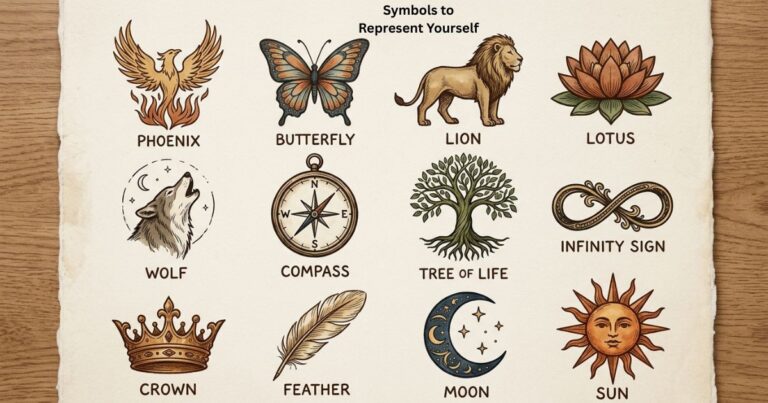
Nothing in world mythology captures resurrection more completely than the Phoenix.
A bird of impossible beauty that lives for five hundred years, then builds a nest, sets itself on fire, burns to ash — and rises from those same ashes, reborn, completely renewed. The story appears in ancient Greek texts, Egyptian mythology, Chinese legend, and Norse tradition. Independently, across cultures with no contact, humans arrived at the same image to describe the same experience.
Because the experience is that universal. The feeling of being burned down to nothing. And then — somehow — the slow, disbelieving awareness that you are still here. Different. But here.
The Phoenix as a symbol of rebirth represents:
- Not just surviving destruction but being made by it
- The understanding that the fire was not punishment — it was process
- The specific courage of beginning again when beginning again feels impossible
As a tattoo, the Phoenix is the most chosen rebirth symbol in the world. People get it after cancer treatment, after addiction recovery, after the end of marriages that felt permanent, after grief that they genuinely did not believe they would survive. The tattoo does not celebrate the fire. It marks the rising.
2. The Lotus Flower — The Symbol That Grows Through Darkness
The lotus flower blooms from muddy, dark water. Not despite the mud — because of it. The deeper the roots grow into the darkness at the bottom of the pond, the more extraordinary the flower that surfaces.
That is the entire teaching. And it has made the lotus one of the most enduring of all symbols of rebirth across multiple spiritual traditions.
In Buddhism, the lotus represents the path to enlightenment — the human soul moving through the suffering of the world toward spiritual awakening, untouched by the mud through which it grew. In Hinduism, deities sit on lotus thrones — divinity resting on the surface of what ordinary life calls ordinary. In ancient Egypt, the lotus was connected to the sun and creation, blooming each morning as the sun rose.
What makes the lotus different from other rebirth symbols is its specificity about process. It does not skip the mud. It does not pretend the darkness is not there. It says: the darkness is not the obstacle. The darkness is the ground.
3. The Butterfly — The Symbol of Complete Transformation
The butterfly’s power as a symbol of rebirth lies in a biological fact so strange that it reads like mythology: inside the chrysalis, the caterpillar does not simply rearrange itself. It dissolves. Almost entirely. What was a caterpillar becomes, briefly, a kind of living soup — then reorganizes itself, from that dissolution, into something with wings.
Metamorphosis this total is rare in nature. And it is exactly why the butterfly became the universal symbol for the kind of personal change that does not just improve you — it remakes you. The kind that requires you to dissolve some part of your old identity before your new one is possible.
The butterfly in transformation symbolism appears across Japanese, Greek, Mexican, and Celtic cultures — always carrying the same message: what you are becoming requires releasing what you were. The cocoon is not comfortable. The dissolving is not comfortable. But the wings were always inside you, waiting for exactly this.
4. The Ouroboros — The Symbol That Eats Itself to Continue
The Ouroboros — a serpent curled in a circle, devouring its own tail — is one of the oldest symbols of rebirth in recorded history. It appears in ancient Egyptian tomb imagery, in Greek alchemical manuscripts, in Norse mythology as the world serpent Jörmungandr encircling the earth.
Its meaning is precise and slightly uncomfortable: death feeds life. The end is consumed to create the beginning. There is no renewal without the thing that ends being eaten by what comes next.
The Ouroboros is the symbol of rebirth that refuses to be sentimental about the process. It does not offer a story where the old thing peacefully retires and the new thing gently emerges. It says: cycles are hungry. Every beginning consumes an ending. That is not tragedy — it is just how the cycle moves.
5. The Scarab Beetle — Ancient Egypt’s Morning Symbol
Ancient Egyptians watched dung beetles roll their spheres of dung across the sand and saw in that motion the sun crossing the sky. From that observation came one of the most powerful of all Egyptian symbols of rebirth: the scarab beetle, associated with Khepri — the god of the rising sun, the god of rebirth, the god of morning itself.
The scarab symbolized:
- The soul’s journey through the underworld toward new life
- The daily miracle of the sun returning after the dark
- Resurrection as a cosmic principle, not an exception
Scarab amulets were placed over the hearts of mummies to protect the soul during its journey toward rebirth. The Egyptians believed so completely in renewal that they built an entire civilization on preparing for it.
6. The Snake Shedding Skin — The Symbol of Walking Away Renewed
Snake shedding skin may be the most quietly powerful of all everyday symbols of rebirth — because it actually happens, regularly, in your garden or your woods, with no mythology required.
A snake grows, its old skin no longer fits, and it leaves that skin behind. Intact, whole, still shaped like a snake — but empty. The snake does not mourn its old skin. It does not carry it. It simply moves forward in what it has grown into.
In ancient Greek medicine, the snake winding around the Rod of Asclepius represented healing and renewal — the ability of life to shed what no longer serves it and regenerate. In Hindu mythology, Lord Shiva wears snakes as ornaments, embodying the mastery of death and rebirth. Across cultures, the snake’s capacity for skin-shedding made it the symbol of transformation through release.
10 More Hidden Symbols of Rebirth You See Every Day
Beyond the famous symbols, rebirth appears in quieter images that most people pass without recognizing.
The Egg — Every egg holds a complete life in potential stasis. In Norse mythology, the world itself hatched from an egg. The egg is the symbol of rebirth in its most concentrated form: everything needed for an entirely new life, waiting in the dark for the right moment to break open.
The Sunrise — Every morning the sun does what the Phoenix does — disappears completely, then returns. Ancient cultures built temples aligned with the solstice sunrise not as an astronomical exercise but as a daily theological statement: the light comes back.
The Seed — Nothing looks less alive than a seed. And nothing contains more future. The seed is the symbol of rebirth that requires the most patience, because the growth is invisible for so long. But the transformation is already happening — underground, in the dark, before anyone can see it.
The Moon — The moon disappears completely for three days every month, then slowly reappears, grows to fullness, and disappears again. Every cycle. Every month. Moon phases as symbols of rebirth teach that darkness is not failure — it is a stage. The dark moon is not the end of the moon. It is the moon preparing for its next fullness.
The Dragonfly — Dragonflies spend most of their lives as nymphs underwater, invisible to the surface world. Then they emerge, transform completely, and live briefly as creatures of air and light. In Japanese culture, the dragonfly represents courage, strength, and renewal. In many Indigenous traditions, it represents the soul’s ability to inhabit new forms.
Rain — Every thunderstorm that feels like it will never stop eventually becomes the thing that made everything grow. Rain in almost every spiritual tradition carries renewal — the washing away, the return of life, the transformation of dry into fertile.
The Chrysalis / Cocoon — The cocoon deserves its own entry separate from the butterfly because the cocoon itself is a symbol of rebirth’s most difficult phase: the transformation that is invisible from outside, that looks like stillness but is actually the most intense change of all.
The Spiral — The Celtic spiral — carved into ancient Irish stonework over five thousand years ago — represents the path of life moving outward from a center, then back inward, then outward again. It is the symbol of rebirth as an ongoing dynamic rather than a one-time event.
The Cherry Blossom — In Japanese culture, mono no aware — the bittersweet awareness of impermanence — is expressed through the cherry blossom, which blooms for one brief, spectacular week and then falls. The falling is not failure. The brevity is the point. The Ankh of ancient Egypt completes this section: the cross with a loop at the top, representing eternal life, the soul’s survival of physical death, and the belief that transformation does not end existence — it continues it.
Symbols of Rebirth Across Ancient Cultures
Every major civilization developed its own language for the experience of renewal and transformation. The remarkable thing is how consistent that language is across cultures with no contact.
Ancient Egypt — The sun’s daily journey was understood as a cosmic rebirth. Ra, the sun god, died each evening and was reborn each morning. The scarab, the Ankh, and the phoenix-like Bennu bird all served this mythology of eternal renewal.
Ancient Greece — The Phoenix was only the most dramatic of many Greek rebirth symbols. Persephone’s annual descent into and return from the underworld was the mythological explanation for winter and spring — death and rebirth on a cosmic scale.
Hinduism and Buddhism — Samsara — the endless cycle of death and rebirth — is the central reality of existence in both traditions. The lotus rises through it. The flame of a candle, passed from wick to wick without diminishment, is the image both traditions use for the soul’s passage between lives.
Celtic tradition — The Celtic spiral, the knot with no beginning and no end, and the sacred oak tree all represent the Celtic understanding of life as an eternal cycle. Druids believed the soul could not be permanently destroyed — only transformed.
Native American traditions — Animals, seasons, and the earth’s own cycles provided the primary rebirth symbolism. The bear hibernating and emerging in spring, the eagle shedding its feathers and growing new ones, the seasons themselves — all were understood as ongoing demonstrations of rebirth’s universal pattern.
The Psychology Behind Symbols of Rebirth
Here is the question that is worth asking honestly: why do humans need symbols of rebirth at all?
The answer comes from what psychologists call narrative identity — the way human beings understand themselves through stories. When something in your life ends — a relationship, a career, a version of yourself you thought was permanent — the mind experiences it as a narrative crisis. The story you were telling about your life no longer works. The character you understood yourself to be no longer fits.
Symbols of rebirth solve this crisis by providing a new narrative framework. Not “this ending means failure” but “this ending is the fire the Phoenix builds.” Not “this darkness means I am lost” but “this darkness is the underground stage before the seed breaks through.”
Carl Jung identified these images as archetypes — patterns so deeply embedded in human psychology that they activate meaning before conscious thought. The Phoenix, the seed, the rising sun — these images work on the mind the way they work because humans have been using them for this exact psychological function for thousands of years.
They are not distractions from reality. They are the tools the human mind has always used to survive reality.
Symbols of Rebirth in Tattoos, Art, and Modern Culture
The surge in rebirth-symbol tattoos over the past two decades is not a fashion trend. It is a psychological one.
People who choose permanent marks carry them because language — “I went through something hard and came out the other side” — does not capture what actually happened. The Phoenix on the back says: I was ash. I am not ash now. That is a complete sentence. No explanation required.
Most meaningful rebirth symbol tattoo choices:
- Phoenix — survival of what felt unsurvivable; the fire was real
- Lotus — beauty that grew specifically because of the difficulty, not in spite of it
- Butterfly — the kind of change that required dissolving the old self completely
- Ouroboros — recognition that endings and beginnings are the same thing, consuming each other
- Seed or seedling — quiet, patient transformation; the growth that happened in the dark
In film, rebirth appears wherever a character is rebuilt by what destroys them. In literature, from Dostoevsky to Toni Morrison to Mary Oliver, the symbols of rebirth structure the most powerful moments — the moment after the breaking, when something new tentatively begins.
In wellness culture, rebirth symbolism has become the organizing language of therapy, recovery, and personal development. The metaphors are ancient. The application is contemporary. The emotional need being met is exactly the same.
Spiritual and Dream Meaning of Symbols of Rebirth
When symbols of rebirth appear in dreams, they tend to surface at specific moments — during major transitions, during grief, during the slow work of recovery from something that changed you permanently.
Phoenix in dreams — Often appears during periods of conscious surrender. You know something is ending. The dream is telling you that the ending is not the story’s conclusion.
Lotus in dreams — Frequently surfaces when someone is in the middle of difficulty, not at its end. The lotus in dream psychology often means: the growth is happening now, even though you cannot see it yet.
Butterfly or chrysalis — Dreams of a chrysalis often precede significant personal change. The transformation has not completed yet — but it has begun.
Snake shedding skin — Often appears after a major identity shift: a career change, the end of a relationship, any moment when a previous version of the self is clearly no longer sufficient.
Spiritually, these symbols function as messages from the part of the self that already knows what the thinking mind is still catching up to.
Positive and Shadow Meanings of Symbols of Rebirth
The most honest thing that can be said about symbols of rebirth is that they do not lie about the cost.
Positive meanings: healing, hope, growth, the discovery that you are more resilient than you believed, the arrival — eventually — at something better than what came before.
Shadow meanings: loss, the fire before the rising, the dissolution before the wings, the long darkness before the seed breaks through. Rebirth is not gentle. It requires something to end. It requires the willingness to stop protecting what has already become a cage.
The symbols are honest about this. The Phoenix does not skip the burning. The lotus does not skip the mud. The butterfly does not skip the chrysalis.
That honesty is precisely what makes them trustworthy.
Conclusion
There is a moment — if you have ever been through something that genuinely broke you open — when you realize that the breaking was not the end of the story.
That moment is what every one of these symbols of rebirth has always been pointing toward.
The Phoenix burns and rises. The lotus blooms from the bottom of something dark and murky. The butterfly dissolves everything it was in order to become what it was always becoming. The snake walks away from the skin it no longer fits without looking back.
Twenty symbols. One truth: you are allowed to become someone the old version of you could not have imagined.
The symbols of rebirth were never about the fire or the mud or the dark. They were always about what comes after — and the faith that something does.
Explore the symbol that speaks to your story. Carry it. Let it remind you of what you already survived and what you are becoming.

Muhammad Shoaib is a passionate content writer and symbolism researcher at TrendyMegzine.com, where he explores the hidden meanings behind symbols, spiritual signs, ancient traditions, dream interpretations, and cultural symbolism.