119+ Spiritual Symbols and Meanings — The Complete Guide for 2026
Something inside you already recognizes them.
A lotus. A spiral. An eye. A tree whose roots and branches mirror each other perfectly. Before your mind can name what you are looking at, something deeper responds — a quiet recognition, a pull, a feeling that this symbol holds a truth you already know but have not yet found the words for.
That recognition is not coincidence. Spiritual symbols and meanings have been shaping the human story for over 40,000 years — carved into cave walls before we had alphabets, painted onto temple ceilings before we had science, worn against skin before we had language for what we feared or hoped.
This guide explores more than 119 spiritual symbols and meanings — not as a flat definition list, but as a living exploration of what each symbol reveals, where it comes from, why it still speaks to us, and what it might be saying to you specifically right now.
What Are Spiritual Symbols and Meanings?
Spiritual symbols and meanings are visual signs — shapes, icons, and patterns — that represent truths beyond the physical world.
They compress vast, complex ideas into simple images. A circle carries the concept of eternity. A cross holds centuries of sacrifice and salvation. A lotus flower rises from mud to encode an entire philosophy about suffering and transcendence in a single bloom.
Long before written language existed, humans carved these symbols into stone. They understood something modern psychology has only recently confirmed: the visual brain processes symbolic meaning faster, deeper, and more emotionally than written words.
A talisman worn around the neck is not decoration. It is a psychological anchor — a physical reminder of an invisible truth the wearer has chosen to carry.
The Psychology Behind Spiritual Symbols and Meanings
Carl Jung called it the collective unconscious.
He proposed that beneath the personal memories and experiences of every individual human mind lies a deeper layer — shared across all of humanity — populated by recurring images and patterns he called archetypes.
The mother. The shadow. The trickster. The hero. These figures appear in myths, dreams, and art across cultures that never had contact with each other. They are not learned. They are inherited — woven into the fabric of being human.
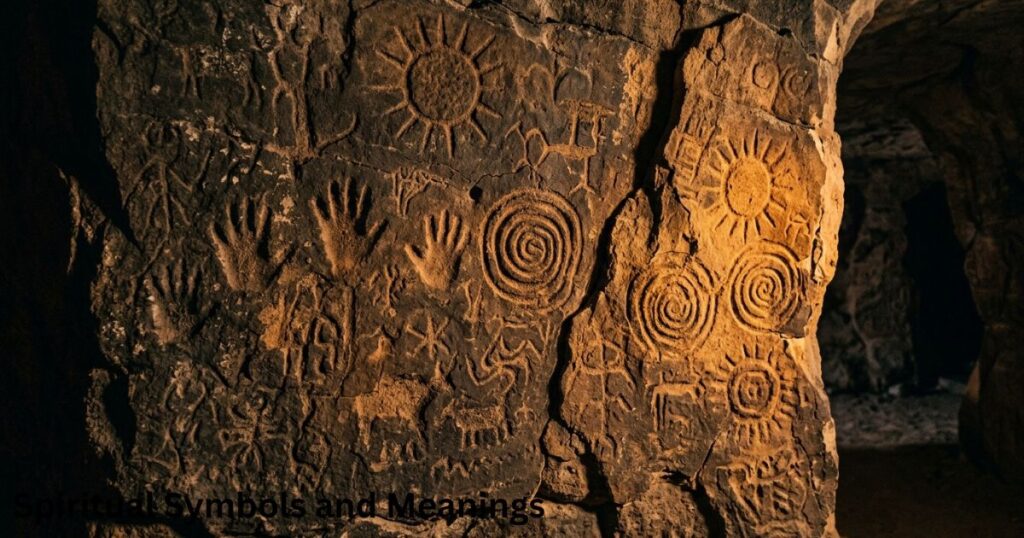
This is why Spiritual symbols and meanings feel familiar even when you encounter them for the first time.
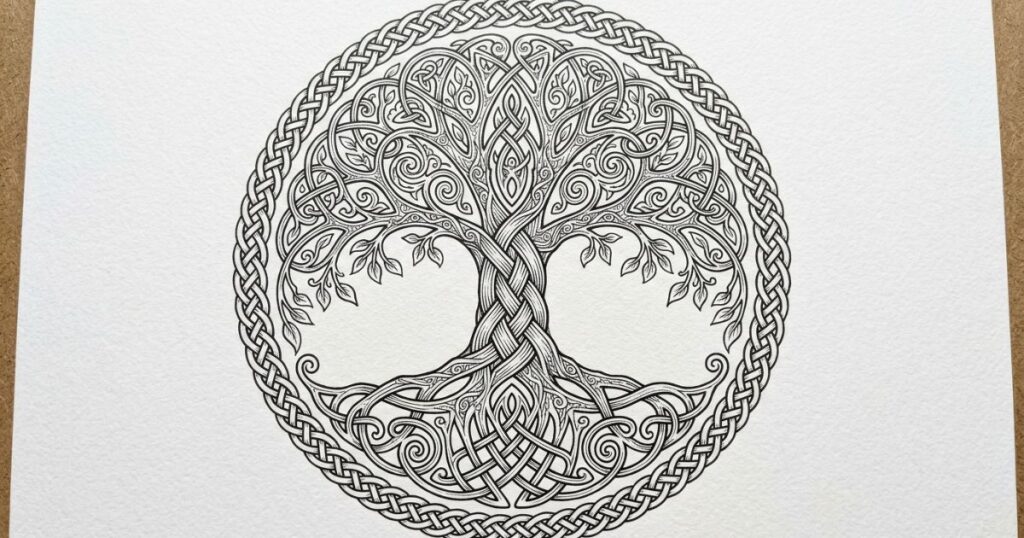
When you see the Tree of Life — its roots reaching into the earth, its branches reaching toward the sky — something resonates before your conscious mind can analyze it. You are not just seeing a tree. You are recognizing a pattern that humans have been using to understand existence for thousands of years.
Sacred geometry operates on the same principle. Circles, spirals, triangles, and hexagons appear in temples across Egypt, India, Greece, and Mesoamerica — built independently, yet structurally identical — because they reflect mathematical truths that feel sacred precisely because they appear in nature itself.
Symbols do not create meaning. They reveal it.
25 Most Powerful Spiritual Symbols and Their Deep Meanings
1. The Ankh
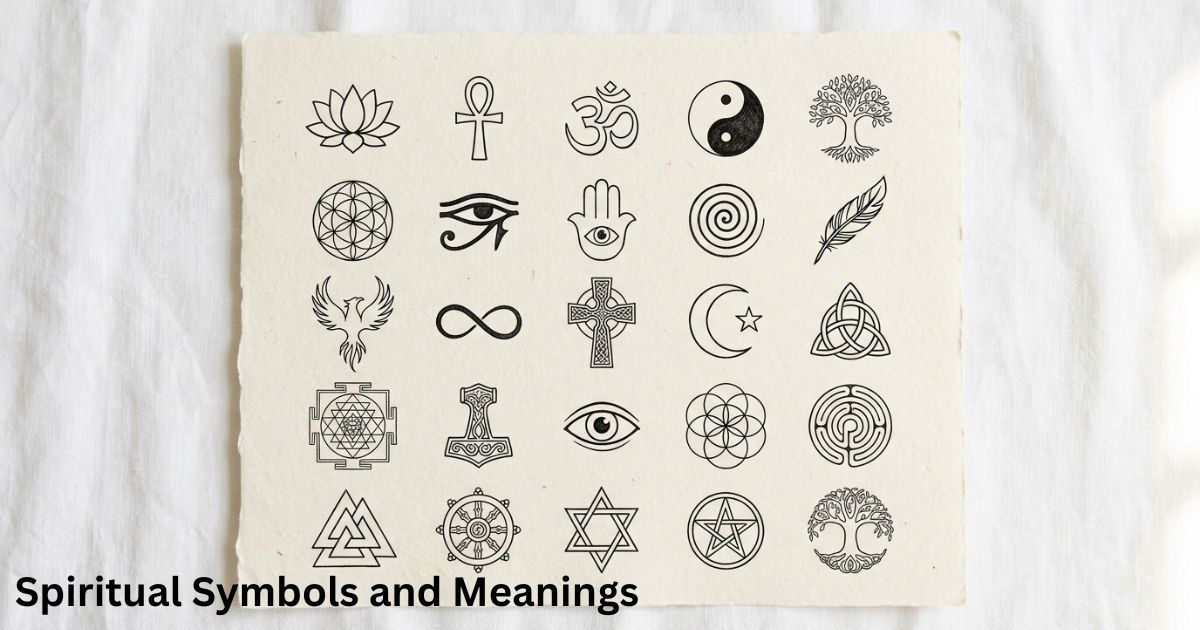
Visual: A cross with a teardrop loop at the top. Meaning: Eternal life, divine protection, the union of masculine and feminine. Origin: Ancient Egypt — pharaohs were depicted holding the Ankh as a key to immortality. Modern use: Tattoos, jewelry, spiritual art, Neo-pagan practice.
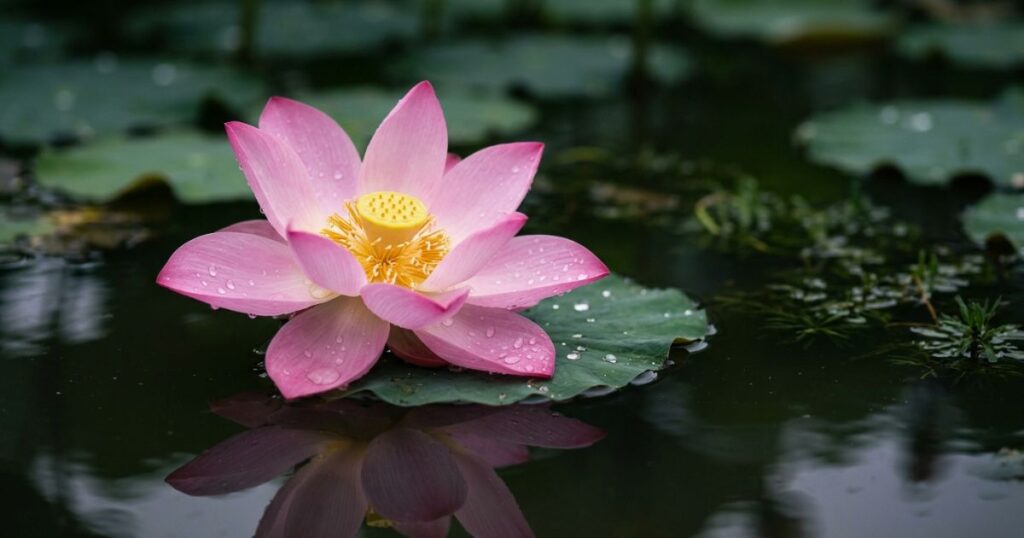
2. The Lotus Flower
Visual: A layered bloom rising from dark water. Meaning: Purity, enlightenment, rebirth — growing beautiful from difficulty. Origin: India and Buddhist traditions — the lotus flower grows in muddy water yet surfaces untouched. Modern use: Yoga culture, meditation spaces, spiritual tattoos, women’s empowerment symbolism.
3. Yin and Yang
Visual: A circle split into black and white halves, each containing a dot of the opposite color. Meaning: Balance, duality, the interdependence of opposites. Origin: Chinese Taoist philosophy — Yin and Yang teaches that light requires darkness to exist. Modern use: Martial arts, mindfulness brands, tattoos representing balance after conflict.
4. The Om Symbol
Visual: A flowing Sanskrit character (ॐ). Meaning: The primordial sound of creation — the vibration from which the universe emerged. Origin: Hindu scriptures — the Om symbol is the first sound of existence itself. Modern use: Meditation, yoga, mantra practice, spiritual jewelry.
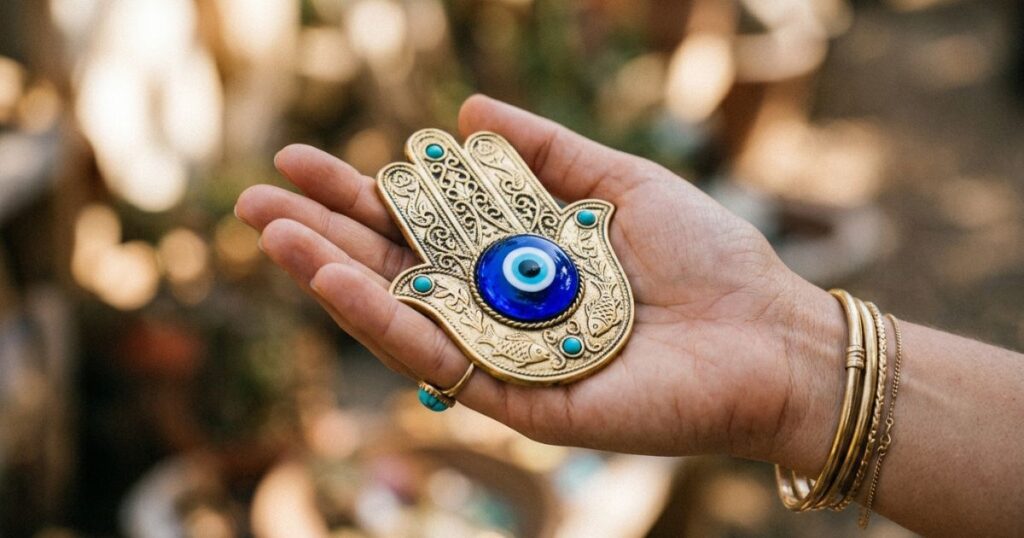
5. The Hamsa Hand
Visual: An open palm with an eye at its center. Meaning: Protection from negative energy, evil eye, and harm. Origin: The Hamsa Hand appears in both Islamic and Jewish traditions as a protective amulet — its name means “five” in Arabic, representing the five fingers. Modern use: Home decor, jewelry, tattoos for protection.
6. The Eye of Horus
Visual: A stylized eye with distinctive markings beneath it. Meaning: Protection, royal power, divine sight, healing. Origin: Ancient Egypt — the Eye of Horus represented the all-seeing protection of the falcon god. Modern use: Tattoos, art, occult and spiritual jewelry.
7. The Tree of Life
Visual: A tree whose roots and branches mirror each other perfectly. Meaning: Connection between heaven and earth, all living beings linked, generational continuity. Origin: Appears across Celtic, Norse (Yggdrasil), Kabbalistic, and Indigenous traditions — the Tree of Life is perhaps the most universal of all Spiritual symbols and meanings. Modern use: Family crests, spiritual tattoos, jewelry.
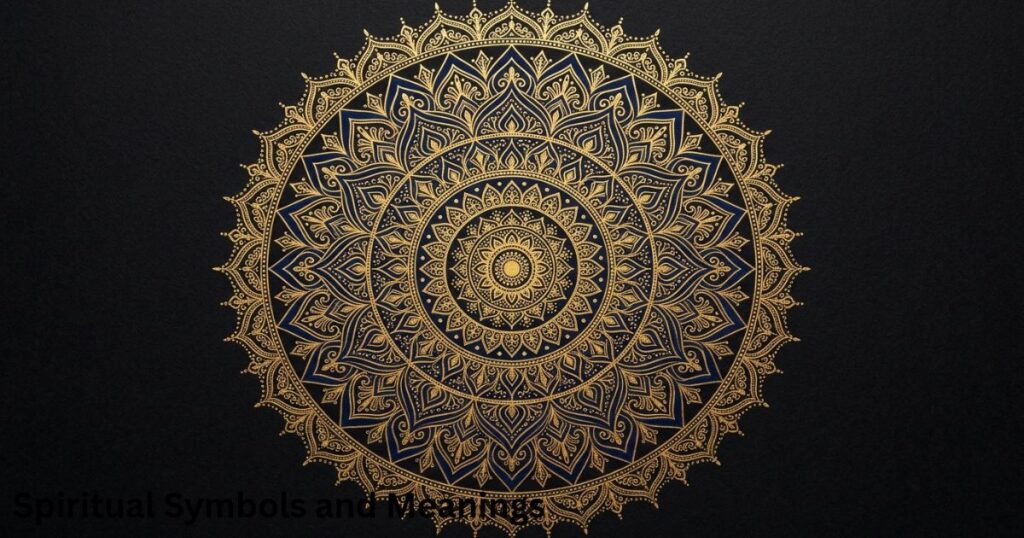
8. The Mandala
Visual: Complex geometric patterns radiating from a central point. Meaning: Cosmic wholeness, unity, the universe represented in a single diagram. Origin: Hindu and Buddhist traditions — the mandala is used in meditation to represent the mind and cosmos as one. Modern use: Sand mandalas in Buddhist ceremony, coloring therapy, tattoos, wall art.
9. The Spiral
Visual: A continuous curved line radiating outward from a center point. Meaning: Growth, evolution, life’s journey, the cyclical nature of time. Origin: Found in Celtic rock carvings at Newgrange (older than Stonehenge), Maori tattoo tradition, and dozens of independent cultures. Modern use: Spiritual tattoos representing personal evolution and never-ending growth.
10. The Infinity Symbol
Visual: A horizontal figure-eight (∞). Meaning: Eternity, endless possibility, unbroken continuity. Origin: Mathematical concept adopted as spiritual symbol — infinity represents that which has no beginning and no end. Modern use: Relationship jewelry, spiritual tattoos, manifestation practices.
11. The Cross
Visual: Two intersecting perpendicular lines. Meaning: Sacrifice, salvation, faith, the meeting point of heaven and earth. Origin: Christianity — but the cross predates Christianity as a symbol of the four directions and cosmic order in multiple ancient cultures. Modern use: The most widely worn religious symbol in the world.
12. The Crescent Moon
Visual: A curved sliver of the moon in partial phase. Meaning: Intuition, feminine energy, change, growth, the passage of time. Origin: Ancient Mesopotamia, Islam, Goddess traditions across the ancient world. Modern use: Spiritual jewelry, lunar magic practice, tattoos.
13. The Phoenix
Visual: A bird consumed by fire, rising reborn from its own ashes. Meaning: Rebirth, transformation, resilience — the truth that destruction and renewal are the same process. Origin: Ancient Egypt (Bennu bird), Greek mythology, Chinese mythology (Fenghuang). Modern use: One of the most chosen tattoo symbols for people who have survived a major life transformation.
14. The Ouroboros
Visual: A serpent eating its own tail, forming a complete circle. Meaning: Eternity, the cyclical nature of existence, the universe consuming and recreating itself. Origin: Ancient Egypt, Gnostic tradition, Norse mythology (Jörmungandr). Modern use: Philosophy, alchemy symbolism, spiritual tattoos.
15. The Feather
Visual: A single bird feather. Meaning: Freedom, lightness, spiritual communication, connection to the divine. Origin: Native American, Ancient Egyptian, and Celtic traditions — feathers were understood as messages from the spiritual realm. Modern use: Tattoos representing freedom, grief transformation, and connection to those who have passed.
16. The Star of David
Visual: Two overlapping triangles forming a six-pointed star. Meaning: The union of heaven and earth, divine protection, identity, and faith. Origin: Jewish tradition — though the six-pointed star predates modern Judaism in multiple ancient traditions. Modern use: Jewish identity, spiritual jewelry, sacred geometry art.
17. The Dharma Wheel (Dharmachakra)
Visual: A wheel with eight spokes. Meaning: The Buddhist path to enlightenment — the eight spokes represent the Eightfold Path. Origin: Buddhism — one of the oldest known Buddhist symbols, representing the teachings of the Buddha. Modern use: Buddhist practice, spiritual tattoos, meditation spaces.
18. The Caduceus
Visual: Two snakes spiraling around a winged staff. Meaning: Healing, balance, communication between worlds, duality in harmony. Origin: Greek mythology — the staff of Hermes, messenger between gods and humans. Modern use: Medicine (often confused with the Rod of Asclepius), spiritual healing practices.
19. The Fleur-de-lis
Visual: A stylized three-petal iris or lily. Meaning: Purity, nobility, divine grace, the Trinity in Christian symbolism. Origin: French heraldry and Christian tradition — the lily was associated with the Virgin Mary. Modern use: Architectural ornamentation, spiritual jewelry, cultural identity symbols.
20. The Triskele (Triple Spiral)
Visual: Three spirals connected at a central point. Meaning: Life, death, and rebirth — past, present, future — mind, body, spirit. Origin: Celtic tradition — found carved at Newgrange, Ireland, in carvings over 5,000 years old. Modern use: Celtic tattoos, Irish heritage symbols, spiritual practice.
21. The Evil Eye (Nazar)
Visual: A blue eye amulet. Meaning: Protection from jealousy, malice, and harmful intentions directed at you. Origin: Mediterranean, Middle Eastern, and South Asian traditions — the evil eye belief spans cultures across the ancient world. Modern use: One of the most globally popular protective amulets in 2026.
22. The Pentagram
Visual: A five-pointed star inside a circle. Meaning: Protection, the five elements (earth, air, fire, water, spirit), the human form. Origin: Ancient Greece, Pagan and Wiccan tradition, Medieval Christian symbolism. Modern use: Wicca, Neo-pagan practice, spiritual protection.
23. The Labyrinth
Visual: A complex winding path leading to a single center. Meaning: The spiritual journey — complex, non-linear, but always leading inward. Origin: Ancient Greece (Minoan culture), Medieval Christian cathedrals (Chartres labyrinth). Modern use: Walking meditation, spiritual retreat practice, tattoos.
24. The Sun Symbol
Visual: A circle with radiating lines. Meaning: Life force, clarity, truth, divine energy, consciousness. Origin: Universal — virtually every ancient culture developed a sun symbol independently. Modern use: Spiritual tattoos, solar energy practices, spiritual art.
25. The Hamsa (Five)
Visual: Open palm — already covered above. Worth noting: the number five itself carries spiritual weight across traditions — the five wounds of Christ, the five pillars of Islam, the five elements in Chinese philosophy. Meaning: Wholeness, protection, divine alignment.
Spiritual Symbols Across Cultures
The same spiritual truths arrived in different packages across cultures that never met.
Ancient Egypt
Egyptian Spiritual symbols and meanings were carved into every surface of daily life. The Eye of Horus guarded tombs. The Ankh opened doors to eternity. The scarab beetle represented rebirth and the sun’s daily cycle. Hieroglyphs were not merely language — they were prayers made visual.
Hindu Tradition
HinduSpiritual symbols and meaningsspiritual symbols are among the most geometrically complex and philosophically rich in the world. The Om symbol precedes creation itself. The mandala maps cosmic consciousness. The lotus represents the soul rising above the material world.
Celtic Traditions
Celtic symbols encode profound truths about time and connection. The triple spiral (triskele) represents the three stages of life. The Celtic knot has no beginning and no end — eternity made visible. Nature was sacred, and every plant, animal, and stone held symbolic significance.
Native American Traditions
Native American spiritual symbols are rooted in the living relationship between humans and the natural world. The dreamcatcher filters harmful dreams. The eagle feather carries prayers to the sky. The medicine wheel maps the four directions of existence — physical, emotional, mental, and spiritual.
Buddhist and Hindu Shared Traditions
The Dharma Wheel, the lotus, and the mandala appear across both Buddhist and Hindu traditions — each carrying related but distinct meanings shaped by centuries of theological development within each tradition.
Healing Spiritual Symbols — For Emotional and Physical Renewal
Some symbols carry specific healing intentions across traditions.
The lotus flower in Buddhist practice represents the healing of suffering — the specific teaching that pain does not define you, that growth happens through difficulty, not despite it.
Reiki healing uses sacred symbols drawn in the air or on the body to direct energy. The Cho Ku Rei symbol is used to amplify healing energy. The Sei He Ki symbol addresses emotional healing and mental clarity.
The feather has long been associated with the lightening of grief — carried by those who have lost someone as a sign that the spirit has taken flight and is at peace.
The caduceus — two snakes spiraling around a staff — is so deeply associated with healing that it became the global symbol of medicine, though its original spiritual meaning was broader: balance between opposing forces is the foundation of health.
Spiritual Symbols for Tattoos — Meaning Before Ink
Tattoo culture has given spiritual symbols a new kind of permanence.
Before choosing a spiritual symbol for a tattoo, understanding its full meaning is essential — not just the surface interpretation that circulates on Pinterest, but the cultural depth behind it.
Lotus — The most chosen spiritual tattoo. Represents personal rise from difficulty. Particularly meaningful for people who have survived addiction, trauma, or major life transition.
Om — Represents connection to the universal. Meaningful for those with a meditation or yoga practice, or those seeking a symbol of universal belonging.
Mandala — Represents inner balance and the universe reflected in the self. Often chosen by people in the midst of a healing journey.
Phoenix — Chosen by survivors. People who have been through destruction and come out changed. One of the most powerful transformation tattoos.
Hamsa Hand — Protective energy. Often chosen by people who have experienced periods of vulnerability and want a visible symbol of protection.
Ankh — Chosen by people drawn to Egyptian history and spirituality, or those whose spiritual practice centers on the continuity of the soul.
Triskele — Celtic heritage, or those drawn to the triple symbolism of mind-body-spirit.
Spiritual Symbols and Their Positive vs Negative Meanings
| Symbol | Positive Meaning | Shadow Meaning |
| Lotus | Purity, rising above difficulty | Spiritual bypassing — using growth narratives to avoid pain |
| Snake | Healing, wisdom, transformation | Temptation, deception, fear |
| Fire | Purification, passion, renewal | Destruction, anger, uncontrolled change |
| Cross | Faith, sacrifice, salvation | Guilt, religious trauma |
| Eye | Awareness, protection, divine sight | Surveillance, paranoia, the evil eye |
| Moon | Intuition, feminine power, cycles | Instability, emotional flooding, illusion |
| Spider | Creativity, the weaving of fate | Entrapment, manipulation |
| Labyrinth | The sacred journey inward | Feeling lost, confusion, no exit |
Every spiritual symbol carries both light and shadow. This is not a flaw — it is the truth. A symbol that only carries positive meaning is not a spiritual symbol. It is a decoration.
Spiritual Symbols in Dreams — What Your Subconscious Is Saying
When spiritual symbols and meanings appear in dreams, they almost never mean what they appear to mean on the surface.
A snake in a dream is not about snakes. It is about transformation — the snake’s ability to shed its skin is the subconscious communicating that something in you is ready to be released.
Water appearing in a dream connected to a spiritual symbol represents emotional depth — the dream is asking you to look beneath the surface of something you have been treating as simple.
Fire in a spiritual dream context is almost always purification rather than destruction. Something that needs to end is ending. The fire is the process, not the punishment.
The lotus flower in a dream often arrives specifically during periods of difficulty — the subconscious offering you its own symbol of the truth that beauty emerges from the most challenging conditions.
Spiritual Awakening Symbols — Signs You Are Transforming
Spiritual awakening is not a single event. It is a process — and certain symbols consistently appear during that process, either in external life or internal experience.
The butterfly — The most direct symbol of transformation in the natural world. Appearing repeatedly during a period of personal change is frequently interpreted across traditions as confirmation that the transformation is real and necessary.
The spiral — Appearing in meditation visions or repetitive dream imagery often signals that life is moving in cycles — returning to familiar territory not because you are stuck but because you are approaching it from a higher level of understanding.
Light and sudden clarity — Described across mystical traditions as the experience of cosmic consciousness — a moment where the boundaries between self and universe briefly dissolve, leaving a permanent shift in how existence feels
Repeating numbers — 111, 333, 1111 — interpreted in numerology as messages from guides, the universe, or the deeper self confirming direction.
Read More: 25 Powerful Winter Symbols and Their Deep Spiritual Meanings
FAQ — Spiritual Symbols and Meanings
What are the most powerful spiritual symbols? The most powerful spiritual symbols include the lotus, Om, Ankh, Tree of Life, Yin and Yang, mandala, and Eye of Horus. Their power comes from centuries of collective belief, use in ritual, and their presence across multiple independent cultures simultaneously.
Are spiritual symbols universal? Some symbols appear across cultures that never had contact — the spiral, the circle, the tree, and the sun appear in virtually every ancient civilization independently. Others are specific to particular traditions and should be understood in their cultural context before use.
Can spiritual symbols influence the subconscious? Yes. Psychological research confirms that repeated exposure to meaningful symbols shapes emotional response, behavior, and belief. This is why symbols are used in therapy, meditation, and ritual — they bypass the analytical mind and speak directly to deeper levels of processing.
Is it appropriate to use spiritual symbols from other cultures? The answer depends on intention, understanding, and context. Using a symbol with genuine respect, understanding of its origin, and reverence for its tradition is different from using it purely as aesthetic decoration without understanding its significance.
Why do spiritual symbols appear in dreams? According to Jungian psychology, symbols that appear in dreams emerge from the collective unconscious — the deep layer of the mind shared across all humanity. They represent psychological truths the conscious mind has not yet processed.
What spiritual symbols are best for tattoos? The lotus (transformation), Om (universal connection), phoenix (rebirth after destruction), mandala (inner balance), and Tree of Life (generational connection) are among the most meaningful choices. The best tattoo is the symbol whose full meaning resonates most deeply with your personal story.
What do healing spiritual symbols do? Healing symbols function as focal points for intention — in meditation, energy healing (Reiki), and ritual practice, they direct attention and intention toward specific outcomes. Their effect is both psychological (focusing the mind) and, for those who work within spiritual frameworks, energetic.
Spiritual Symbols Are the Language Your Soul Already Speaks
You do not learn spiritual symbols and meanings the way you learn a foreign language.
You remember them.
That moment of recognition — when a symbol you have never consciously studied produces a feeling of deep familiarity — is not imagination. It is the collective unconscious doing what Carl Jung described: showing you that you are connected to something larger than one lifetime, one culture, one set of experiences.
Spiritual symbols are the oldest form of human communication. They predate every alphabet, every religion, every civilization as we know it. They have survived because they carry truths that do not expire.
When you understand a spiritual symbol — truly understand it, not just its definition but its depth — you gain a lens for seeing your own life differently.
Your struggles become a lotus. Your transformation becomes a phoenix. Your journey becomes a labyrinth with a center, not a maze with no exit.
Explore Symbolefy for the complete library of spiritual symbols and meanings — from ancient civilizations to modern spiritual practice.

Muhammad Shoaib is a passionate content writer and symbolism researcher at TrendyMegzine.com, where he explores the hidden meanings behind symbols, spiritual signs, ancient traditions, dream interpretations, and cultural symbolism.