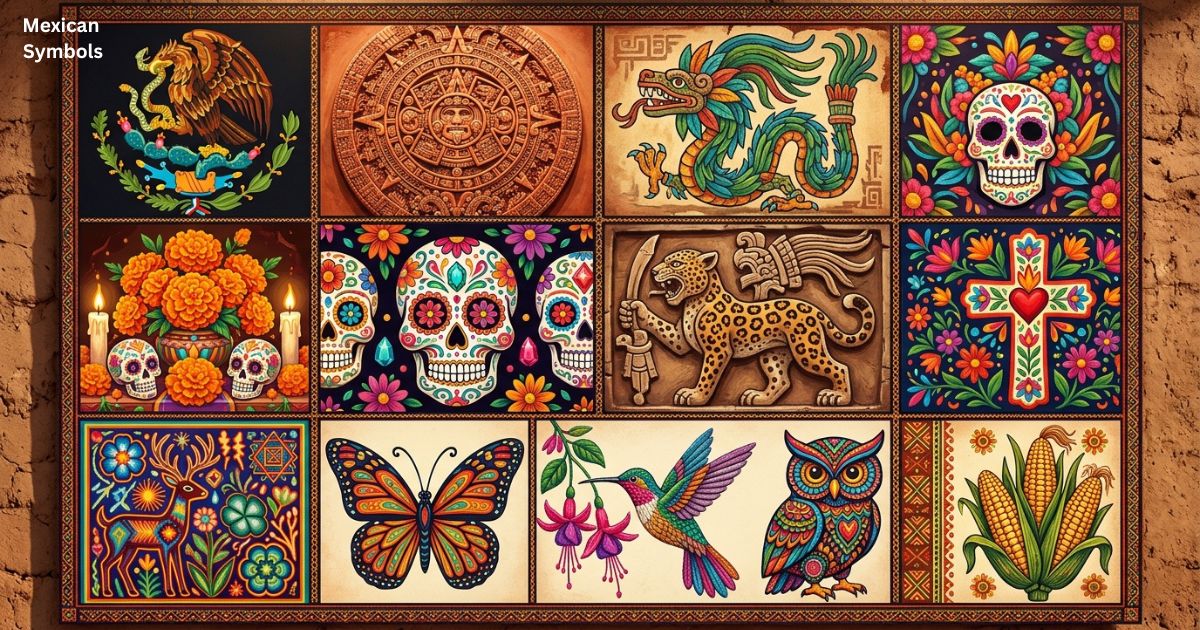
83+ Mexican Symbols — Meanings, History & Hidden Spiritual Truths (2026)
📦 Quick Answer Box
- Mexican symbols come from Aztec, Mayan, and colonial history
- The eagle, snake, and cactus represent the founding of Mexico
- Sugar skulls celebrate life — they do not fear death
- The Aztec Sun Stone tracks cosmic time cycles
- Marigolds guide spirits during Day of the Dead
- Mexican symbols appear in tattoos, art, dreams, and spiritual practice
- They carry meanings of strength, rebirth, protection, and love
Have you ever looked at a Mexican symbol and felt something deep inside?
Maybe you saw an eagle on a flag. Or a colorful skull at a festival. These symbols are not just pretty pictures. They hold thousands of years of stories, feelings, and spiritual wisdom.
Mexican symbols connect the living with the dead. They link modern people to ancient gods. They carry the voices of civilizations that no longer exist — but whose messages still speak today.
In this guide, you will learn what each Mexican symbol means. You will understand why ancient people created them. And you will see how these powerful signs still shape life and culture today.
What Are Mexican Symbols?
Mexican symbols are images, signs, and patterns with deep meaning.
They come from ancient civilizations. The Aztecs, Mayans, Zapotecs, and other groups created them. Each symbol told a story. Each one held a message about gods, nature, life, and death.
These symbols appeared on temple walls. They were carved into stone. They were painted on pottery and woven into clothing. They were sacred — meaning holy and very important to the people.
Later, when Spanish people came to Mexico in the 1500s, new symbols arrived too. Catholic crosses and saints mixed with ancient beliefs. This created a unique blend that is still alive today.
Today, Mexican symbols appear in tattoos, art, jewelry, festivals, and flags. They are recognized all over the world.
But many people only see the surface. They see beautiful colors and patterns. They do not understand the meaning beneath.
This guide will change that. By the end, you will see Mexican symbols the way the ancient people saw them — as living messages full of power, wisdom, and emotion.
Mexican Symbols — History and Origin
The story of Mexican symbols begins more than 3,000 years ago.
The Olmec people were among the first great civilizations in Mexico. They created early symbols around 1500 BCE. (BCE means “Before Common Era” — very long ago.) Their jaguar imagery became a foundation for future cultures.
Then came the Maya. They developed one of the most advanced writing systems in the ancient world. Their symbols tracked stars, predicted eclipses, and recorded history. The Maya saw symbols as a language between humans and gods.
The Aztecs rose to power around 1300 CE. They built a vast empire in central Mexico. Their symbols were bold and dramatic. Eagles, serpents, skulls, and suns appeared everywhere.
Then in 1521, Spanish conquistadors (conquerors) arrived. They brought Christianity with them. Indigenous (native) symbols did not disappear — they adapted. Aztec temples became churches. Ancient rituals blended with Catholic celebrations. New symbols were born from this collision of worlds.
Today, Mexican symbols carry all of these layers. They hold Olmec mystery, Mayan mathematics, Aztec power, and colonial history — all at once.
That is why they feel so deep when you look at them.
83+ Mexican Symbols and Their Meanings
Now let’s explore the symbols themselves. Each one carries a unique story.
National and Cultural Symbols
🦅 Eagle and Snake on Cactus
This is the most famous Mexican symbol. It appears on the Mexican flag.
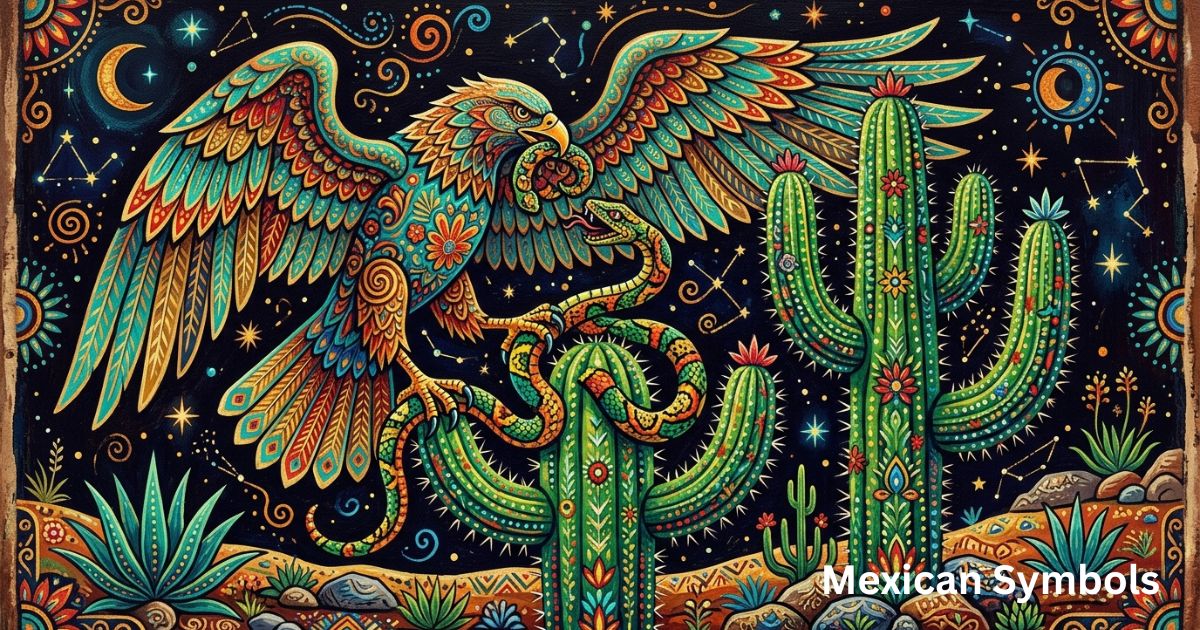
An eagle stands on a cactus. It grips a snake in its beak and talons. This image comes from an old Aztec legend.
The Aztec god Huitzilopochtli (weet-zee-lo-POCH-tlee) told his people to find this exact sign. When they saw it, they would know where to build their city. They found it on an island in Lake Texcoco. That city became Tenochtitlan — now known as Mexico City.
The eagle represents the sun and strength. The snake represents the earth and wisdom. The cactus (nopal) represents the land.
Together, they mean: courage over chaos, spirit over struggle.
🇲🇽 The Mexican Flag
The flag has three vertical stripes — green, white, and red.
Green means hope and independence. White means unity and purity. Red means the blood of heroes who fought for Mexico.
The eagle and snake image sits in the center. It ties all three colors together with history and meaning.
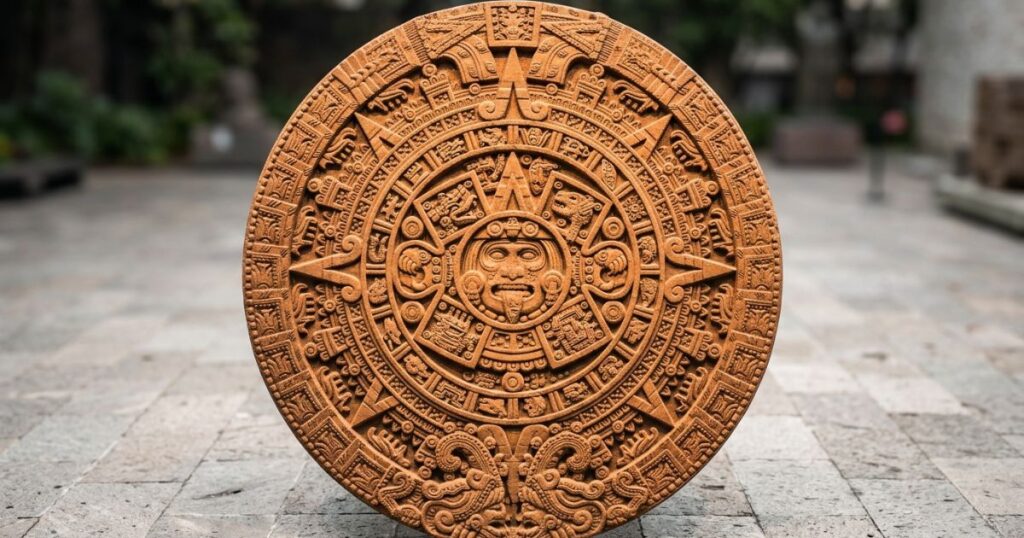
☀️ Aztec Sun Stone (Tonalpohualli)
Many people call this the “Aztec Calendar.” But it is more than a calendar.
The Sun Stone is a massive carved circle. It was completed around 1479 CE. It weighs 24 tons. It is almost 12 feet wide.
In the center sits Tonatiuh — the sun god. His face shows the power of the sun. Around him are rings that represent different eras of the universe.
The Aztecs believed the universe had already been destroyed and rebuilt four times. They called these eras “Suns.” We are now living in the Fifth Sun.
The stone tracks cosmic time cycles. It maps the relationship between humans, nature, and divine order.
Meaning: time cycles, cosmic balance, the universe’s endless renewal.
🐍 Quetzalcoatl — The Feathered Serpent
Quetzalcoatl (ket-zal-KOH-ah-tl) is one of the most important Aztec gods.
He appears as a serpent covered in feathers. He is part snake (earth) and part bird (sky). This combination makes him a bridge between the two worlds.
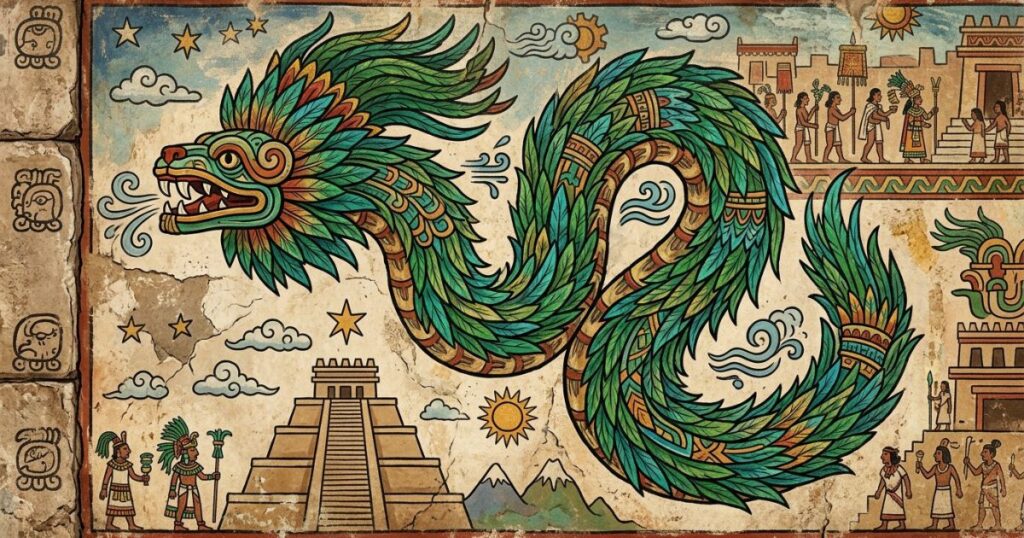
He represents wisdom, wind, creation, and divine knowledge. He brought corn to humans. He taught people how to measure time.
In some legends, he created humans by mixing his own blood with ancient bones.
Quetzalcoatl appears in both Aztec and Mayan mythology. The Maya called him Kukulcan.
Meaning: wisdom, creation, the joining of earth and heaven.
🌺 Marigold Flower (Cempasúchil)
The marigold is bright orange and yellow. Its smell is strong and sweet.
During Day of the Dead (Día de los Muertos), families use marigolds to guide spirits home. They believe the bright color and strong scent help souls find their way back to the living world.
Marigold petals are scattered from the cemetery to the home altar. They create a golden path for the dead.
Meaning: remembrance, spiritual connection, the bridge between the living and the dead.
💀 Sugar Skull (Calavera)
Sugar skulls are colorful, decorated skull shapes. They are made of sugar or clay.
Many outsiders think skulls represent fear. In Mexican culture, the opposite is true. Skulls represent the joy of life. They celebrate people who have died. They say: “We remember you. We honor you. You are still part of our family.”
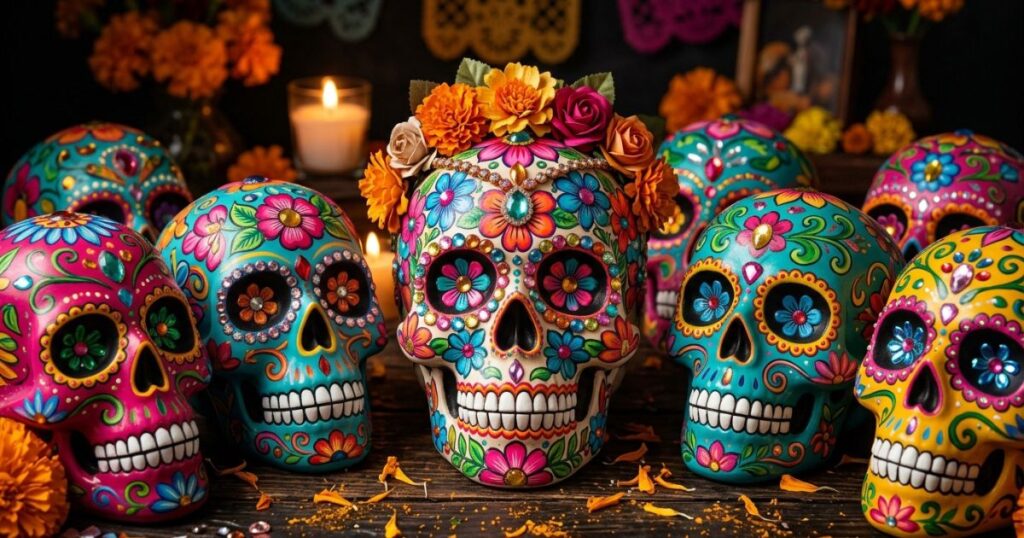
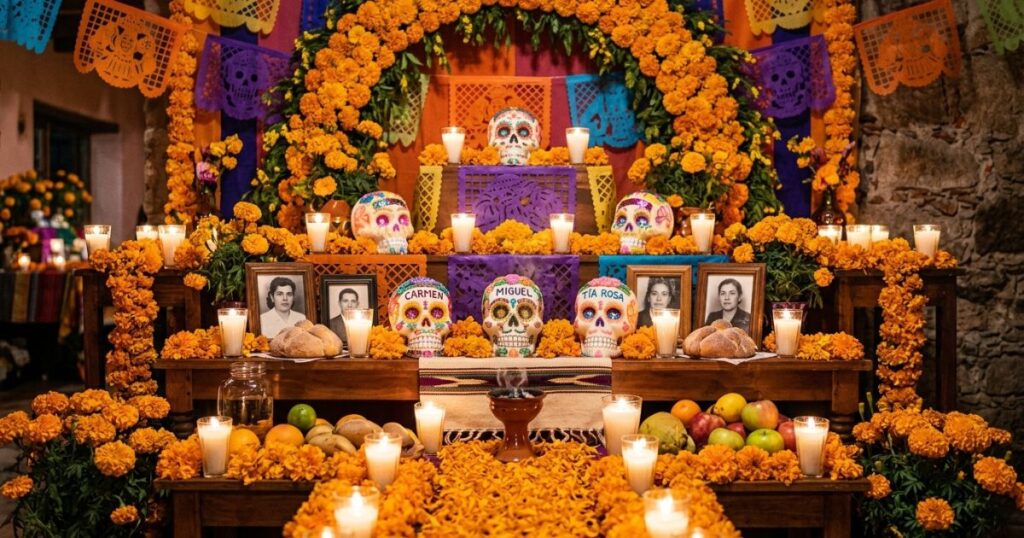
Sugar skulls are placed on altars (ofrendas) during Day of the Dead. Each skull represents a loved one who has passed.
Meaning: celebration of life, honoring ancestors, the beauty of remembrance.
🐆 Jaguar (Ocelotl)
The jaguar was the most powerful animal in ancient Mexico.
Aztec warriors who reached the highest rank were called Jaguar Warriors. They wore jaguar skins and helmets shaped like jaguar heads.
The jaguar was also linked to the night, the underworld, and rain. Some people believed jaguars could move between the physical world and the spirit world.
Meaning: strength, warrior spirit, power, and the ability to move between worlds.
🌵 Cactus (Nopal)
The nopal cactus is a Mexican symbol of survival. It grows in dry, harsh places where other plants cannot survive.
The Aztecs ate the fruit and pads of the nopal. It fed entire civilizations. The eagle stood on this plant — making it sacred.
Today, cactus appears in Mexican art, tattoos, and national symbols. It represents resilience (the ability to survive hard times), adaptability, and the spirit of Mexico itself.
Meaning: survival, toughness, the will to thrive in difficult conditions.
🦋 Butterfly (Papalotl)
In Aztec belief, butterflies held the souls of fallen warriors.
A warrior who died in battle would return as a butterfly. For four years, that warrior would drink nectar from flowers. Then they would fly toward the sun.
Butterflies also represented the souls of women who died in childbirth. They were honored equally with warriors.
Seeing a butterfly was not sad. It was joyful — a sign that a loved one’s spirit was nearby.
Meaning: transformation, rebirth, the soul’s journey after death.
🐦 Hummingbird (Huitzitzilin)
The hummingbird is the symbol of the Aztec god Huitzilopochtli — the god of war and the sun.
The name “Huitzilopochtli” literally means “Hummingbird of the South.”
Hummingbirds were believed to carry the spirits of fallen warriors. Like the butterfly, they represented soldiers returning from battle.
They also symbolized love, joy, and good luck. In folk belief, a hummingbird visiting your home brings positive energy.
Meaning: love, spiritual energy, the warrior spirit reborn.
🦉 Owl (Tecolote)
Owls carried dual meanings in Mexican culture.
To some indigenous groups, owls were messengers of death and the underworld. Hearing an owl at night was a warning of coming darkness.
But owls also represented wisdom. They could see in the dark — a metaphor for seeing through lies and hidden truths.
Meaning: wisdom, warning, the ability to see what others cannot see.
🌽 Corn (Maíz)
Corn is sacred in Mexico. It is not just food — it is life itself.
In Mayan mythology, the first humans were created from corn dough. The Maize God (Hun Hunahpu) was one of the most important Mayan deities.
Corn fed every civilization in ancient Mexico. Without it, there was no life.
Today, corn remains central to Mexican food, culture, and spiritual identity.
Meaning: life, creation, sustenance, the very material of human existence.
🐰 Rabbit (Tochtli)
In Aztec culture, the rabbit was linked to the moon.
Ancient people saw a rabbit shape in the patterns of the moon’s surface. The rabbit in the moon was a beloved image across many Mesoamerican cultures.
Rabbits were also connected to pulque — a sacred drink made from agave. The 400 rabbits (Centzon Totochtin) were a group of gods who represented intoxication and excess.
Meaning: fertility, the moon, abundance, and the wild aspects of nature.
🌙 Moon (Metztli)
The moon goddess Coyolxauhqui (koh-yol-SHAU-kee) was one of the most dramatic figures in Aztec mythology.
According to legend, her brother — the sun god Huitzilopochtli — defeated her and cut her into pieces. Her body became the moon, scattered across the night sky.
The moon represented the night, feminine power, and the cycles of time.
A massive stone carving of Coyolxauhqui was discovered at the Templo Mayor in Mexico City in 1978.
Meaning: feminine power, cycles of time, the eternal battle between night and day.
🌊 Water (Atl)
Water was sacred and feared. It gave life but could also destroy it.
Tlaloc (TLAH-lok) was the god of rain and water. He was one of the most worshipped gods in the Aztec pantheon (group of gods). Farmers prayed to him for rain. Parents sacrificed children to him during droughts — some of the most disturbing rituals in Aztec religion.
Water symbols appeared on temples, pottery, and murals. They showed wavy lines, spirals, and jade stones (jade was associated with water because of its blue-green color).
Meaning: life, cleansing, divine power, and the terror of nature’s force.
🔥 Fire (Tletl)
Fire was the oldest and most sacred element in Aztec belief.
Xiuhtecuhtli (shyoo-tek-OOT-lee) was the fire god. He lived at the center of the universe. Every 52 years, the Aztecs performed the New Fire Ceremony. They extinguished every fire in the empire. Then priests lit a new sacred fire on a hilltop. If the fire lit successfully, the world would survive another 52 years.
Fire symbols represent purification, renewal, and the danger of chaos.
Meaning: transformation, divine power, the gift that makes civilization possible.
✝️ Cross (Cruz)
After the Spanish arrived, the Catholic cross became a powerful symbol in Mexico.
But the cross already existed in ancient Mexico — with a different meaning. The Aztec cross symbol represented the four cardinal directions (north, south, east, west) and the center of the universe.
When the two meanings merged, the cross became a symbol of both faith and cosmic order.
Today, crosses appear at roadside shrines, cemeteries, and festivals — blending Catholic devotion with indigenous spiritual tradition.
Meaning: faith, the four directions, the meeting point of heaven and earth.
👁️ Evil Eye (Ojo de Venado / Ojo de Dios)
The “Eye of God” (Ojo de Dios) is a woven diamond shape made from yarn and sticks.
It was created by the Huichol (WEE-chol) people of western Mexico. The eye symbol was meant to watch over children and bring protection.
Parents hung these over babies’ cribs. They believed the eye would see danger and drive it away.
Meaning: divine protection, the watching eye of God, safety for the vulnerable.
🦅 Tlaltecuhtli — Earth Monster
Tlaltecuhtli (tlal-te-KOO-tlee) was the earth goddess.
She was depicted as a massive toad-like creature with mouths at every joint. She was terrifying but also life-giving. The earth — both beautiful and dangerous — was her body.
Ancient people believed the earth rested on her back. She represented the dual nature of the natural world: provider and destroyer.
Meaning: the earth’s power, the balance between creation and destruction.
🐊 Cipactli — Primordial Crocodile
Cipactli (see-PAK-tlee) was a great sea monster at the beginning of creation.
The gods Tezcatlipoca and Quetzalcoatl used Cipactli’s body to create the earth. They tore the creature apart. Her upper body became the sky. Her lower body became the earth.
This is why the earth is seen as a living, breathing creature with a dark and wild nature.
Meaning: primordial chaos, the raw material of creation.
🌟 Venus Star (Tlahuizcalpantecuhtli)
The planet Venus was extremely important to both the Maya and Aztecs.
Venus appears both at dawn (as the morning star) and at dusk (as the evening star). Ancient astronomers tracked Venus cycles with great precision.
The Aztecs feared Venus as the dawn star. Priests would block their chimneys so Venus light could not enter homes — they feared it could bring illness.
The Maya used Venus to time warfare. They launched battles on specific Venus dates.
Meaning: divine timing, the cycle of death and rebirth, the boundary between day and night.
Symbols of Love, Protection, and Strength
❤️ Heart (Corazón)
The heart in Mexican culture is a deeply emotional symbol.
In an Aztec ritual, the human heart was offered to the sun god to keep the sun rising each day. It was the most sacred offering possible.
Today, the heart in Mexican folk art appears in a more joyful form. Bright red hearts decorate pottery, clothing, and artwork. They represent love, family bonds, and emotional connection.
Meaning: love, sacrifice, the emotional core of human life.
🛡️ Shield (Chimalli)
Aztec warriors carried circular shields called chimalli.
These shields were not just protective gear. They were sacred objects. Each design told others who the warrior was and what they had achieved.
Feathers, gold, and turquoise decorated the shields. The most elaborate shields were given as gifts between rulers.
Meaning: protection, warrior identity, strength in the face of danger.
🌸 Rose (Rosa)
Roses became powerful symbols after the Spanish arrived.
The most famous story involves the Virgin of Guadalupe. According to tradition, the Virgin Mary appeared to a Mexican man named Juan Diego in 1531. She told him to gather roses — in December, when no roses should be blooming. He carried them to the bishop in his cloak. When he opened his cloak, roses fell out — and an image of the Virgin had appeared on the cloth.
That cloth (tilma) is still preserved in Mexico City today.
Meaning: divine miracles, love, the presence of the sacred in everyday life.
🕊️ Dove (Paloma)
The dove in Mexican culture represents peace and purity.
Doves are popular symbols at weddings. A pair of white doves represents the couple’s pure love and commitment. In some ceremonies, doves are released to bless the marriage.
Doves are also associated with the Holy Spirit in Catholic tradition — a belief that merged with indigenous ideas of spiritual messengers.
Meaning: peace, purity, love, divine blessing.
🌈 Rainbow (Mixcoatl)
Rainbows in Mexican tradition were signs from the gods.
Mixcoatl (meesh-KOH-atl) was the cloud serpent — a god of storms and the Milky Way. Rainbows appeared as his sign. They meant that rain — and therefore life — was coming.
Meaning: divine communication, hope after storms, the promise of renewal.
Mexican Symbols in Different Cultures
Mexican symbols did not stay inside Mexico’s borders. They spread across the world in fascinating ways.
In Ancient Aztec Culture: Every symbol connected to gods, rituals, and cosmic order. Nothing was random. Everything had divine meaning.
In Mayan Culture: Mayan symbols focused on time, astronomy, and sacred mathematics. Their writing system could express complex ideas in ways few ancient cultures could match.
In Spanish Colonial Culture: Catholic symbols merged with indigenous images. Crosses sat next to serpents. Saints appeared above ancient altars. Hybrid images were born.
In Modern Mexican Culture: Symbols appear in murals, fashion, music, and celebration. Artists like Diego Rivera used ancient symbols in their paintings to celebrate Mexican identity after colonization.
In Global Pop Culture: Films like Coco brought Day of the Dead imagery to billions of viewers. Fashion designers use Aztec patterns on runways worldwide. Tattoo culture embraces Mexican symbols as powerful personal statements.
In the Mexican-American Community: Mexican symbols become bridges between two cultures. They help people honor their heritage while living in a different country.
Mexican Symbols in Dreams — What Does It Mean?
When Mexican symbols appear in your dreams, pay close attention.
Dreams featuring an eagle often mean personal transformation is coming. You may be rising above a difficult situation. The eagle tells you: fly higher.
A snake in your dream carries dual meaning. It may represent hidden fears you need to face. Or it may mean healing is coming — like the snake’s ability to shed its old skin.
Skulls in dreams are rarely negative in Mexican symbolism. They usually represent acceptance of change. Something in your life is ending — and that is okay. New things will follow.
Marigold flowers in dreams often suggest a message from an ancestor or loved one who has passed. It may be a moment of spiritual communication.
Butterflies signal transformation. Something in your life is changing shape. Trust the process.
Fire in a dream may mean purification. Something old must burn away before the new can arrive.
A jaguar in your dream signals that great strength is available to you. But it also warns: use power wisely.
Dreams are personal. Context matters. But these ancient symbols carry consistent energetic meaning that crosses cultures and time periods.
Spiritual Meaning of Mexican Symbols
At their deepest level, Mexican symbols express a spiritual worldview — a way of understanding reality.
The Aztec universe was not divided into “good” and “evil” the way many modern religions describe it. Instead, everything existed in balance. Life required death. Day required night. Creation required destruction.
This philosophy shows up in every symbol.
The eagle and snake: strength and wisdom must work together.
The Aztec Sun Stone: time is circular, not a straight line. Everything returns.
Sugar skulls: death is not the enemy. It is part of life’s natural cycle.
Marigolds: love does not end at death. It continues across worlds.
The jaguar: true power comes from understanding both darkness and light.
These are not just decorations. They are philosophical teachings. They help people navigate the deepest questions of existence: Why are we here? What happens after we die? How do we find strength when life is painful?
Mexican symbols answer these questions not with words, but with images that go straight to the heart.
Mexican Symbols — Common Myths vs Real Facts
| Myth | Real Fact |
| Skulls in Mexican culture represent fear of death | They represent CELEBRATION of life and honoring loved ones |
| Aztec rituals were only about violence and sacrifice | They were complex spiritual ceremonies tied to survival, astronomy, and cosmic balance |
| The “Aztec calendar” predicts the end of the world | The Sun Stone tracks time cycles — it makes no prediction about destruction |
| Quetzalcoatl was evil because he was a snake | He was the god of wisdom, wind, and creation — one of the most revered gods |
| Mexican symbols are just decorative patterns | Every symbol carries deep historical, spiritual, and psychological meaning |
| Day of the Dead is Mexican Halloween | The two holidays have completely different origins and meanings |
| The jaguar was feared as a monster | It was the highest symbol of warrior honor and spiritual power |
How to Use Mexican Symbols in Your Life
You do not have to be Mexican to connect with these symbols. These are human symbols. They speak to universal experiences.
Use them as tattoos. Many people choose Mexican symbols for tattoos because they carry powerful personal meaning. An eagle for strength. A butterfly for transformation. A marigold for a loved one who has passed. Choose symbols that match your own story.
Place them in your home. A small sugar skull on your desk reminds you to celebrate life today. A cross at your door invites protection. Marigolds on a windowsill honor those you have lost.
Meditate on their meaning. Before making a big decision, sit with a symbol. What does the eagle say about your situation? What does the snake teach you about hidden fears?
Use them in art and journaling. Draw these symbols. Write about what they mean to you. This is a form of spiritual practice that connects you to thousands of years of human wisdom.
Learn their history. The more you understand where these symbols come from, the more meaning they carry. History makes symbols alive.
Respect their origin. These symbols come from real cultures with real histories of struggle and survival. Use them with gratitude and respect.
Read More: 100+ Iconic War Symbols — Meanings, History and Power 2026
FAQ — Mexican Symbols
1. What are the most important Mexican symbols?
The eagle and snake, Aztec Sun Stone, marigolds, sugar skulls, the jaguar, Quetzalcoatl, and the cross are among the most important.
2. What does the eagle mean in Mexican culture?
The eagle represents strength, courage, and the founding of Mexico. In Aztec belief, it was linked to the sun god and warrior power.
3. Why do Mexican symbols use skulls so much?
In Mexican culture, death is not feared — it is honored. Skulls are joyful symbols. They celebrate loved ones who have passed and remind us to appreciate life now.
4. What is Quetzalcoatl’s symbol?
Quetzalcoatl appears as a feathered serpent — part snake, part bird. He is the god of wisdom, wind, and creation in Aztec mythology.
5. What do Mexican symbols mean in tattoos?
Mexican symbol tattoos represent strength, identity, spiritual connection, and cultural pride. Common choices include eagles (strength), butterflies (transformation), skulls (life celebration), and marigolds (remembrance).
6. What are Mexican symbols of protection?
The evil eye (Ojo de Dios), warrior shields, the jaguar, and crosses are common Mexican protection symbols. They were believed to guard against negative energy and danger.
7. Are Mexican symbols and Aztec symbols the same thing?
Aztec symbols are one category within the broader world of Mexican symbols. Mexican symbols also include Mayan, Olmec, Zapotec, and colonial-era symbols.
8. What is the most famous good luck symbol in Mexico?
The hummingbird is one of the most popular good luck symbols. It represents love, joy, and positive energy. The four-leaf clover and certain amulets (charms) are also popular luck symbols in Mexican folk culture.
9. What do Mexican symbols mean in dreams?
Eagles mean rising above challenges. Snakes suggest healing or hidden fears. Skulls signal acceptance of change. Butterflies mean transformation. Each symbol carries its own dream message.
10. What is the Day of the Dead symbol?
The most famous Day of the Dead symbols are the sugar skull, marigold, and altar (ofrenda). Together, they represent the celebration of life, remembrance of the dead, and the connection between this world and the next.
Conclusion
Mexican symbols are living messages. They have survived thousands of years. They crossed empires, colonization, and globalization — and they are still speaking.
When you look at an eagle on a flag, a skull at a festival, or a jaguar carved in stone, you are connecting with something ancient and deeply human. You are touching the wisdom of people who understood life, death, and the cosmos in ways that still feel relevant today.
These symbols teach us to honor our ancestors. They remind us that death is part of life. They show us that strength and wisdom go hand in hand.
The next time you see a Mexican symbol, pause. Look deeper. The meaning is there — waiting for you to find it.
Want to explore more? Read our articles on Aztec symbols, Day of the Dead traditions, and the spiritual meanings hidden in ancient art.

Muhammad Shoaib is a passionate content writer and symbolism researcher at TrendyMegzine.com, where he explores the hidden meanings behind symbols, spiritual signs, ancient traditions, dream interpretations, and cultural symbolism.