90+ Hand Symbols & Their Meanings Fully Explained 2026
Quick Answer Box
What are the most important hand symbols?
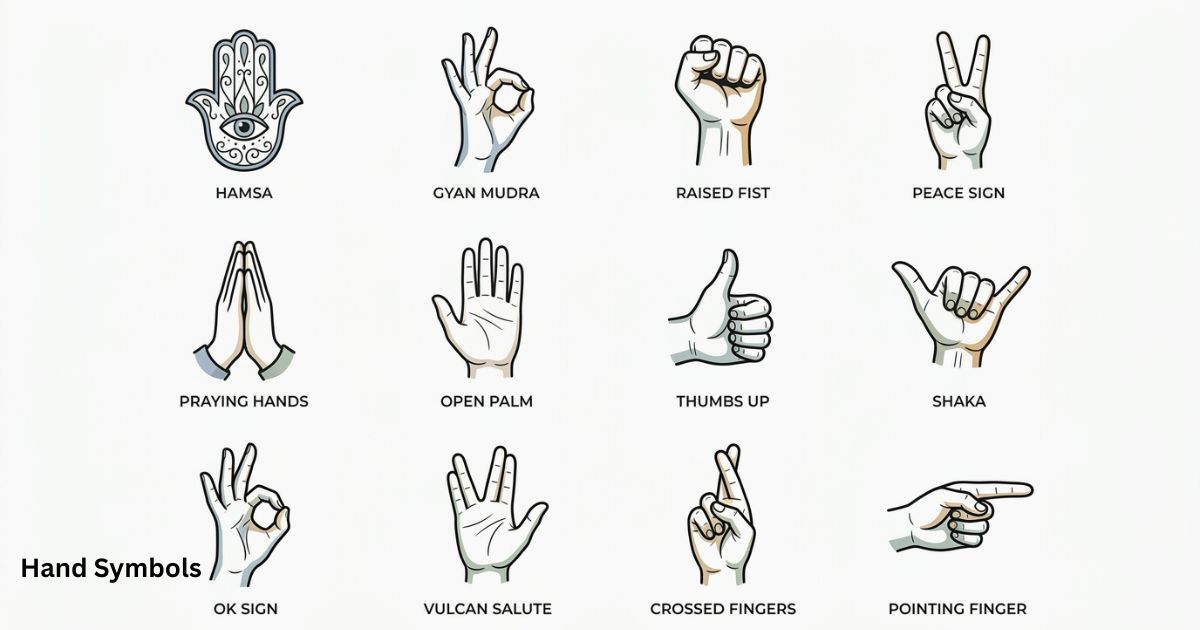
- 🖐️ Hamsa Hand — protection from evil
- 🙏 Praying Hands — faith and devotion
- ✊ Raised Fist — strength and resistance
- ✌️ Peace Sign — victory and harmony
- 🤲 Open Palm — blessing or surrender
- 🤝 Handshake — trust and agreement
- 🤘 Mudras — spiritual energy channels (Hindu/Buddhist)
- 👆 Pointing Finger — direction and authority
- 🤙 Shaka Sign — friendliness and aloha spirit
- 🫱 Reaching Hand — connection and invitation
Your hand just told someone something — and you probably did not even know it.
Hand symbols are one of the oldest forms of communication in human history. Long before alphabets existed, people used their hands to speak. Ancient cave painters pressed their palms onto stone walls. Monks shaped their fingers into sacred positions. Warriors raised their fists to signal battle cries.
Today, hand symbols appear in tattoos, emoji, religious art, protest signs, and even pop music videos. But most people never stop to ask: what do these hand symbols actually mean?
In this guide, you will learn about 90+ hand symbols — where they came from, what they mean spiritually and culturally, and how they still shape our world today. Whether you are curious about the Hamsa hand, Buddhist mudras, or what a raised fist really represents — you will find your answer here.
Let’s get started.
What Are Hand Symbols?
Hand symbols are images, gestures, or signs made with the human hand that carry a message or meaning.
They work without words. A single hand position can say “stop,” “I love you,” “peace,” or “I am praying” — all without speaking.
These symbols appear in many forms:
- Physical gestures — movements people make in real life
- Artwork and carvings — hands drawn in paintings, stone, or jewelry
- Religious icons — sacred hand positions in temples and churches
- Digital emojis — hand emoji used in texting and social media
- Tattoos — permanent hand symbols on skin
Why do hand symbols matter so much?
Because the human brain responds to hands instantly. Before we understand words, we understand hands. A baby reaches for a parent’s hand. A child waves goodbye. A stranger raises a palm to say “stop.”
Hands are the most expressive part of the human body after the face. They signal safety or danger within seconds. They show love, anger, power, and peace — all without a single word spoken.
Hand symbols are a universal language that every human being understands at some level — no translation needed.
Hand Symbols — History and Origin
Hand symbols are as old as humanity itself. Let us travel back through time.
The First Hand Symbols: Cave Art (40,000+ Years Ago)
The oldest known hand symbols are stenciled handprints found in caves across Spain, France, Indonesia, and Argentina. These are over 40,000 years old.
Early humans would press their hands against cave walls and blow colored pigment — red ochre or black charcoal — around them. The result was a glowing outline of a human hand on stone.
These were not random marks. Researchers believe they served important purposes:
- Identity markers — “I was here. I exist.”
- Spiritual protection — hands linked to the spirit world
- Group communication — signs of alliance between tribes
In some caves, researchers found hands with missing fingers. These may have represented people who lost fingers in rituals or accidents, or who deliberately removed fingers as spiritual offerings.
Ancient Egypt (3000 BC+)
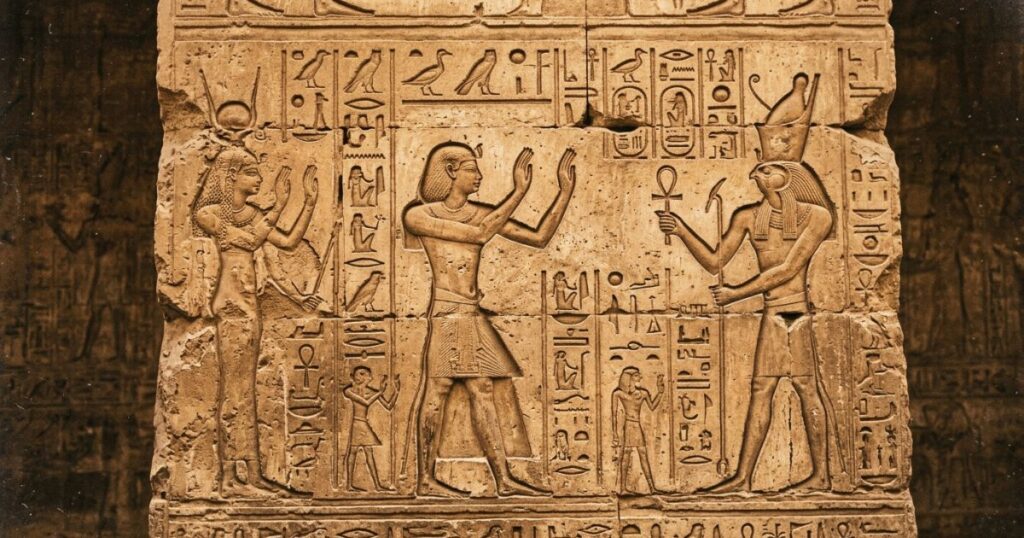
In Ancient Egypt, hands appeared everywhere in sacred art. Hieroglyphs — the Egyptian writing system — included many hand images.
The open hand represented action, power, and giving. Gods and pharaohs were shown with outstretched arms and hands blessing the people. The “ka” symbol — two arms raised upward — represented the soul’s life force.
Egyptians also used hands in amulets. A raised hand on jewelry meant protection from enemies and evil spirits.
Ancient Greece and Rome (800 BC – 400 AD)
Greek and Roman sculptors paid enormous attention to hand positions. Philosophers were shown with raised index fingers — a symbol of teaching and wisdom. Gods were carved with open palms, indicating blessing.
The Roman gladiator “thumbs up” is perhaps the most famous ancient hand symbol — though historians now believe it may have meant something different than we think (more on that in the Myths section).
South Asian Traditions: Mudras (2000 BC+)
In India, hand gestures called mudras developed in Hindu and Buddhist traditions. The word “mudra” means “seal” or “mark” in Sanskrit.
These precise finger positions were used in:
- Temple dance performances
- Meditation and yoga
- Paintings and statues of gods
- Healing practices
Over 100 different mudras exist, each with a specific meaning and spiritual function.
Middle Eastern Traditions: The Hamsa (2000 BC+)
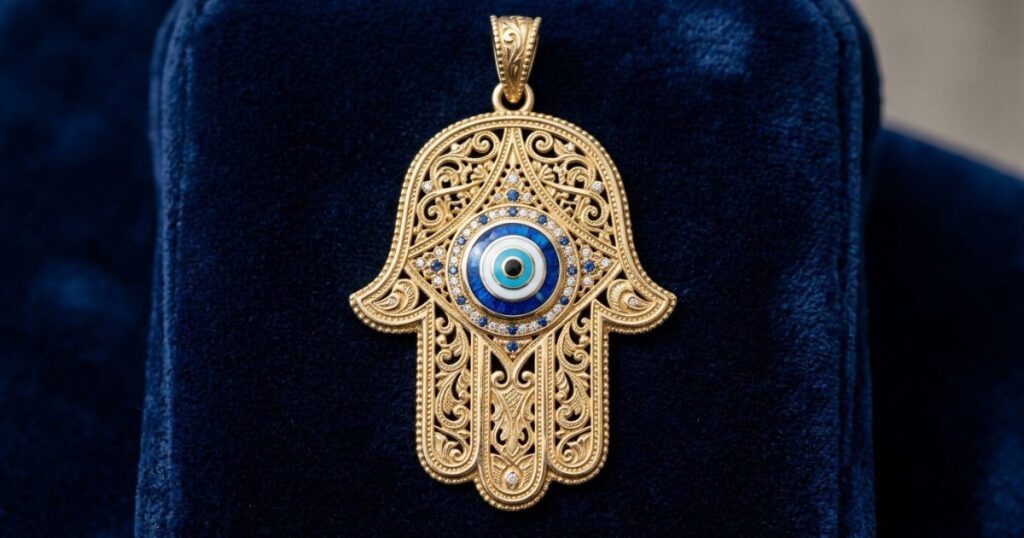
The Hamsa hand symbol — an open palm with an eye in the center — appeared in ancient Mesopotamia and Carthage thousands of years ago. It spread across Jewish, Islamic, and Christian cultures.
The name “Hamsa” comes from the Arabic word for “five” — referring to the five fingers of the hand.
Medieval and Renaissance Europe
During the Middle Ages, hand gestures carried legal meaning. Raising your right hand in court meant you were swearing an oath to tell the truth. This tradition continues in courtrooms today.
In religious painting, artists like Leonardo da Vinci and Michelangelo used hand positions to communicate entire theological messages without words.
Modern Era: Protests and Pop Culture
The 20th century gave hand symbols new political power. The raised fist became a global symbol of resistance during civil rights movements. The peace sign was created in 1958 by British designer Gerald Holtom for the nuclear disarmament movement.
Today, hand symbols travel at the speed of the internet. A new hand emoji can become a cultural symbol within days.
Top 30+ Meanings of Hand Symbols
Here is a complete guide to the most important hand symbols and exactly what they mean.
1. The Hamsa Hand 🖐️
What it looks like: A stylized open palm with an eye drawn in the center. Sometimes fingers point up, sometimes down.
What it means: Protection from evil, bad luck, and negative energy. The eye in the center — called the “evil eye” — watches and deflects harm.
Where it comes from: Ancient Mesopotamia, later adopted in Jewish, Islamic, and Christian traditions across the Middle East and North Africa.
Fingers pointing up: Active protection — repelling evil. Fingers pointing down: Inviting good fortune and blessings.
The Hamsa remains one of the most popular amulets in the world. It is worn as jewelry, hung in homes, and tattooed on skin by millions of people across many different religions and cultures.
2. Mudras — Buddhist and Hindu Hand Symbols 🙏
What they look like: Specific positions of fingers, palms, and wrists used during meditation and religious ceremonies.
What they mean: Each mudra channels a specific type of spiritual energy or carries a sacred message.
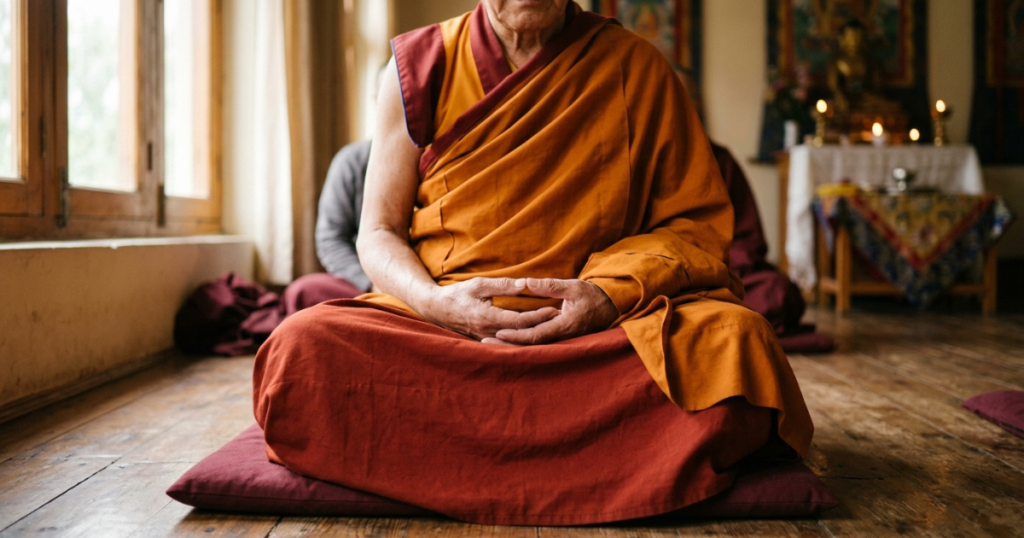
The most important mudras include:
| Mudra Name | Hand Position | Meaning |
| Dhyana Mudra | Both hands resting in lap, palms up, one on top of the other | Meditation and inner peace |
| Abhaya Mudra | Right hand raised, palm facing outward | Fearlessness and protection |
| Varada Mudra | Right hand facing downward, palm open | Compassion and giving |
| Vitarka Mudra | Index finger and thumb touching, other fingers raised | Teaching and wisdom |
| Gyan Mudra | Thumb and index finger touching, other fingers extended | Knowledge and focus |
| Karana Mudra | Index and little fingers extended, others folded | Warding off evil |
If you have ever seen a statue of Buddha, his hands are almost always showing a specific mudra. Each one tells you what the Buddha is doing — meditating, teaching, protecting, or blessing.
3. The Raised Fist ✊
What it looks like: A tightly closed fist raised high in the air.
What it means: Solidarity. Resistance. Unity in the face of injustice.
The raised fist became globally recognized during the civil rights movement of the 1960s in the United States. It then appeared in anti-apartheid movements in South Africa, labor union protests in Europe, and independence movements worldwide.
Today, it appears at protests, in music, in artwork, and in social media as a symbol of standing up against oppression.
Cultural note: In some contexts, a raised fist can also mean simple victory or celebration — like a sports win. Context always matters.
4. The Peace Sign ✌️
What it looks like: Index and middle fingers raised together in a V shape, with other fingers curled down.
What it means: Peace, victory, and non-violence.
British designer Gerald Holtom created this specific symbol in 1958. He combined the semaphore (flag signal) letters N and D — standing for “Nuclear Disarmament.” He described being inspired by Goya’s painting of a peasant with arms outstretched.
During the Vietnam War, the symbol became popular worldwide as a symbol of anti-war sentiment. Today it simply means peace in most contexts.
In Japan: The peace sign means something different in Japanese youth culture — it is a playful, happy pose for photographs. It carries no political meaning there.
5. Praying Hands 🙏
What they look like: Both palms pressed flat together, fingers pointing upward.
What they mean: Prayer, faith, gratitude, and devotion to God or a higher power.
This gesture appears in almost every major world religion — Christianity, Islam, Buddhism, Hinduism, and more. It signals that a person is turning their attention away from the physical world and toward the spiritual one.
In everyday communication, folded hands now mean “please,” “thank you,” or even apology — especially in Asian cultures and in emoji use worldwide.
The most famous artistic depiction of praying hands is the drawing by German artist Albrecht Dürer, made in 1508. It is one of the most reproduced artworks in history.
6. The Open Palm 🤲
What it looks like: One or both hands held open, facing outward or upward.
What it means: Multiple things depending on direction:
- Palm facing outward (toward someone): Stop. Warning. Do not come closer.
- Palm facing upward: Receiving. Openness. Asking or welcoming.
- Palm facing downward: Calming. Settling energy. Pressing down anger or chaos.
- Both palms up together: Offering, giving, or complete openness to receive a blessing.
In religious art, saints and angels are almost always shown with open palms. It signals that they come in peace and carry divine gifts.
7. The Handshake 🤝
What it looks like: Two hands grasping each other firmly.
What it means: Trust, equality, and agreement.
The handshake has an ancient origin. Historians believe it began in ancient Greece as a gesture of peace — showing that neither person was holding a weapon. By gripping the right hand, both people revealed their weapon hand was empty.
The up-and-down pumping motion is said to shake loose any hidden daggers that might be stored in the sleeve.
Today, the handshake marks business deals, sports competitions, diplomatic treaties, and everyday greetings. It is one of the most universally understood hand symbols on Earth.
8. Thumbs Up 👍
What it looks like: A closed fist with the thumb pointing straight up.
What it means: Approval, agreement, “good job,” or “yes.”
Modern origin: The thumbs up became popular in the 20th century. American soldiers used it as a signal to pilots during World War II. Hollywood films spread it globally as a sign of approval.
Ancient Roman myth: Many people believe ancient Romans used thumbs up to spare a gladiator’s life. However, historians now argue this is probably a misconception. The actual Roman gesture may have been a covered fist (thumb inside fingers), not a raised thumb. The “thumbs up” meaning was largely invented by a 19th century painting.
Cultural warning: In some countries — including parts of the Middle East, West Africa, and South America — a thumbs up gesture is considered very rude, equivalent to a middle finger in Western culture.
9. The OK Sign 👌
What it looks like: Thumb and index finger forming a circle, other fingers extended.
What it means: “Okay,” approval, or “everything is fine” in most Western cultures.
Diving meaning: Among scuba divers, the OK sign is a critical safety signal meaning “I am fine, all is well underwater.”
Cultural warning: In France, the OK sign traditionally meant “zero” or “worthless.” In Brazil and Turkey, it can be considered an obscene gesture. In some other contexts, it has been used as a symbol by extremist groups — though its mainstream meaning remains positive approval.
Always research local gesture meanings before traveling.
10. The Peace Fingers / V Sign ✌️
Already covered above (Peace Sign), but worth noting: in the UK and Australia, the V sign with palm facing inward (toward yourself) is an extremely rude gesture — equivalent to the middle finger. Palm must face outward for peace.
11. The Shaka Sign 🤙
What it looks like: Thumb and pinky extended, middle three fingers curled in. Often shaken loosely.
What it means: Aloha spirit — friendliness, good vibes, relaxation, and “hang loose.”
Where it comes from: Hawaii. The exact origin is debated, but it has been a symbol of Hawaiian culture and the surfing community for decades. It now appears globally as a sign of laid-back friendliness.
12. The Fig Sign (Mano Fico) 🤜
What it looks like: Thumb inserted between index and middle fingers, making a fist.
What it means: In ancient Mediterranean cultures, it was a protective talisman against evil. In modern Italy, Spain, and Brazil, it is a rude or obscene gesture.
Historical use: Ancient Romans wore fig hand amulets around their necks as protection. The symbol was common in medieval European art as a ward against evil spirits.
13. The Horn Sign (Mano Cornuta) 🤘
What it looks like: Index and pinky fingers extended upward, middle fingers and thumb curled in.
What it means:
- In Italy and Mediterranean cultures: a protection charm against the evil eye, warding off bad luck
- In rock music culture: the “devil horns” or “rock on” symbol, popularized by Ronnie James Dio in the 1970s
- In American Sign Language: the letter “I love you” (with thumb extended too)
- In some conspiracy theories: symbol of secret societies
The same gesture carries wildly different meanings across cultures — a perfect example of why context always matters.
14. The Pointing Finger ☝️
What it looks like: Index finger extended upward, all other fingers curled.
What it means: Direction, attention, authority, accusation, or divine instruction.
In Western art, God and important figures point upward to indicate heaven or divine will. Teachers point at chalkboards to draw attention. Accusers point at the guilty. Leaders point forward to inspire followers.
In Islam, raising the index finger during prayer — called the “Shahadah gesture” — means affirming belief in one God.
15. Crossed Fingers 🤞
What it looks like: Index finger crossed over middle finger.
What it means: Hoping for good luck. Or in some uses, secretly “canceling” a promise you just made.
Origin: Some historians trace it to early Christians who would cross fingers as a secret sign of their faith when Christianity was persecuted. Others say it comes from the belief that a cross shape captured good luck spirits at the intersection.
16. The High Five 🙌
What it looks like: Two people each raising one hand and slapping their palms together.
What it means: Celebration, congratulation, and shared joy.
The high five is a surprisingly modern invention. Most sports historians trace it to baseball in the late 1970s. It quickly spread to all sports and into everyday culture as a universal celebration gesture.
17. The Fist Bump 👊
What it looks like: Two closed fists gently bumped together.
What it means: Casual greeting, congratulation, team unity.
The fist bump rose to popularity in sports during the 1990s and 2000s as a more relaxed alternative to the handshake. During health-conscious periods like the COVID-19 pandemic, it also became preferred over handshakes for hygiene reasons.
18. Praying Hands with Beads 📿
What it looks like: Clasped hands holding prayer beads (rosary, misbaha, mala).
What it means: Deep devotion and structured prayer. Found in Christianity (rosary), Islam (misbaha/tasbeeh), Buddhism and Hinduism (mala beads).
The beads help the person count prayers or repetitions. The hands holding them become a symbol of serious spiritual dedication.
19. The Blessing Hand in Christian Art ✝️☝️
What it looks like: Three fingers extended (representing the Trinity) with the other two curled.
What it means: A priestly blessing in the Christian tradition. This gesture appears in thousands of paintings and statues of Jesus Christ, saints, and bishops.
The three extended fingers represent the Father, Son, and Holy Spirit. The two curved fingers represent the dual nature of Christ — both human and divine.
20. The Namaste / Anjali Mudra 🙏
What it looks like: Both palms pressed together at the chest, with a slight bow.
What it means: Respect, greeting, and recognition of the divine in another person. “Namaste” means “I bow to the divine in you” in Sanskrit.
This gesture is the standard greeting in India, Nepal, and many parts of Southeast Asia. It has also spread globally through yoga culture.
21. ASL Hand Alphabet — American Sign Language
American Sign Language (ASL) uses hand symbols to represent letters, words, and concepts. It is a complete language — not just a simple set of gestures.
Some key ASL hand symbols:
- I Love You (ILY): Thumb, index, and pinky extended — combines the letters I, L, and Y
- Letter A: Closed fist with thumb resting on side
- Letter B: Four fingers extended upward, thumb folded across palm
ASL is used by millions of deaf and hard-of-hearing people worldwide. It shows how hand symbols can form a complete language with grammar, nuance, and expression.
22. The Thumbs Down 👎
What it looks like: Closed fist with thumb pointing straight down.
What it means: Disapproval, rejection, or “no.”
Directly opposite of thumbs up in meaning. Used in product reviews, reaction buttons, and everyday feedback to show something was bad or unwanted.
23. Waving Hand 👋
What it looks like: Open hand raised, moving back and forth.
What it means: Greeting or farewell. “Hello” or “Goodbye.”
Waving is one of the most universal human gestures. Even young children learn to wave before they learn to speak. Some researchers believe it evolved from showing empty hands — proving to strangers “I have no weapon, I come in peace.”
24. The Clapping Hands 👏
What it looks like: Both hands slapping together repeatedly.
What it means: Appreciation, approval, and celebration of a performance or achievement.
Clapping creates sound — which amplifies the emotional signal of approval. Audiences clap for performers. Sports fans clap for athletes. People clap at weddings and birthdays.
In some Middle Eastern cultures, rhythmic clapping during prayers or celebrations also has spiritual significance.
25. The Heart Hand Sign 🫶
What it looks like: Thumbs and index fingers touching to form a heart shape.
What it means: Love, affection, and support. Popular in K-pop culture and social media photography.
A smaller version — “finger heart” — uses just the thumb and index finger crossed slightly. It originated in South Korean pop culture and spread globally through social media in the 2010s.
26. Beckoning Hand — “Come Here”
What it looks like: Index finger curled and uncurled toward the body.
What it means: In most Western cultures, it means “come here” or “come closer.”
Cultural warning: In Japan, Philippines, and some other Asian countries, beckoning someone with a curled index finger is considered extremely rude — it is a gesture used for animals, not people. In those cultures, the whole hand is waved palm-down to beckon someone.
27. The Open Hand Over Heart
What it looks like: One or both hands placed flat over the chest/heart.
What it means: Sincerity, genuine emotion, honesty, and heartfelt feeling. “I truly mean this from my heart.”
This gesture appears in public apologies, national anthems, proposals of marriage, and expressions of deep gratitude.
28. Two Hands Together — Interlocked Fingers
What it looks like: Both hands with fingers woven together.
What it means: Unity, partnership, and deep connection. Used between romantic partners, close friends, and in prayer.
Interlocked fingers say: “We are stronger together than we are apart.”
29. The Shrug 🤷
What it looks like: Both palms turned upward, shoulders raised, head tilted.
What it means: “I don’t know.” Confusion, uncertainty, or not caring about something.
The open palms in a shrug show emptiness — “I have nothing to offer you, I do not know the answer.”
30. The Stop Hand 🛑
What it looks like: Open palm thrust forward, facing the person you are signaling.
What it means: Stop. Do not move. Wait. Danger ahead.
Traffic police use this gesture to stop cars. Angry people use it to end conversations. Parents use it to freeze children in place before crossing a street.
The stop hand is so instinctive that it works even when the other person does not speak your language.
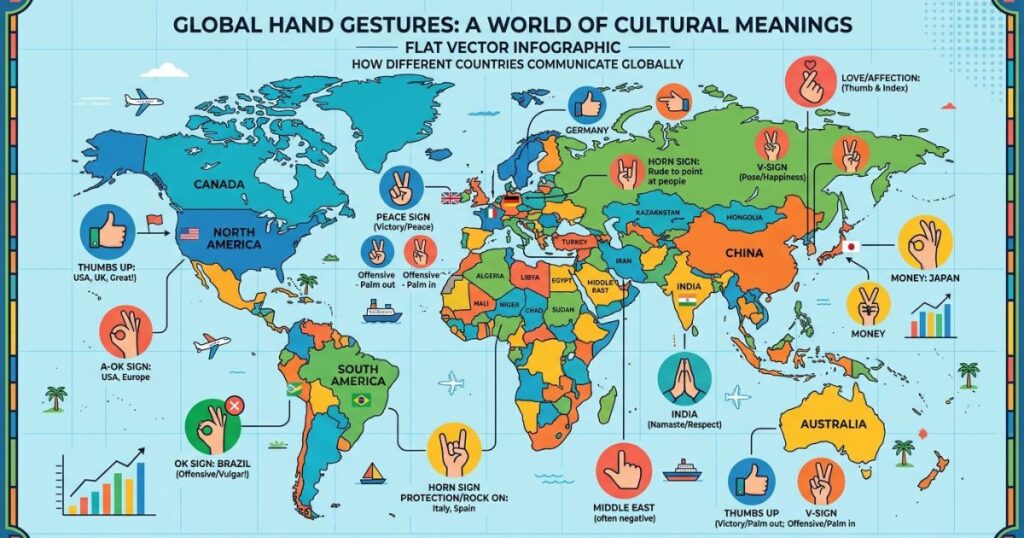
Hand Symbols in Different Cultures
The same hand gesture can mean completely different things around the world. Here is a clear comparison:
| Hand Symbol | USA/UK Meaning | Other Country Meaning |
| 👍 Thumbs Up | Great! Approval | Offensive in parts of Middle East, Greece, West Africa |
| 👌 OK Sign | Okay, Good | “Zero/worthless” (France); Rude (Brazil, Turkey) |
| ✌️ V Sign (palm in) | Peace (palm out) | Extremely rude in UK, Australia |
| ☝️ Index Finger Beckon | “Come here” | Rude/for animals only in Japan, Philippines |
| 🤝 Handshake | Standard greeting | Left-hand handshake seen as disrespectful in some Muslim cultures |
| 🙏 Pressed Palms | Prayer | Standard greeting in India, Nepal (Namaste) |
| 🤘 Horn Sign | Rock music; good | Protective charm in Italy; may be rude to some |
| 👋 Wave | Hello/Goodbye | In Greece, palm-out wave (moutza) is a severe insult |
Key lesson: Always research local hand symbol meanings before traveling abroad. A well-meaning gesture at home can deeply offend someone in another country.
Hand Symbols in Dreams — What Does It Mean?
When you see hand symbols in your dreams, your mind is sending you messages. Here is what different hand symbols mean in dreams.
Dreaming of open, outstretched hands: You are ready to receive something new in life. This can mean new opportunities, new friendships, or new gifts coming your way. If the hands are warm and glowing, it is a very positive sign.
Dreaming of a clenched fist: You are holding onto anger or frustration. Something in your waking life is making you feel powerless, and your mind is expressing that through a symbol of tension.
Dreaming of the Hamsa hand: Your subconscious is reminding you that you are protected. You may be going through a difficult period, but this dream says: something is watching over you.
Dreaming of shaking hands: A new agreement, partnership, or friendship is forming in your life. Pay attention to who you are shaking hands with in the dream — it may represent a real person.
Dreaming of injured or bleeding hands: You feel unable to do something important. You may feel blocked from reaching a goal. This dream often appears during periods of high stress or creative blockage.
Dreaming of many hands reaching toward you: People in your life need your help and attention. Or, you feel overwhelmed by demands from others. Check if the hands feel threatening or welcoming — this changes the meaning.
Dreaming of your own hands glowing: Spiritual awakening and healing energy. Many people report this dream when beginning a period of personal growth or spiritual practice.
Dreaming of a handshake that feels wrong: Be cautious about a new agreement or partnership in real life. Your subconscious may be picking up on something your conscious mind has not noticed yet.
Spiritual Meaning of Hand Symbols
Hands carry deep spiritual power in virtually every tradition on Earth. Here is why.
Hands as Energy Centers
In many spiritual traditions, the palms of the hands contain powerful energy centers. In Hindu tradition, these are related to chakras — spinning wheels of energy in the body. Healers use their hands to channel and transfer healing energy.
Reiki healing, for example, is entirely based on the principle that a practitioner can channel healing energy through their hands and into another person’s body. Millions of people practice and receive Reiki worldwide.
The Right Hand and the Left Hand
In most spiritual traditions, the right and left hands carry different energies:
- Right hand: Giving, action, solar energy, masculine principle, sending energy out
- Left hand: Receiving, intuition, lunar energy, feminine principle, taking energy in
This is why prayers in many traditions use the right hand for offering and the left hand for receiving.
Hands in Sacred Art
In nearly every world religion, divine figures are shown with symbolic hand positions:
- Jesus Christ blesses with three raised fingers
- Buddha meditates with precise mudras
- Hindu gods and goddesses each hold specific objects and make specific gestures
- Angels in Christian art extend open palms in welcome
These positions were not random. Artists carefully followed religious guidelines to communicate sacred meaning through hand positions.
Read More: 60+ Powerful Symbols of Friendship & Their Meanings 2026
The Hamsa and Spiritual Protection
The Hamsa hand is one of the most spiritually powerful symbols in the world. Across Jewish, Islamic, and Christian traditions, it represents the protective hand of God. The eye in the center watches and deflects negative spiritual energy.
Many people hang Hamsa hands at the entrance of their homes — not just as decoration, but as a spiritual guardian of the threshold.
Mudras and Healing
Research in ayurvedic medicine (traditional Indian healing) suggests that different finger positions can actually affect the flow of energy in the body. For example:
- Gyan Mudra (thumb and index finger touching) is said to improve concentration and calm the mind
- Prana Mudra (ring and little fingers touching thumb) is said to boost life energy
- Shuni Mudra (middle finger and thumb touching) is said to improve patience and discipline
Whether or not you believe in the physical effects, millions of meditators worldwide report that mudras deepen their practice.
Hand Symbols — Common Myths vs Real Facts
Many beliefs about hand symbols turn out to be wrong. Here is the truth:
| Myth | Real Fact |
| “Romans used thumbs up to spare gladiators” | Most historians now believe this is a 19th century invention. The actual Roman gesture was probably a covered fist or sword-shaped gesture. |
| “The peace sign is a Satanic or anti-Christian symbol” | False. Gerald Holtom designed it in 1958 for nuclear disarmament. It combines semaphore letters N and D. |
| “Praying hands with fingers together is only Christian” | False. The same gesture is used in Buddhism, Hinduism, and across Asian cultures as a greeting. |
| “The OK sign is always fine to use anywhere” | False. It is offensive in multiple countries and has been co-opted by some extremist groups in recent years. |
| “The Hamsa is only for Jewish people” | False. The Hamsa is used by Jewish, Muslim, and Christian communities, and it predates all three religions. |
| “Hand gestures mean the same thing everywhere” | Completely false. The same gesture can mean “great” in one country and be deeply offensive in another. |
| “The raised fist always means violence” | False. In most contexts, the raised fist means solidarity and resistance against injustice, not violence. |
| “Mudras are just decoration on Buddha statues” | False. Every mudra has a precise spiritual meaning and purpose. They are sacred communication, not decoration. |
How to Use Hand Symbols in Your Life
You do not need to be religious or spiritual to benefit from hand symbols. Here are practical ways to bring them into your daily life:
1. Learn Your Mudras Try the Gyan mudra (thumb and index finger touching) during stressful moments. Rest your hands in this position and take five deep breaths. Many people find it instantly calming and centering.
2. Hang a Hamsa in Your Home Whether for spiritual protection or simply as beautiful art, a Hamsa above your front door is a welcoming symbol. It signals protection and positive energy for everyone who enters.
3. Use Hand Symbols in Meditation Before meditation, choose a mudra that matches your intention. Gyan for focus. Dhyana for peace. Varada for compassion. Hold the position throughout your practice.
4. Get a Meaningful Tattoo Praying hands, the Hamsa, or an infinity-linked hand symbol can be powerful personal tattoos. Choose a symbol that connects to your values, faith, or life story.
5. Research Before Traveling Before visiting another country, spend 10 minutes learning which hand gestures are offensive there. This small act of research can prevent significant misunderstandings.
6. Teach Children ASL Basics Learning basic American Sign Language hand symbols teaches children that communication goes beyond spoken words. It also builds empathy and awareness of deaf culture.
7. Use Hand Symbols in Art and Design If you create art, logos, or graphic designs, hand symbols carry instant emotional meaning. An open palm feels welcoming. A raised fist feels powerful. Use them intentionally.
8. Practice Mindful Gesturing Notice how you use your hands when you speak. Open hand movements signal honesty and openness. Closed or hidden hands can signal defensiveness. Becoming aware of your own hand symbols can improve how you communicate.
Read More: 93+ Taylor Swift Symbols — Hidden Meanings, Secret Codes and the Emotional Stories Behind Every Era
FAQ — Hand Symbols
Q1: What is 🤌 called?
This emoji is called the “Italian Hand” or “pinched fingers” gesture. In Italian culture, it asks “What do you want?” or expresses confusion or emphasis. It was added to emoji sets in 2020 and became popular worldwide as a funny expression of Italian-style emphasis.
Q2: What is the most protective hand symbol in the world?
The Hamsa hand is widely considered the most universally protective hand symbol. It appears across Jewish, Islamic, and Christian traditions, as well as in secular use. The eye in the center is said to deflect the “evil eye” — negative energy sent intentionally or unintentionally by others.
Q3: What do hand symbols mean spiritually?
Spiritually, hands represent divine power, healing energy, and connection between the human and the divine. Open palms receive blessings. Raised hands send energy upward. Specific finger positions (mudras) channel different types of spiritual energy. Many traditions believe the hands are literal conduits of healing and spiritual force.
Q4: Why do hand gestures differ between cultures?
Because gestures develop locally within communities. A thumbs up in one culture simply means “good job” — in another, it grew to mean something offensive. Without cultural exchange, the same movement develops completely different meanings. This is why no hand gesture is truly universal except perhaps a wave or open-palm greeting.
Q5: What is the most misunderstood hand symbol?
The OK sign 👌 is probably the most misunderstood today. It means “okay” and approval in most of the world. But in France it traditionally means “zero.” In Brazil and Turkey it can be obscene. And in recent years, it has been associated with extremist groups in some contexts — though its mainstream meaning remains positive.
Q6: What do hand symbols mean in dreams?
Open hands in dreams typically mean readiness and openness. Clenched fists suggest frustration or held-back anger. Glowing hands suggest healing energy and spiritual awareness. Injured hands suggest feeling blocked or powerless. The emotional tone of the dream — whether it feels comforting or threatening — matters as much as the symbol itself.
Q7: What are Buddhist hand symbols called?
Buddhist hand symbols are called mudras. The word comes from Sanskrit and means “seal” or “mark.” Each mudra is a specific finger and hand position that carries a sacred meaning — such as teaching, meditation, fearlessness, or enlightenment. They appear on nearly every statue of the Buddha and are used in meditation and yoga practices worldwide.
Q8: Are hand symbol tattoos meaningful?
Yes, deeply so. Praying hands represent faith and devotion. The Hamsa represents protection. An open palm represents welcome and giving. An infinity loop connecting two hands represents eternal partnership. Many people choose hand symbol tattoos to permanently mark a value, belief, or important relationship on their body.
Conclusion
Hand symbols speak a language older than words — and louder than silence.
From ancient cave walls to modern emojis, from Buddhist mudras to protest signs, the human hand has always carried messages that go straight to the heart. These are not just gestures. They are history, culture, faith, and emotion made visible.
Every time you press your palms together, raise your fist, or extend an open hand, you are participating in a conversation that stretches back 40,000 years.
Now you know what these hand symbols really mean. Use them with intention. Use them with awareness. And use them to connect more deeply with the people around you.
Want to keep learning? Read our guides on spiritual symbols, ancient signs, and cultural meanings from around the world.

Muhammad Shoaib is a passionate content writer and symbolism researcher at TrendyMegzine.com, where he explores the hidden meanings behind symbols, spiritual signs, ancient traditions, dream interpretations, and cultural symbolism.