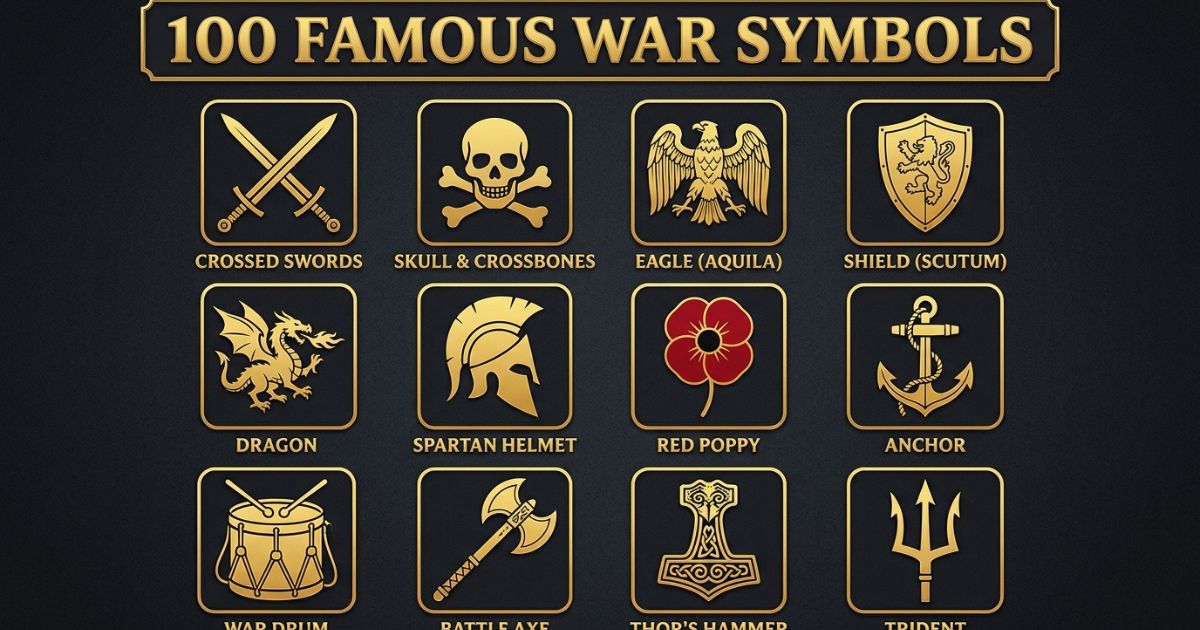
100+ Iconic War Symbols — Meanings, History and Power 2026
⚡ Quick Answer Box
- War symbols represent courage, power, sacrifice, protection and survival
- Most famous: Eagle, Crossed Swords, Skull, Viking Valknut, Red Poppy
- Used by: Romans, Vikings, Samurai, Greeks, Native Americans, Medieval knights
- They appear in: tattoos, military badges, flags, armor, dreams and art
- War symbols carry both positive and negative meanings — heroism AND tragedy
Have you ever looked at a symbol and felt something powerful inside? That is exactly what war symbols do to people. They have done it for thousands of years.
Long before phones, cameras, or newspapers existed, warriors carried symbols into battle. A painted eagle on a shield. A carved rune on a sword. A flag waving above a bloody field. These were not just decorations. They were messages. They said: we are strong. We will not break. We fight for something bigger than ourselves.
War symbols have followed humanity through every battlefield, kingdom, and empire ever created. Some of them inspired armies of thousands. Some terrified entire nations. And some quietly remind us today of the people who gave their lives so others could live.
In this guide, you will explore 100+ iconic war symbols. You will learn what they mean, where they came from, and why humans still connect with them so deeply today.
What Are War Symbols?
War symbols are images, shapes, objects, or marks connected to battle and conflict. They represent big ideas like bravery, sacrifice, power, protection, and survival.
Think of them like a language. But instead of words, they use pictures and shapes. A single eagle image on a Roman shield said more than any speech could. It said: the power of an entire empire stands behind us.
War symbols are not always about violence or destruction. Many of them carry beautiful meanings. They honor the soldiers who died. They celebrate the families who waited at home. They remind whole nations of the cost of freedom.
Here is what war symbols commonly represent:
- Courage — the strength to fight even when afraid
- Protection — keeping family and homeland safe
- Sacrifice — giving up everything for something greater
- Victory — winning against impossible odds
- Remembrance — never forgetting those who fell
- Unity — fighting together as one force
War symbols also served very practical purposes in ancient times. Armies were massive and chaotic. Thousands of soldiers clashed together in confusion and noise. Symbols on flags and armor helped soldiers identify their own side quickly. Without them, battles would have been even more deadly.
Today, war symbols still appear on military uniforms, national flags, memorial statues, tattoos, and even in video games and movies. They remain powerful because the human heart still understands what they stand for.
War Symbols — History and Origin
The history of war symbols goes back further than most people realize. Let us walk through the timeline.
The Earliest War Symbols (Before 3000 BCE)
The very first war symbols were simple. Early humans painted animals on cave walls. The strongest animals — lions, bears, eagles, wolves — became symbols of warrior power.
Tribes decorated their bodies with war paint before battles. These painted marks were not just decoration. They were spiritual armor. Warriors believed the marks connected them to powerful spirits that would protect them in battle.
Simple weapon shapes like spears and axes carved into stone served as warnings to enemy tribes. They said: armed warriors live here. Stay away.
Ancient Egypt (3000 BCE — 30 BCE)
The ancient Egyptians created some of the world’s first organized military symbols. The pharaoh was always shown as a powerful warrior. Images of the pharaoh defeating enemies appeared on temple walls across Egypt.
The falcon was sacred to the god Horus, the protector of kings. Egyptian armies carried falcon symbols into battle. Soldiers believed Horus himself watched over them from the sky.
The scarab beetle symbolized protection and rebirth. Soldiers wore scarab amulets to protect themselves from death. Even if they died in battle, the scarab promised that their souls would continue.
Ancient Greece (800 BCE — 146 BCE)
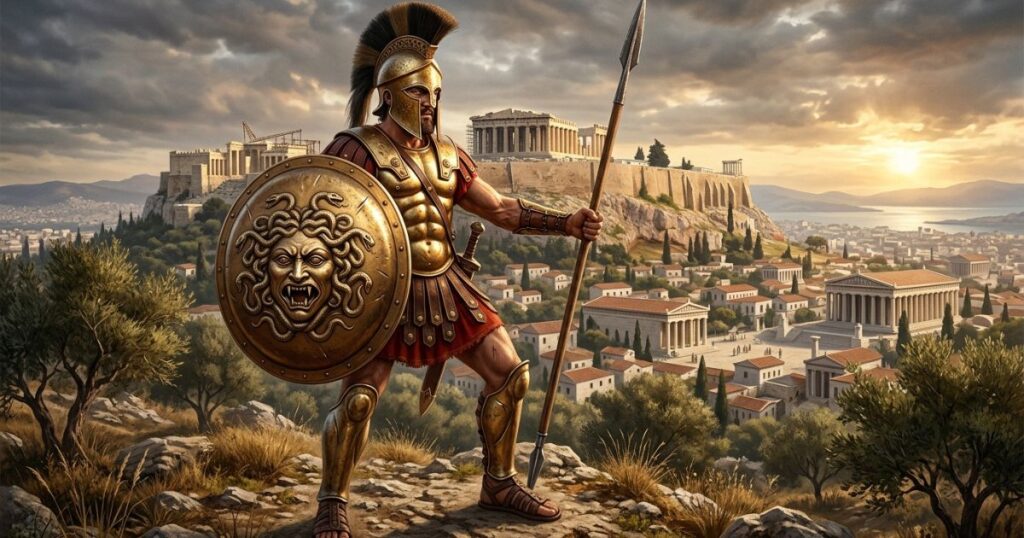
Greek warfare produced some of history’s most iconic symbols. Greek soldiers called hoplites carried large round shields called hoplon. These shields were often painted with powerful symbols — serpents, owls, Gorgon faces, or family emblems.
The gods of war were central to Greek military culture. Ares, the god of war, was associated with blood-red colors, iron, and the dog — an animal known for aggression. Athena, goddess of wisdom and strategic warfare, was symbolized by the owl and the olive tree.
The Spartan warriors painted a simple Lambda (Λ) on their shields. This stood for Lacedaemon — the ancient name for Sparta. It was clean, bold, and instantly recognized. No enemy could mistake a Spartan shield.
Ancient Rome (509 BCE — 476 CE)
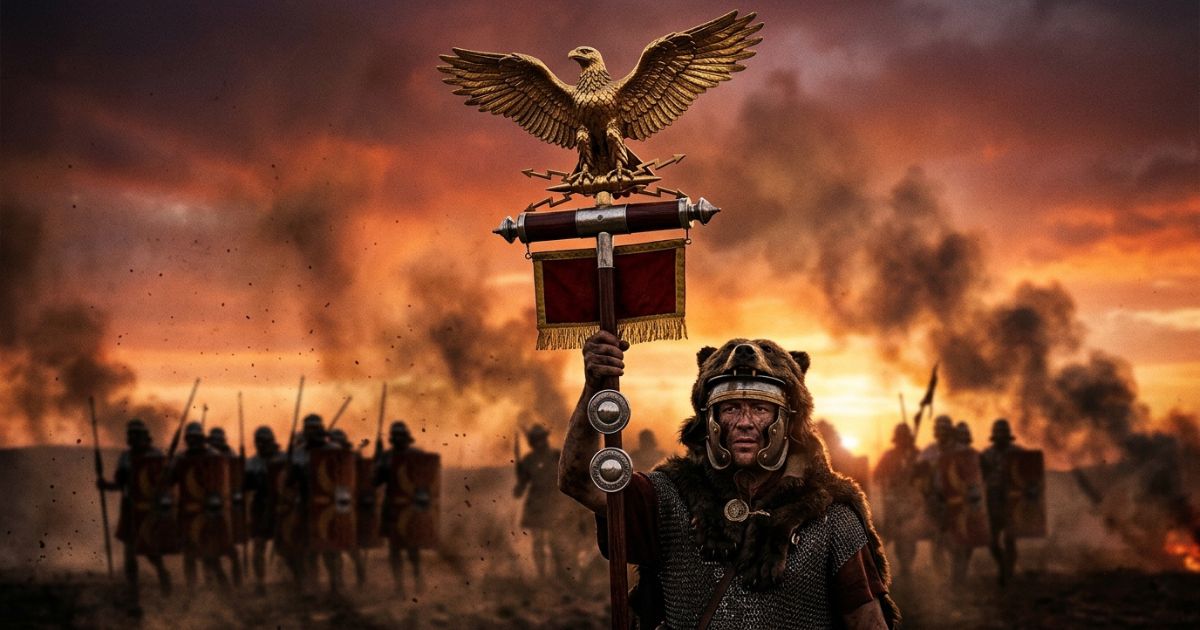
Rome created one of the most powerful military symbol systems in history. The Aquila — the Roman eagle standard — was the supreme symbol of a Roman legion.
Each legion had one Aquila. It was carried by a soldier called the Aquilifer — the eagle bearer. Losing the Aquila in battle was the greatest possible shame for a Roman army. Emperors sometimes sent entire armies to recover a lost eagle standard.
Roman soldiers also used the SPQR symbol — Senatus Populusque Romanus — meaning “the Senate and People of Rome.” This appeared on shields, armor, buildings, and military standards. It represented the entire Roman civilization marching into battle.
Viking Age (793 CE — 1066 CE)
The Vikings of Scandinavia created some of the most recognizable war symbols in world history. Their symbols were deeply spiritual and connected to Norse gods.
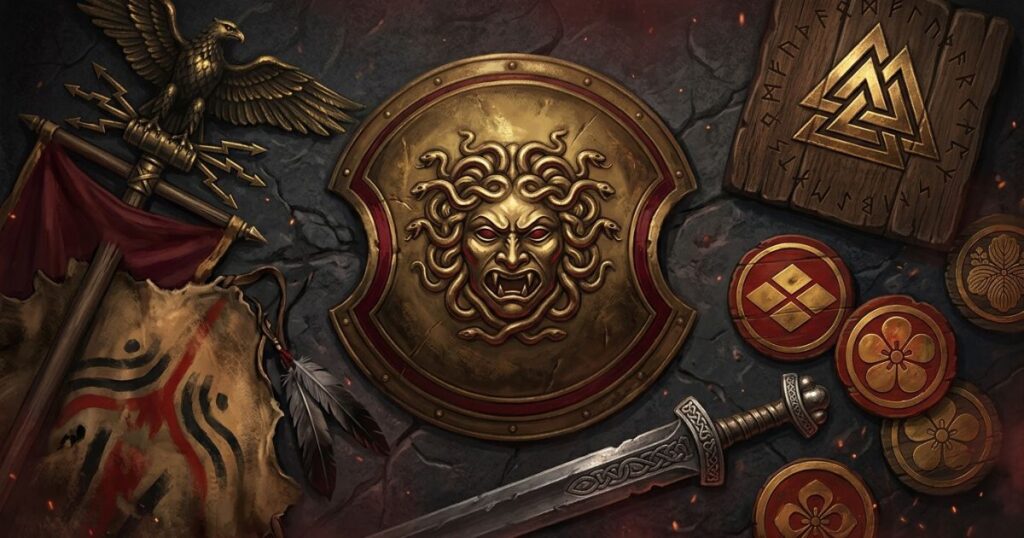
The Valknut — three interlocking triangles — was associated with Odin, the chief Norse god. It appeared on burial stones near fallen warriors. Many historians believe it represented the power of Odin to bind and release warriors on the battlefield.
The Helm of Awe (Aegishjalmur) was a runic symbol warriors believed could make them invincible. Vikings carved it on their foreheads or on the inside of their helmets before battle. It looked like eight pointed arms reaching out from a center point.
Feudal Japan (1185 CE — 1868 CE)
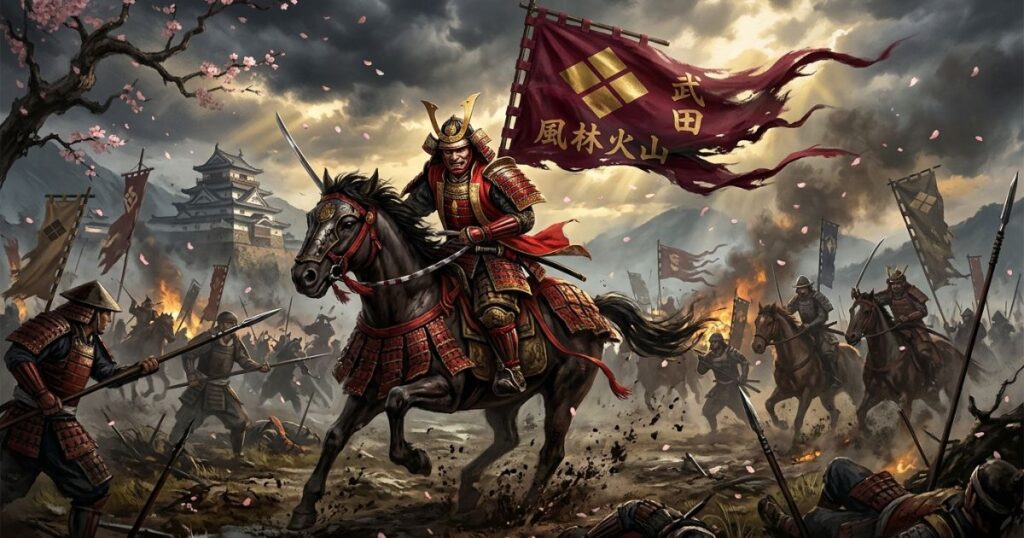
Japanese samurai warriors used a unique system of family crests called mon. Each samurai clan had its own mon, and these crests appeared on armor, flags, and weapons. On chaotic battlefields, a mon instantly told everyone: this warrior belongs to this clan and this lord.
The cherry blossom became one of the most famous symbols of the samurai spirit. Cherry blossoms bloom beautifully but fall quickly — just like a warrior’s life. Samurai accepted that death could come at any moment, and they chose to live with honor until it did.
100+ War Symbols and Their Meanings
Now let us explore the most powerful war symbols ever used. We will cover symbols from ancient times all the way to the modern era.
⚔️ Weapons as War Symbols
The Spear
The spear was the most common weapon in ancient warfare. As a symbol, the spear represents aggression, power, and the willingness to fight. The Greek god Ares always carried a spear. Native American warriors decorated their spears with feathers and symbols of power.
The Battle Axe
Vikings, Celts, and many other warrior cultures used the battle axe as both a weapon and a symbol. As a war symbol, the axe represents raw strength, destruction, and fearlessness. It says: I will meet you head on and I will not back down.
The Bow and Arrow
The bow and arrow represents precision, skill, and readiness for battle. Native American warriors used arrow symbols extensively. An arrow pointing down meant peace. An arrow pointing up or to the side meant war readiness.
The Trident
Three-pronged like a fork, the trident was the weapon of Poseidon in Greek mythology and Neptune in Roman mythology. Naval empires like Rome used the trident to represent sea power and military dominance on water.
🦅 Animal War Symbols
The Eagle
The eagle is probably the most universal war symbol in history. Romans, Americans, Germans, Austrians, and many other civilizations chose the eagle to represent their military power. Eagles fly higher than almost any other bird. They hunt with incredible speed and precision. As a war symbol, the eagle represents dominance, freedom, victory, and supreme power.
The Lion
Medieval European knights put lions on their shields and coats of arms more than any other animal. The lion represents courage, strength, and royal authority. The British used the lion so extensively that it became a core symbol of English national identity. Richard the Lionheart — one of England’s most famous warrior kings — took his entire identity from this powerful animal.
Crossed Swords
Two swords crossing each other is one of the oldest war symbols. It appears on military flags, coats of arms, and military rank insignia. Crossed swords represent combat readiness, military honor, and the warrior lifestyle. Many armies still use this symbol today on medals and military badges.
The Wolf
Viking warriors called Berserkers were sometimes called “wolf warriors.” The wolf represents ferocity, teamwork, loyalty, and dangerous unpredictability. Roman mythology says that twin brothers Romulus and Remus — the legendary founders of Rome — were raised by a wolf. This made the wolf sacred in Roman military culture.
The Dragon
Dragons appear as war symbols across multiple cultures — Chinese, Welsh, Viking, and Medieval European. As a symbol of war, the dragon represents overwhelming destructive power, wisdom combined with ferocity, and supernatural strength. Chinese battle banners often featured dragons to signal that the emperor’s divine power stood behind the army.
The Raven
Vikings associated ravens with Odin, who always had two ravens — Huginn (thought) and Muninn (memory) — flying across the world to bring him information. On battlefields, real ravens appeared after battles to feed on the fallen. Warriors saw this as a sign that Odin was collecting the souls of the brave dead. The raven became a symbol of war, death, and the afterlife.
The Bear
Many cultures used the bear as a war symbol because of its enormous strength and its terrifying power when provoked. Native American warriors sought the bear spirit before battle. Berserker Vikings fought in bear skins to channel the bear’s power. The bear represents unstoppable physical strength and fearless rage.
🛡️ Protective War Symbols
The Shield
A shield as a symbol represents defense, protection, and the duty to guard those who cannot protect themselves. Ancient Greek shields, Roman shields, and medieval knight shields all carried powerful symbolic designs. The shield says: I stand between danger and the people I love.
The Helm of Awe (Aegishjalmur)
This Norse symbol consists of eight runic arms radiating from a center point. Vikings believed it created an invisible shield around the warrior. It confused and paralyzed enemies. Today this symbol appears on countless war-themed tattoos and artwork.
The Armor
Full body armor as a symbol represents the complete warrior — someone fully prepared for battle. It also represents protection, duty, and sacrifice. Medieval knights in full armor became symbols of the ideal Christian warrior — strong, disciplined, and righteous.
The Ankh
Ancient Egyptian soldiers carried ankh amulets — the cross-shaped symbol of eternal life. In the context of war, the ankh represented hope for survival and the promise that the soul would continue even if the body died in battle.
✝️ Religious and Spiritual War Symbols
The Cross (Crusades)
During the Crusades (1096–1291 CE), Christian knights wore red crosses on white backgrounds. This became one of the most powerful military religious symbols in Western history. The cross told the world these warriors fought for their God and their faith. The Knights Templar — a legendary military order — made the red cross their permanent symbol.
Thor’s Hammer (Mjolnir)
The Norse god Thor wielded a magical hammer that could destroy mountains. Vikings wore small Mjolnir pendants around their necks as protection amulets. As a war symbol, Thor’s Hammer represents divine protection, unbreakable power, and the blessing of the gods.
The Crescent Moon and Star
Used in Islamic military culture for centuries, the crescent and star combination became a powerful symbol of Muslim armies. The Ottoman Empire spread this symbol across North Africa, the Middle East, and into Europe during their centuries of military expansion.
The Valknut
Three interlocking triangles. Simple but deeply powerful. This Norse symbol appeared on Viking burial stones and was connected to warriors who died in battle. Odin — the god who chose which warriors lived and which died — owned this symbol. Warriors used it to show they accepted Odin’s judgment on the battlefield.
🌸 Memorial War Symbols
The Red Poppy
The red poppy became the most famous memorial war symbol in the modern world. During World War I, the battlefields of Flanders in Belgium were completely destroyed. Almost nothing grew in the shattered earth — except wild red poppies. A Canadian doctor named John McCrae wrote a famous poem called “In Flanders Fields” that described these poppies growing above the graves of fallen soldiers. From that moment, the red poppy became the symbol of remembrance for all soldiers who died in war.
The Empty Boots
A pair of military boots placed upside down with a rifle or helmet became a modern symbol to honor fallen soldiers. This arrangement — called a battlefield cross — represents the absence of a warrior who will never return. It is one of the most emotionally powerful memorial symbols in the modern world.
The Folded Flag
In military funerals — especially in the United States — the national flag is folded into a precise triangle and presented to the family of a fallen soldier. The folded flag represents the nation’s gratitude, respect, and grief. It carries enormous emotional weight for military families.
The Eternal Flame
Flames that burn forever at war memorials represent the permanent memory of sacrifice. The most famous is the Eternal Flame at John F. Kennedy’s grave at Arlington National Cemetery in the USA. Eternal flames also burn at the Tomb of the Unknown Soldier in Paris, Moscow, and London.
💀 Symbols of Fear and Danger
The Skull and Crossbones
A human skull above two crossed bones. This symbol was used by pirates to terrify their targets before attacking. It was also used on poison bottles and explosive warnings. In military history, certain elite units adopted the skull symbol to say: we have no fear of death. We are already beyond it. The famous German Death’s Head units in World War I wore skull insignias.
The Black Flag
A completely black flag in medieval warfare meant: no mercy will be given. No prisoners will be taken. Surrender is pointless. This was the most terrifying flag an enemy army could see approaching. Even today, black flags are sometimes used by extremist groups to signal ruthlessness.
The Burning Torch
Fire has always been one of the most terrifying weapons of ancient warfare. The burning torch as a symbol represents destruction, conquest, and the complete defeat of an enemy. Greek fire, Viking raids with burning arrows, and the burning of cities all made fire one of the most feared symbols of military aggression.
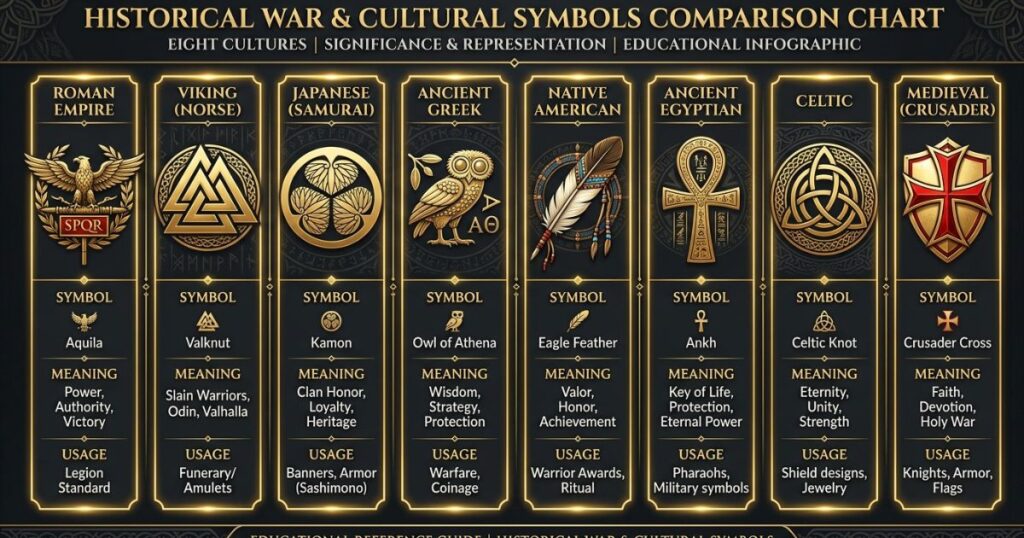
War Symbol Comparison Table
| Symbol | Culture | Meaning | Used On |
| Eagle (Aquila) | Rome | Supreme power, victory | Legion standards, coins |
| Valknut | Norse | Odin’s power, warrior afterlife | Burial stones, shields |
| Lambda (Λ) | Sparta | Spartan identity, discipline | Shields |
| Mon Crest | Japan | Clan loyalty, honor | Armor, banners, weapons |
| Red Cross | Medieval Europe | Holy war, crusade | Knight armor, shields |
| Red Poppy | WWI/Modern | Remembrance, sacrifice | Memorials, ceremonies |
| Skull & Crossbones | Pirates/Military | Fear, death, fearlessness | Pirate flags, military patches |
| Helm of Awe | Norse | Magical protection | Helmet, skin |
| Mjolnir | Norse | Divine strength, protection | Pendants, shields |
| Dragon | China/Wales | Supreme power, divine rule | Battle banners, royal seals |
War Symbols in Different Cultures
Every civilization in history created its own war symbols. Let us look at the most important ones from around the world.
Ancient Rome — The Eagle Empire
Rome built the greatest military machine the ancient world ever saw. Their symbols reflected that power. The eagle dominated everything. Roman soldiers were called “the eagles.” A Roman legion without its eagle standard was considered dead — even if all its soldiers still lived.
Roman war symbols also included the fasces — a bundle of wooden sticks tied around an axe. This symbolized that many individual people, united together, become something stronger than any single person. The fasces became one of Rome’s most important political and military symbols.
Norse Vikings — Gods and Warriors
Viking war culture was inseparable from religion. Every symbol a Viking warrior used was also a prayer. The Valknut asked Odin to watch over the warrior. The Helm of Awe asked for invincibility. The Mjolnir pendant asked Thor for strength and protection.
Vikings also used the raven banner in battle. A raven banner was a flag shaped like a raven with its wings spread. According to Norse belief, if the raven on the banner seemed to flutter and move during battle, victory was certain. If it hung limp and still, defeat was coming.
Japanese Samurai — Honor Above Everything
The samurai warrior code called Bushido — meaning “the way of the warrior” — shaped every aspect of samurai war culture including their symbols. Honor was more important than life itself. A samurai who failed in his duty was expected to perform ritual suicide called seppuku rather than live in shame.
The mon family crest system was incredibly detailed. There were thousands of different mon designs used by different clans and families. Famous mon include the Tokugawa hollyhock, the Oda clan’s mokko symbol, and the Shimazu clan’s cross-in-circle design.
Ancient Greece — Gods and Philosophy
Greek warriors fought under the watchful eyes of their gods. Before every major battle, Greek armies performed sacrifices and checked signs from the gods. If the omens were bad, some armies refused to fight at all.
The Gorgon face — usually the snake-haired monster Medusa — appeared on many Greek shields. The Greeks believed that showing this terrifying face to an enemy would paralyze them with fear, just as Medusa herself paralyzed people by turning them to stone.
Athena’s owl represented wisdom in warfare — the idea that a general who thinks clearly and plans carefully will always defeat a general who relies only on brute strength.
Native American Tribes — Spirit and Strength
Different Native American tribes used completely different war symbol systems, but some themes appeared across many cultures.
Eagle feathers were the highest symbol of warrior honor. A warrior earned each feather through specific acts of bravery. A headdress covered in eagle feathers represented a lifetime of courage and leadership.
War paint was deeply spiritual. Before battle, warriors painted their faces and bodies with specific colors and symbols. Red represented blood and life force. Black represented death to enemies. The specific patterns varied by tribe and by warrior.
Spirit animals chosen through vision quests gave individual warriors their personal war symbols. A warrior who had a vision of a bear would carry bear symbols. A warrior who saw a wolf would paint wolf symbols on his shield and body.
Medieval Europe — Faith and Heraldry
Medieval European warfare was deeply connected to both Christianity and the system of heraldry — the use of personal family symbols called coats of arms.
A knight’s coat of arms appeared on his shield, his horse’s covering, his flag, and his servants’ clothing. It was his complete identity in a world where everyone wore armor that covered their faces. Coats of arms used specific animals, colors, and patterns with strict rules about what each element meant.
Lions were the most popular heraldic animal because they represented courage and royal power. Eagles represented authority and military strength. Dragons represented ferocity and supernatural power. Crosses represented faith and religious duty.
War Symbols in Dreams — What Does It Mean?
Many people dream about war symbols — especially during times of personal stress, conflict, or major life changes. Here is what common war symbols mean when they appear in your dreams.
Seeing Swords in Dreams
A sword in a dream almost always represents a decision you need to make or a conflict you are facing. If the sword is sharp and gleaming, it suggests you have the strength to face your challenge directly. If the sword is broken or rusty, it may mean you feel powerless or unprepared for a situation in your life.
Seeing a Shield in Dreams
A shield in a dream represents self-protection and emotional boundaries. Your mind may be telling you to protect yourself from someone who is draining your energy or causing you harm. It can also mean you need to stand firm in your beliefs even when others pressure you to change.
Seeing Military Flags or Banners
Flags in dreams represent loyalty, identity, and causes you believe in deeply. If the flag is flying high and strong, it suggests confidence and clarity about your values. If the flag is torn or falling, it may represent confusion about who you are or what you stand for.
Seeing Battles or Armies
A dream about a large battle often reflects inner conflict — two parts of yourself fighting against each other. Perhaps you want to do something but feel guilty about it. Perhaps you know the right choice but keep choosing the wrong one. The battle in your dream mirrors a real war happening inside you.
Seeing Eagles or War Birds
An eagle in a dream represents personal power, ambition, and the desire to rise above your current situation. If the eagle is soaring freely, you may be entering a period of great personal strength. If the eagle is caged or injured, you may feel trapped or limited in your real life.
Seeing Skulls or Death Symbols
A skull in a war-related dream does not necessarily predict death. More often, it represents the end of something — a relationship, a job, a phase of life — and the beginning of something new. Death in dreams almost always means transformation, not literal death.
Spiritual Meaning of War Symbols
On a spiritual level, war symbols carry meanings that go far beyond physical conflict.
The Inner Warrior
Many spiritual traditions teach that the greatest war is not fought on a battlefield. It is fought inside the human heart. The battle between fear and courage. The battle between selfishness and love. The battle between who you are now and who you are meant to become.
War symbols in spiritual practice represent this inner warrior. When someone wears a sword symbol or a warrior tattoo, they are often saying: I am fighting my own battles. I refuse to give up. I have the heart of a warrior even if I never touch a physical weapon.
Protection Symbols in War
Ancient warriors genuinely believed that certain symbols could protect them from physical harm. Viking warriors carved runes into their weapons. Roman soldiers prayed to Mars before battle. Japanese samurai performed purification rituals. Egyptian soldiers wore ankh amulets.
Whether or not these symbols provided real physical protection, they absolutely provided psychological protection. A warrior who believes he is protected fights with more confidence, more courage, and less fear. That psychological advantage could absolutely change the outcome of a real battle.
The Duality of War Symbols
Every war symbol carries two sides — light and darkness. A sword can defend the innocent or murder the helpless. A flag can unite people or divide them. An eagle can represent freedom or oppression.
This duality is exactly what makes war symbols so endlessly powerful and meaningful. They contain the full range of human experience — the best and worst that people are capable of doing.
Read More: God Symbols 2026: 50+ Powerful Meanings Explained
War Symbols — Common Myths vs Real Facts
Let us clear up some common misunderstandings about war symbols.
| Myth | Real Fact |
| War symbols always mean violence | Many war symbols represent sacrifice, protection, and remembrance |
| The skull always means evil | In many warrior cultures, the skull represents fearlessness and acceptance of mortality |
| The swastika is only a Nazi symbol | The swastika is actually an ancient symbol of good luck used for thousands of years in Hindu, Buddhist, and many other cultures |
| Black flags always mean danger | In some cultures, black represents dignity, power, and authority — not just danger |
| War symbols are only for soldiers | Many people use war symbols to represent their personal battles, strength, and survival |
| All ancient war symbols are forgotten | Many ancient war symbols — Viking runes, Roman eagles, Celtic knots — are more popular today than ever before |
How to Use War Symbols in Your Life
You do not need to be a soldier to connect with war symbols. Here are meaningful ways to bring these powerful symbols into your everyday life.
As Personal Tattoos
War symbol tattoos are among the most popular tattoo choices worldwide. They represent strength, survival, personal battles, and warrior spirit. Before choosing a war symbol tattoo, take time to research its history. Understand what it meant to the people who originally used it. Choose a symbol whose meaning genuinely connects with your personal story.
As Jewelry and Accessories
Viking Mjolnir pendants, Celtic warrior knots, Roman eagle medallions, and Japanese mon-inspired jewelry all make powerful personal accessories. Wearing a war symbol as jewelry is a way of carrying that symbol’s meaning — its courage, protection, or strength — with you every day.
For Understanding History
Learning about war symbols is one of the best ways to understand human history. Every symbol carries the story of a real civilization, a real battle, and real human beings who used that symbol to find courage in terrifying moments.
For Creative Projects
Writers, artists, game designers, and filmmakers use war symbols constantly to create powerful, emotionally resonant work. Understanding the real history and meaning behind these symbols will make your creative projects far more authentic and impactful.
For Memorial and Remembrance
The red poppy, the empty boots, the folded flag — these symbols remind us to honor those who sacrificed their lives so others could live in freedom. Using these symbols during memorial ceremonies connects the present to the past and keeps important memories alive.
FAQ — War Symbols
What are the most common symbols of war?
The most common war symbols include the eagle, crossed swords, skull and crossbones, shield, red poppy, battle axe, military flags, and the Spartan helmet. These appear across many different cultures and time periods.
What are the 7 elements of war?
Military scholars often identify seven elements of war: personnel (soldiers), materiel (weapons and equipment), leadership, intelligence (knowing your enemy), operations (planning), logistics (supply chains), and morale (the will to fight). Symbols historically boosted morale — making them a genuine element of warfare.
What are some iconic war symbols from WW2?
Famous WW2 war symbols include the British bulldog (representing Churchill’s determination), the V for Victory sign, the American bald eagle, the Soviet red star, the Nazi swastika (a symbol of immense historical notoriety), and the red poppy of remembrance.
What is the symbol of war and peace?
The olive branch represents peace in ancient Greek, Roman, and modern culture. In contrast, the sword, spear, or battle axe represents war. Together, the sword and olive branch represent the balance between the willingness to fight and the desire for peace. The United Nations logo actually features a world map surrounded by olive branches.
Why were war symbols so important in ancient battles?
In ancient battles, thousands of soldiers fought in chaotic, dust-filled, screaming environments. There were no radios, no phones, and no clear way to tell friend from enemy. Symbols on shields, flags, and armor let soldiers identify their own side instantly. They also boosted morale — seeing your army’s symbol gave soldiers courage during moments of extreme fear.
What do war symbols mean in dreams?
War symbols in dreams typically reflect inner conflict, personal struggles, major decisions, or emotional battles you are currently facing. Swords represent difficult choices. Shields represent self-protection. Battles represent inner conflict. Eagles represent personal ambition and power.
Are war symbols still used today?
Absolutely. Military uniforms worldwide use eagle symbols, crossed swords, shields, and star symbols. National flags carry war symbols. Memorial ceremonies use the red poppy. Sports teams use warrior symbols. War symbols are more visible today than ever before.
What is the difference between a war symbol and a peace symbol?
War symbols generally represent conflict, strength, aggression, protection, or military power. Peace symbols represent reconciliation, rest, cooperation, and the end of conflict. However, many symbols can represent both — a soldier who carries a sword but uses it to defend the innocent becomes a symbol of both war and peace.
Final Thoughts
War symbols are far more than old markings on ancient shields and battlefields. They are the emotional language of humanity’s greatest struggles.
Every war symbol you have read about in this guide carried real meaning to real people in real moments of danger. A Viking warrior carved the Helm of Awe into his skin and believed it would keep him alive. A Roman soldier marched behind his eagle standard knowing he would die before letting it fall. A mother pinned a red poppy to her coat every November to remember a son who never came home.
Explore more powerful symbol meanings on TrendyMegzine.com — your guide to the hidden meanings behind the world’s most powerful symbols.

Muhammad Shoaib is a passionate content writer and symbolism researcher at TrendyMegzine.com, where he explores the hidden meanings behind symbols, spiritual signs, ancient traditions, dream interpretations, and cultural symbolism.