100+ Powerful Holy Thursday Symbols That Reveal the True Meaning of the Last Supper
There is a room in Jerusalem that changed everything.
Twelve men gathered around a table. A teacher who knew exactly what was coming. A meal that would be remembered for two thousand years. And in that room — in the bread broken, the cup lifted, the water poured over tired feet — a set of Holy Thursday symbols was born that still speaks to the human soul with extraordinary force.
These are not just religious signs. They are emotional archives. Each one holds a specific feeling that the human heart has always known: the weight of love before loss, the strange grace of being served by someone greater than yourself, the silence that falls when something sacred is about to end.
This guide unpacks every major symbol of Holy Thursday, traces them through history, culture, and psychology, and explains why — two millennia later — they still stop people in their tracks.
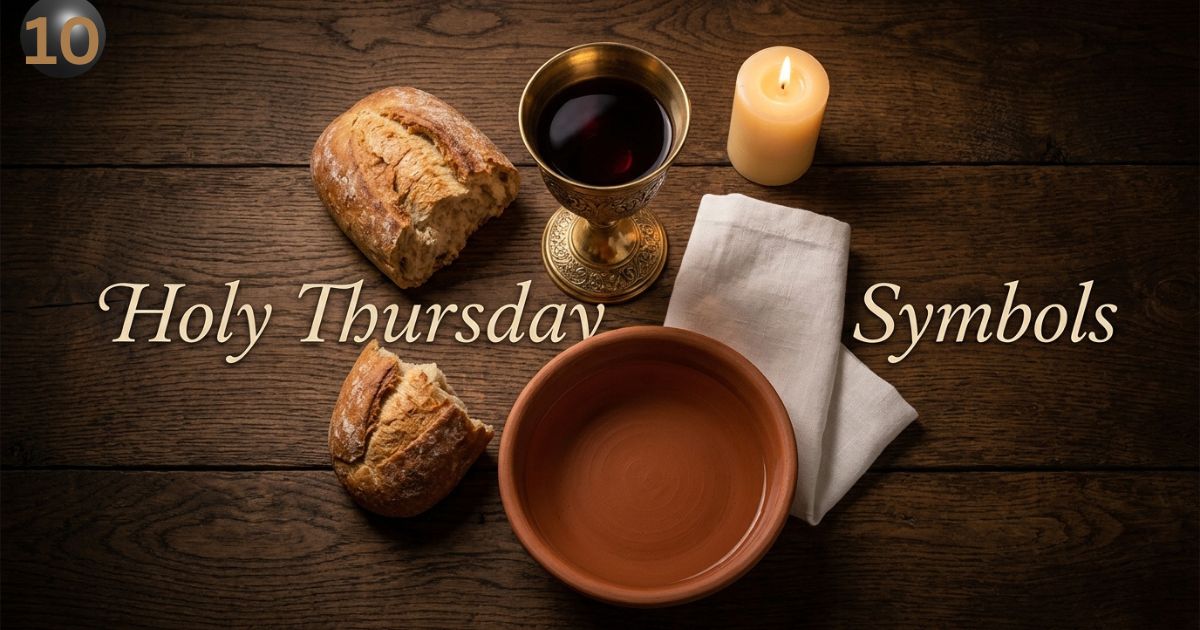
[IMAGE ALT: Holy Thursday symbols arranged on aged wood — bread loaf, golden chalice, white towel, water basin, and candle — representing the Last Supper and Maundy Thursday rituals]
What Are Holy Thursday Symbols?
Holy Thursday symbols are the sacred signs, rituals, and objects associated with Holy Thursday — also called Maundy Thursday — the Christian observance commemorating the Last Supper of Jesus Christ with his twelve disciples.
This day, the Thursday before Easter, is one of the most emotionally layered in the Christian calendar. It contains the institution of the Eucharist, the act of foot washing, the last shared meal, and the beginning of the Passion narrative — all within a single night.
Each symbol from that night carries a different weight. Some represent love. Others, humility. Some carry the quiet devastation of betrayal. Together, they form a complete emotional portrait of what it means to be human at the edge of something irreversible.
Over twenty centuries, these symbols have migrated from that upper room in Jerusalem into churches, paintings, tattoo parlors, literature, film, and the interior lives of people who may not even define themselves as religious — because their emotional truth extends far beyond doctrine.
The 10 Core Holy Thursday Symbols — Full Breakdown
| Symbol | Visual | Core Meaning | Where It Appears |
| Bread | Broken loaf | Body of Christ, sacrifice, unity | Mass, art, communion ceremonies |
| Chalice & Wine | Golden cup with wine | Blood of Christ, divine covenant | Altars, religious paintings, tattoos |
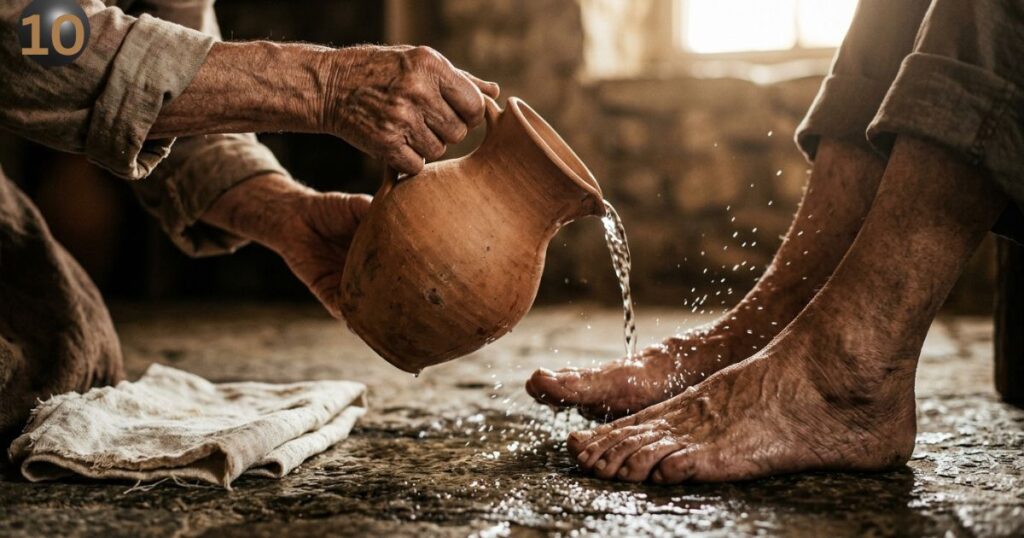
| Basin and Towel | Bowl of water, folded cloth | Humility, service, cleansing | Foot washing rituals, church art |
| Stripped Altar | Bare altar, no cloth | Abandonment, loss, preparation | Churches on Holy Thursday evening |
| Twelve Disciples | Group around a table | Community, loyalty, human frailty | Paintings, literature, mosaics |
| Paschal Lamb | White lamb | Sacrifice, innocence, redemption | Church iconography, Easter symbolism |
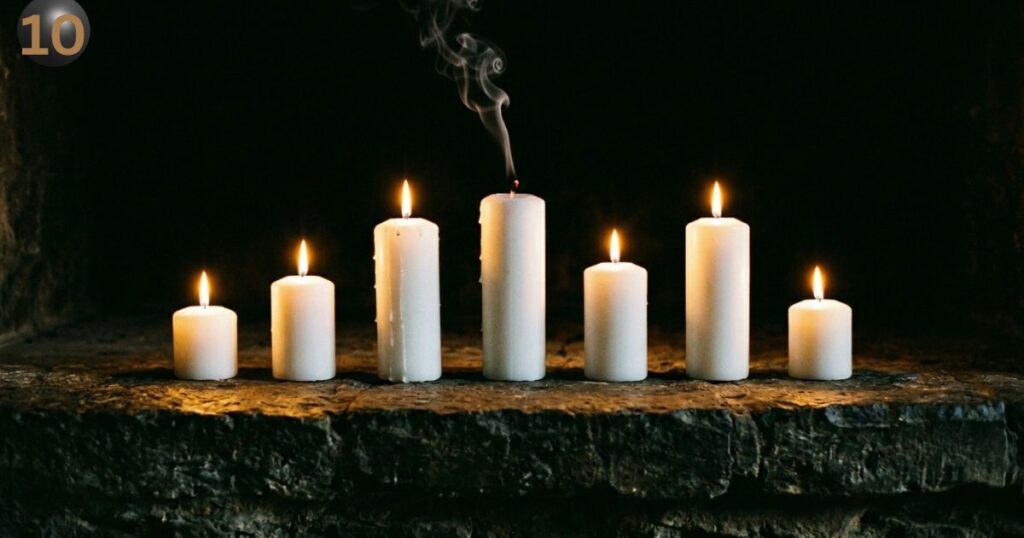
| Candles / Fire | Lit candles, flame | Divine presence, the light before darkness | Liturgy, vigil services |
| Oil of Chrism | Sacred anointing oil | Priesthood, healing, consecration | Chrism Mass, ordination rites |
| Upper Room | Intimate interior space | Sacred gathering, community, the last sanctuary | Architecture, religious art |
| Water | Flowing or still water | Purification, baptism, spiritual renewal | Foot washing, baptismal rites |
1. Bread — The Symbol That Holds Everything Together
Bread is the most universal of all Holy Thursday symbols, and it is universal for a reason.
Every culture in human history has gathered around bread. It is survival. It is hospitality. It is what you offer someone when you want them to know they are welcome. On the night of the Last Supper, Jesus took that universal act — breaking bread — and permanently transformed its meaning.
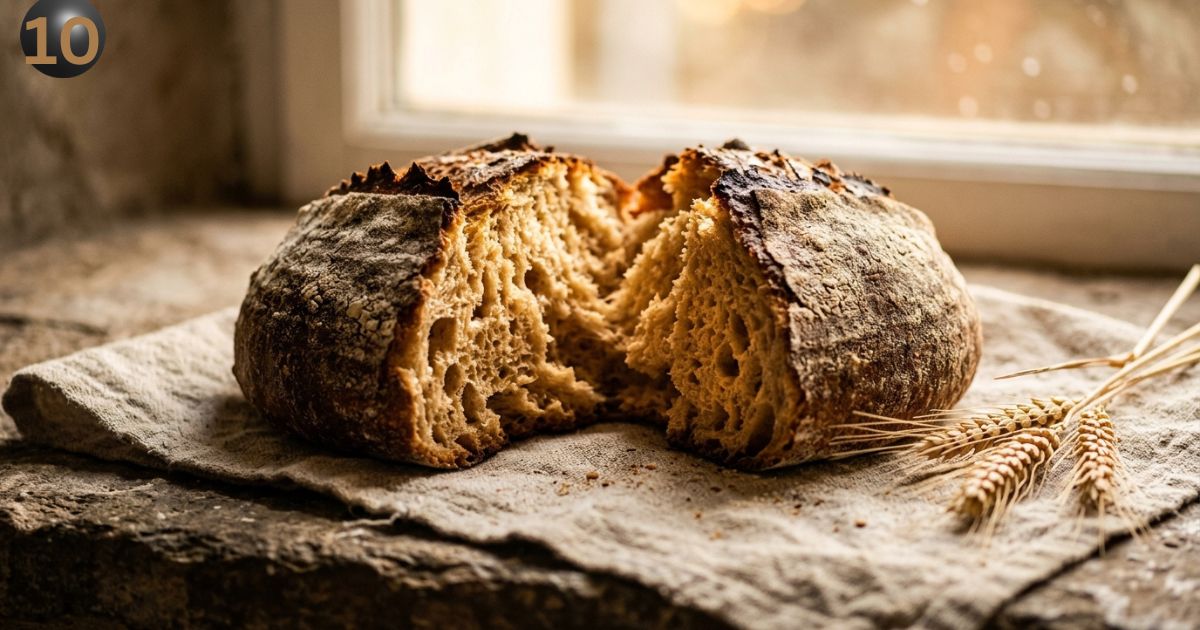
“This is my body,” he said. And from that moment, a simple loaf became one of the most theologically dense objects in world religion.
As a Holy Thursday symbol, bread represents:
- Sacrifice — something given completely, broken for others
- Unity — shared between everyone at the table equally
- Sustenance — the idea that spiritual life requires nourishment just as physical life does
- Presence — the belief that the divine can dwell inside the ordinary
In the Catholic tradition, the consecrated bread becomes the Eucharist — the literal body of Christ according to Catholic doctrine. In Protestant traditions, it is a powerful memorial. But across both, the emotional weight is the same: something precious was broken so that something else could live.
2. The Chalice and Wine — Symbol of the Covenant
The chalice is arguably the most visually iconic of all Holy Thursday symbols. Gold. Ornate. Filled with wine. It appears in paintings, in church architecture, in stained glass windows, in tattoos on forearms and shoulder blades of people who needed to carry something sacred close to their skin.
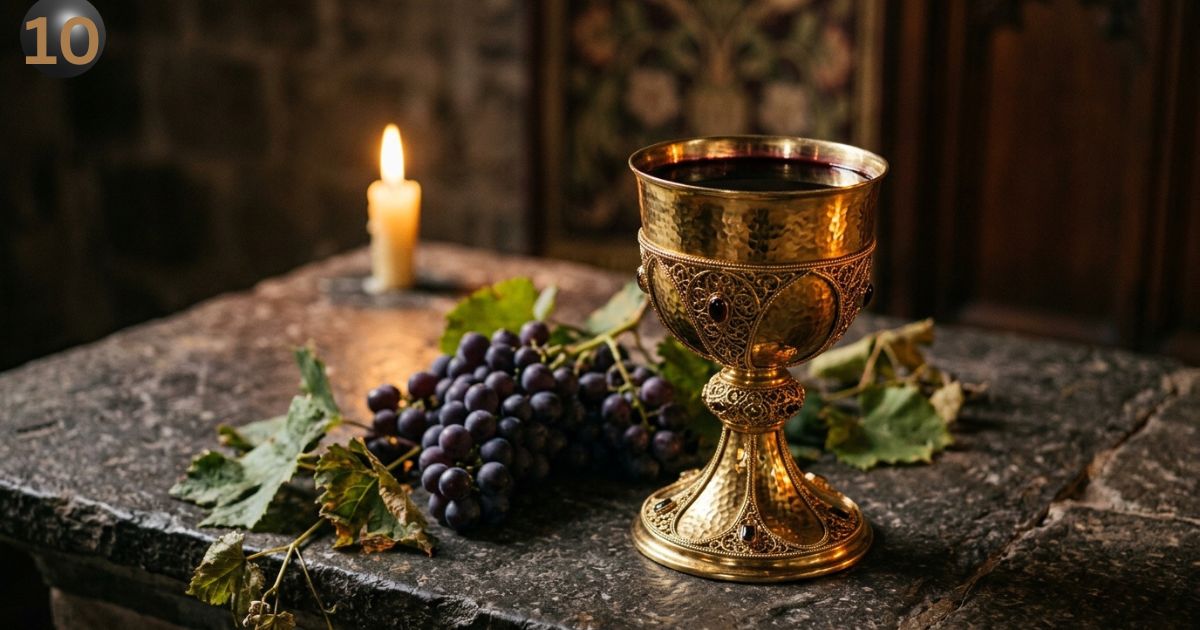
Wine as a Holy Thursday symbol carries two simultaneous meanings that seem contradictory until you hold them together. It is joy — wine was present at celebrations, at weddings, at moments of abundance. And it is the blood of sacrifice — the cost of love taken to its extreme.
The chalice represents the divine covenant: the ancient agreement between the human and the divine that love would not be conditional, that the relationship would hold even through betrayal and suffering and death.
For many people, the chalice in art or meditation is less about theology and more about this: the willingness to drink from a cup you did not choose. To accept what is hard. To trust that the bitter and the sacred are sometimes the same thing.
3. The Basin and Towel — The Symbol That Broke Every Expectation
If you want to understand what made the disciples fall silent, it is this: their teacher, their Rabbi, the one they had followed for three years believing he was the Messiah — got down on his knees and washed their feet.
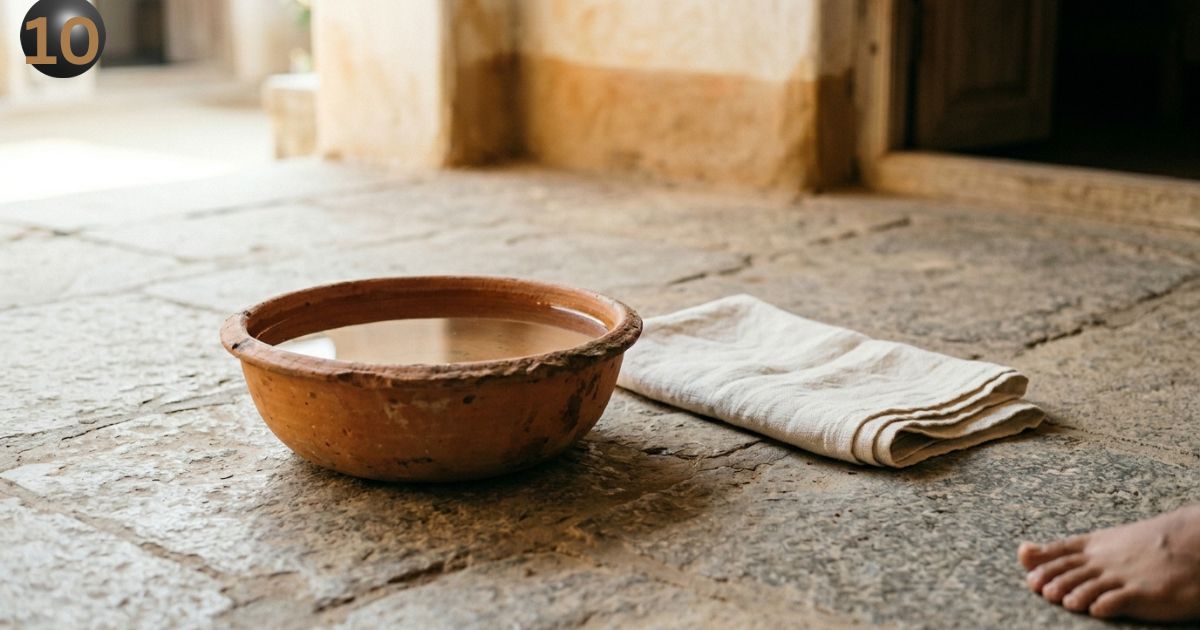
The basin and towel are the Holy Thursday symbols of complete inversion. In the ancient world, washing feet was the work of the lowest servant. Not a disciple. Not a rabbi. Not a king. When Peter saw what was happening, he could not let it happen. “You shall never wash my feet,” he said.
And Jesus answered: “Unless I wash you, you have no part in me.”
That exchange is the entire sermon. The symbol does not just represent humility. It represents a redefinition of what greatness actually is. The one with the most authority kneels to the one with the least. The teacher becomes the servant. Power is expressed not through domination but through care.
The foot washing ritual — still practiced in Catholic, Orthodox, and many Protestant churches on Holy Thursday — is one of the most psychologically powerful liturgical acts in Christianity. Something about actually washing another person’s feet, or having your own feet washed, bypasses the intellectual and lands directly in the emotional. It is almost impossible to remain detached during it.
4. The Stripped Altar — Symbol of Abandonment
At the end of Holy Thursday services, something happens that is deliberately unsettling.
The altar is stripped. The candles are extinguished. The decorations are removed. The church is left bare — and the congregation departs in silence.
The stripped altar is one of the most emotionally affecting of all Holy Thursday symbols precisely because it represents absence rather than presence. The warmth and light and community of the evening give way to something cold and empty. The sanctuary that felt like home moments ago now feels like a room where someone has left and is not coming back.
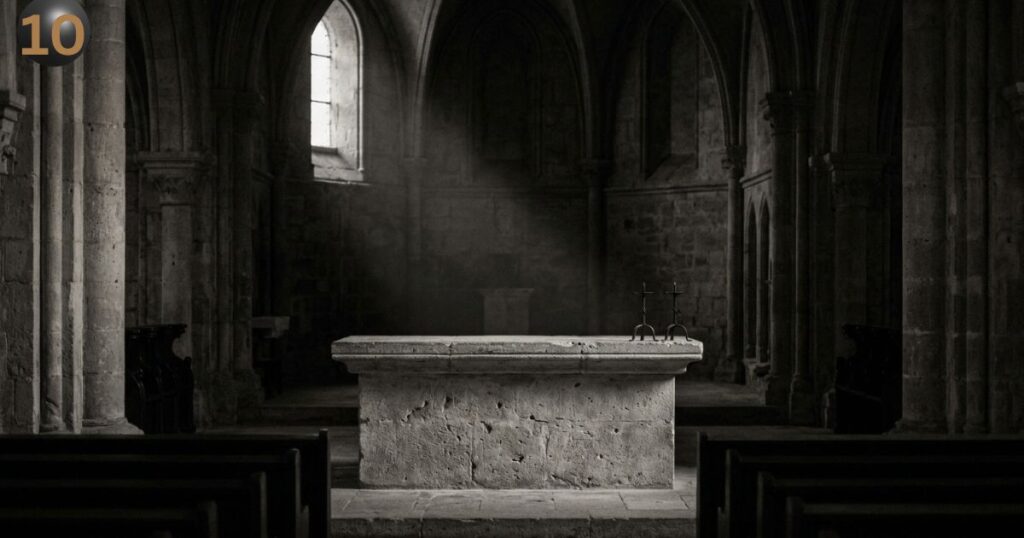
This symbol represents:
- Abandonment — the disciples scattered; Jesus was left alone
- Loss — the removal of everything familiar
- Preparation — the stripping away that precedes Good Friday’s darkness
- Invitation to stay — in many traditions, a vigil is kept through the night beside the reserved sacrament, echoing Jesus’s request in Gethsemane to “watch and pray”
For many believers, the stripped altar is the moment Holy Thursday becomes real. The ceremony ends. The music stops. The comfortable is taken away. And you are left with exactly what the disciples were left with: a night that offers no easy comfort.
5. The Paschal Lamb — Symbol of Innocent Sacrifice
The Paschal Lamb connects Holy Thursday directly to the oldest layers of the Hebrew Bible. At the first Passover, Jewish families marked their doorposts with the blood of a lamb so that death would pass over their homes. The lamb was sacrificed so the family could live.
As a Holy Thursday symbol, the Paschal Lamb carries that entire weight of history forward. Jesus, in Christian theology, becomes the Lamb of God — the one whose sacrifice ends all sacrifices, whose blood marks the beginning of something completely new.
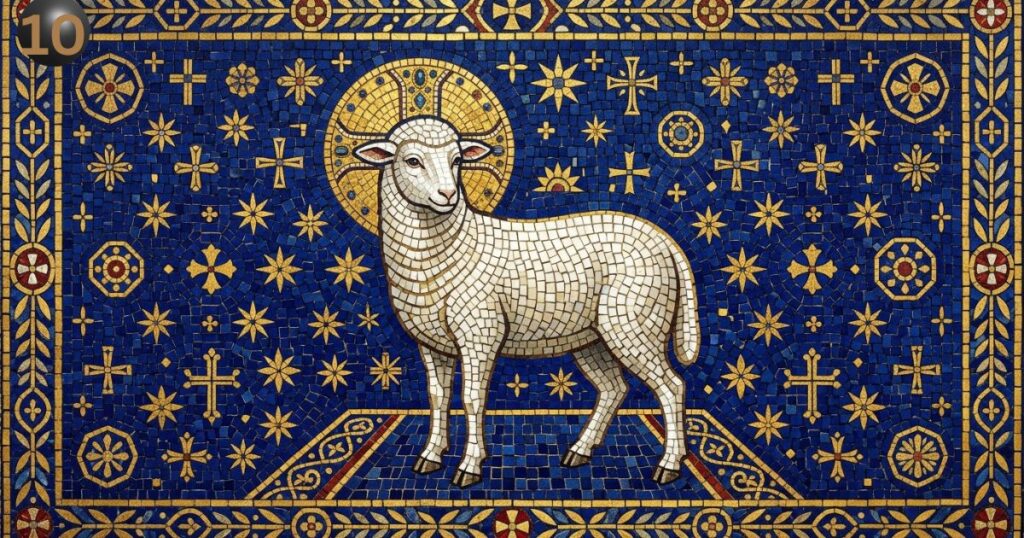
The lamb in Holy Thursday symbolism appears in:
- Religious art and iconography
- Easter liturgy
- Church architecture and stained glass
- The phrase “Agnus Dei” (Lamb of God) used in Catholic and Anglican mass
The Paschal Lamb teaches that the most significant things in life are often accomplished not through force, but through surrender. Through the willingness to give what cannot be taken back.
[IMAGE ALT: Paschal Lamb Holy Thursday symbol depicted in Byzantine mosaic style — white lamb with golden halo on a field of deep blue, representing innocent sacrifice and redemption]
6. The Oil of Chrism — Symbol of Consecration
On Holy Thursday, many Catholic and Anglican dioceses hold what is called the Chrism Mass — a gathering where the bishop blesses the sacred oils used throughout the year for baptism, confirmation, ordination, and the anointing of the sick.
The Oil of Chrism is a Holy Thursday symbol that most people outside liturgical traditions rarely encounter, but its meaning is rich. Oil in ancient tradition represented strength, healing, and divine selection. Kings were anointed with oil. Priests were anointed. The sick were anointed.
The Chrism Mass on Holy Thursday connects this ancient tradition to the Last Supper’s theme of servant leadership. The oils blessed on this day will be used to consecrate priests, to welcome new Christians at Easter, and to comfort the dying. All of that flows from this one Thursday gathering.
Holy Thursday Symbols in the Catholic Tradition
In Catholic observance, Holy Thursday Catholic symbols are woven into a liturgy of extraordinary emotional depth. The Mass of the Lord’s Supper on Holy Thursday evening is considered one of the most beautiful and moving services in the entire Catholic year.
The core Catholic Holy Thursday symbols include:
- The Eucharist — consecrated during this Mass and then processed in a solemn procession to a place of repose where the faithful keep watch
- The Chalice — central to the institution narrative read aloud from the Gospel of John
- The Washing of Feet — performed by the priest, following Jesus’s example with his disciples
- White Vestments — representing joy, purity, and the presence of God before the darkness of Good Friday
- The Bell — rung during the Gloria for the last time until Easter, then silenced
Each of these symbols builds on the others to create a liturgical narrative that mirrors the emotional arc of that original night: joy, intimacy, service, and then — when the altar is stripped and the lights go dark — the terrible weight of what is coming.
Maundy Thursday Symbols Across Different Cultures
Holy Thursday’s symbols have traveled the world and taken root in cultures far beyond their origin.
In medieval Europe, kings and nobles washed the feet of the poor on Maundy Thursday in a public act of ritual humility. The English monarch gave out “Maundy money” — specially minted coins — to elderly citizens in a tradition that continues today. The word “Maundy” itself comes from the Latin “mandatum” — meaning commandment — referring to Jesus’s commandment to love one another.
In Latin American cultures, Holy Thursday processions are some of the most elaborate and emotionally powerful in the world. Communities gather for hours, carrying sacred images through the streets, reenacting the Last Supper with extraordinary detail. The symbols are not observed quietly — they are lived publicly, communally, with the full force of cultural identity and religious devotion combined.
In Eastern Orthodox Christianity, Holy Thursday is called Great and Holy Thursday. The foot washing ritual is performed by the Patriarch in a public ceremony. The liturgy emphasizes the mystical and transformative dimension of the Last Supper, connecting communion directly to the divine life of the Trinity.
In Anglican traditions, the Maundy ceremony retains the royal connection. Holy Thursday symbols in this context carry both religious and civic meaning — service to the vulnerable as an act of sacred duty.
The Psychology Behind Holy Thursday Symbols
Why do people who are not religious find themselves moved by Holy Thursday symbols?
The answer is psychology, not doctrine.
Every major Holy Thursday symbol addresses something fundamental in the human experience. The breaking of bread speaks to generosity and vulnerability. The washing of feet speaks to the humbling of pride. The stripped altar speaks to loss and the courage to remain present in emptiness. The betrayal — Judas’s departure from the table — speaks to the particular pain of being hurt by someone trusted.
Carl Jung would have recognized these as archetypes — images that speak across culture and time to the shared interior landscape of humanity. They work on people not because they have been taught to respond, but because the emotional content is already there, waiting to be recognized.
Holy Thursday symbols offer something rare: a language for experiences that are almost impossible to put into words. The feeling of serving someone at great personal cost. The feeling of being served when you feel unworthy. The feeling of a meal that is also a goodbye.
Holy Thursday Symbols in Art, Tattoos, and Literature
Few artistic subjects have inspired more masterworks than the Last Supper — and by extension, the full constellation of Holy Thursday symbols.
Leonardo da Vinci’s The Last Supper is the most reproduced religious painting in the world. Its power comes from the psychological realism: twelve distinct human reactions to the announcement of betrayal, captured in a single frozen moment. Every figure at that table is a different emotional response to the same unbearable news.
In tattoos, Holy Thursday symbols are chosen for deeply personal reasons:
- The chalice — faith, sacrifice, the willingness to drink from a hard cup
- Bread and wine — communion, connection, spiritual identity
- The basin and towel — humility as a value, service as a vocation
- The Paschal Lamb — innocence, sacrifice, redemption from a specific past
In literature, from Dostoevsky to Flannery O’Connor to Marilynne Robinson, Holy Thursday symbols appear as markers of moral crisis and spiritual turning points. A shared meal becomes a confession. A washing becomes a transformation. A betrayal becomes the moment everything else becomes clear.
[INTERNAL LINK: Holy Week symbols and their meanings] [INTERNAL LINK: Christian symbols and their spiritual significance] [EXTERNAL LINK: Vatican — The Meaning of Maundy Thursday]
Spiritual and Dream Meaning of Holy Thursday Symbols
When Holy Thursday symbols appear in dreams or meditation, they carry specific emotional messages.
Dreaming of bread often reflects a longing for connection, community, or spiritual nourishment. It can indicate a season of life where something essential feels missing.
Dreaming of a chalice may point to a decision that must be accepted rather than avoided — the cup that cannot be passed. It is a symbol of conscious surrender to something larger than the self.
Dreaming of water or the washing of feet frequently signals a desire for forgiveness — either to give it or receive it. It often surfaces during periods of guilt, conflict, or emotional exhaustion.
A stripped altar in dreams can indicate transition: the painful clearing-away that must happen before something new can begin.
Spiritually, these symbols function as invitations — not commands. They do not demand a specific theological response. They simply point inward, toward the places in the human soul that most need attention.
Positive and Shadow Meanings of Holy Thursday Symbols
Like all symbols of genuine depth, Holy Thursday symbols carry both light and shadow.
Positive meanings:
- Love expressed as radical service
- Unity across difference and hierarchy
- Sacrifice that transforms rather than merely endures
- Humility as a form of strength
- Communion — the deep belonging of sharing what sustains life
Shadow meanings:
- Betrayal — the Last Supper includes Judas, and that darkness is inseparable from the symbol
- Suffering — sacrifice is never painless, and these symbols do not pretend otherwise
- Abandonment — the disciples fled; the stripped altar holds that truth
- Loss — the joy of the meal is shadowed by what both host and guests already know
This dual nature is not a flaw in the symbols. It is what makes them real. Life contains both. Love contains both. The most honest sacred symbols acknowledge that light and shadow share the same space.
Read More: 10+ Symbols of Virgo That Reveal Its True Personality and Hidden Power
Conclusion
The room in Jerusalem is two thousand years gone. The table has long since turned to dust.
But the Holy Thursday symbols born in that room on that night are as alive as they have ever been — because they carry something that does not age. The truth that love, taken to its full conclusion, always looks like service. That sharing what sustains you is an act of faith. That being washed by someone greater than yourself requires the humility to let it happen. That an empty altar is not the end of the story.
These symbols — bread, wine, chalice, basin and towel, Paschal Lamb, stripped altar, candle flame — are not relics of a religion. They are mirrors of what it means to be human at the moments that matter most.
Look at them honestly. Let them do what they were always meant to do: tell you something true about love, loss, sacrifice, and the grace that comes from serving rather than being served.
Explore the Holy Thursday symbols that speak to you. Carry them. Understand them. Let them remind you that the most enduring things in this world are not the grand gestures but the broken bread, the water poured over tired feet, and the light that holds steady even when everything else goes dark.

Muhammad Shoaib is a passionate content writer and symbolism researcher at TrendyMegzine.com, where he explores the hidden meanings behind symbols, spiritual signs, ancient traditions, dream interpretations, and cultural symbolism.