71+ Powerful Voodoo Symbols: The Hidden Meanings, Secrets and Spiritual Power Behind Every Sign for 2026
The image that most people carry of voodoo symbols was designed to frighten them.
Skull and crossbones. Dripping candles. Dark rituals in swamps at midnight. That version of voodoo symbols was constructed — deliberately, systematically — by people who needed a powerful African spiritual tradition to seem dangerous rather than what it actually was: a complete, sophisticated, living religion that helped enslaved people survive conditions designed to destroy their humanity.
The truth behind these symbols is more interesting, more complex, and ultimately more moving than any horror movie could manage.
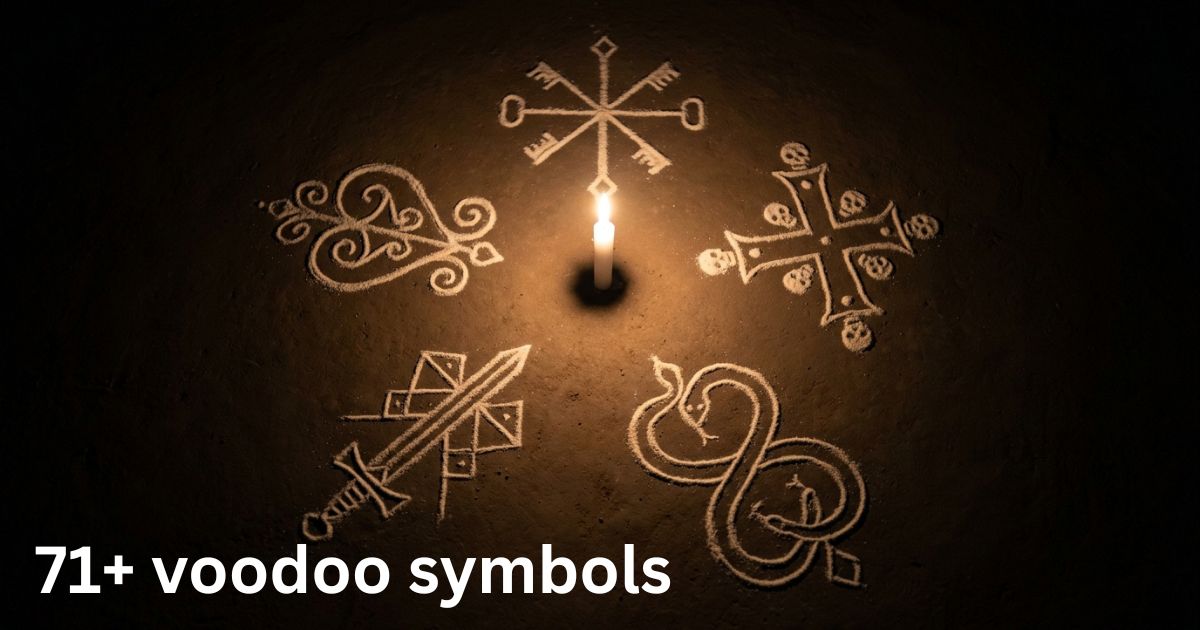
Voodoo symbols — called veve in Haitian Vodou — are sacred ritual drawings that function as spiritual gateways. They are intricate, geometrically precise, and deeply intentional. Each one represents a specific spirit. Each one carries centuries of prayer, practice, and survival. Each line drawn in cornmeal on the floor of a ceremony is a communication — a reaching across the boundary between the seen world and the unseen one.
This guide covers 71+ of these symbols honestly and completely: what they are, who they represent, where they came from, why they look the way they do, and why their psychological power remains intact across centuries and cultures.
What Are Voodoo Symbols?
Voodoo symbols, more precisely called veve, are the sacred ceremonial drawings of Haitian Vodou — one of the major African diaspora religions that developed in Haiti during the eighteenth and nineteenth centuries among enslaved Africans and their descendants.
The word voodoo derives from the Fon word vodun, meaning spirit or divine essence. The religion itself weaves together West African spiritual systems — particularly from the Fon, Ewe, and Yoruba peoples of modern Benin, Togo, and Nigeria — with elements of French Catholicism that were imposed during the colonial period. What emerged was not a corrupted version of either tradition but something new: a complete spiritual system uniquely adapted to the specific experience of survival under slavery.
Each veve serves as the visual signature of a specific Lwa (also written as Loa) — a spirit who holds authority over a particular domain of human life: love, death, the sea, healing, justice, war, agriculture, creativity. When a practitioner draws a veve with powdered cornmeal, ash, or flour during ceremony, they are not decorating the floor. They are sending a direct spiritual communication — creating a sacred landing space, inviting the Lwa into the gathering, opening a channel between the human and the divine.
The closest analogy in Western tradition would be a prayer address — a specific name and location that directs spiritual attention. Except a veve is drawn by hand, with the full embodied focus of the person drawing it, in a tradition that has been transmitted person to person across centuries.
Understanding voodoo symbols means understanding this: they are not magic spells or threats. They are love letters to the divine, drawn in powder, meant to dissolve after the ceremony ends, carrying their meaning in the act of their creation.
The 10 Most Powerful Voodoo Symbols — Full Breakdown
| Symbol | Visual | Lwa | Core Meaning |
| Papa Legba Veve | Crossroads with cane and keys | Papa Legba | Gateway, spiritual access, beginnings |
| Erzulie Freda Veve | Adorned heart with crown | Erzulie Freda | Love, beauty, feminine power |
| Baron Samedi Veve | Cross with coffin and skull | Baron Samedi | Death, transformation, humor |
| Damballa Veve | Two intertwined serpents | Damballa | Creation, purity, cosmic wisdom |
| Ogou Veve | Sword/machete with geometric lines | Ogou | War, strength, justice |
| Agwe Veve | Ship with waves and oars | Agwe | The sea, protection at sea, abundance |
| Ayizan Veve | Palm frond with geometric base | Ayizan | Healing, priesthood, sacred markets |
| La Sirene Veve | Mermaid form with waves | La Sirene | Mystery, beauty, the ocean’s secrets |
| Maman Brigitte Veve | Cross with rooster and skull | Maman Brigitte | Death and healing, protection of graves |
| Simbi Veve | Serpent with water and geometric lines | Simbi | Water magic, crossings, communication |
1. Papa Legba — The Gatekeeper of All Spiritual Doors
Every Vodou ceremony begins with Papa Legba. His veve is drawn first, before any other spirit is invited. Without him, no communication with the other Lwa is possible. He is the gatekeeper — the old man who stands at the crossroads between the human world and the spirit world, deciding who may pass.
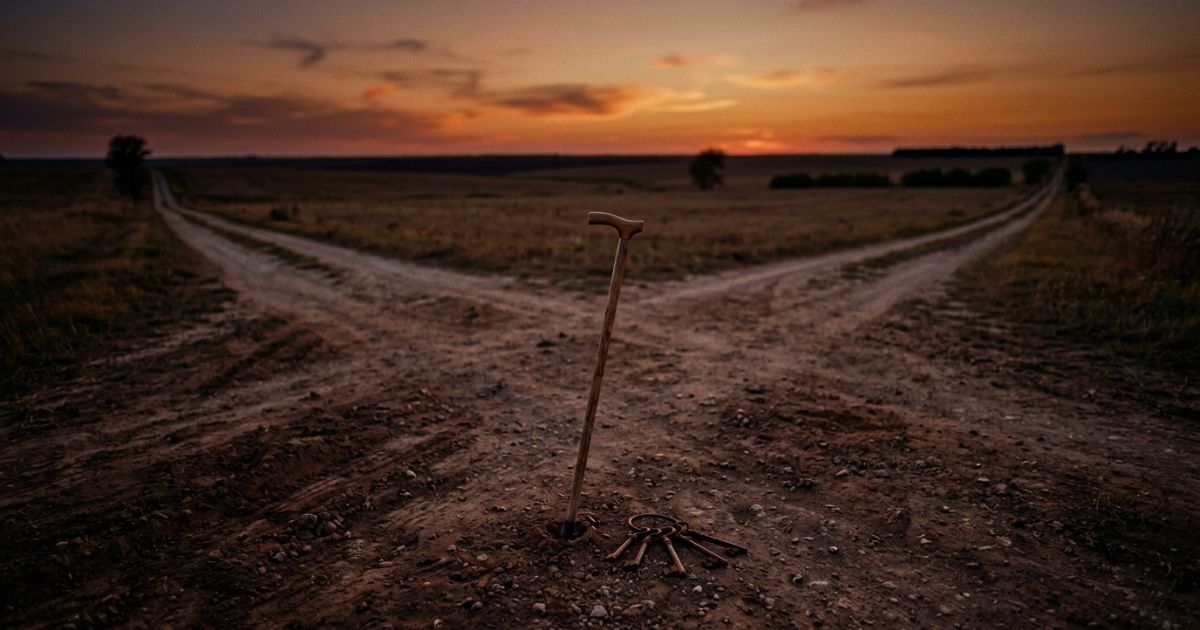
His veve typically shows a crossroads shape — two lines intersecting — combined with a walking cane, a set of keys, and sometimes a rising sun. The crossroads itself is one of humanity’s oldest spiritual symbols: the place where paths meet, where decisions must be made, where different worlds touch each other.
In the Catholic syncretism that developed within Haitian Vodou, Papa Legba is associated with Saint Peter — because both figures hold keys and both guard doorways to what lies beyond ordinary experience. This association was practical as well as spiritual: during slavery, Catholic imagery could be displayed openly while African spiritual practice was suppressed. The saint’s image protected the spirit’s worship.
As a voodoo symbol, Papa Legba’s veve carries a precise psychological meaning: before anything else can be accessed — love, healing, justice, power — the threshold must be crossed. The gatekeeper must be honored. You cannot reach the destination without acknowledging the door.
2. Erzulie Freda — The Symbol of Love’s Full Complexity
Erzulie Freda is the Lwa of love, beauty, luxury, and feminine power — and her veve is one of the most visually recognizable in the Vodou tradition. A decorated heart, often adorned with intricate curls, sometimes crowned, always beautiful.
But Erzulie Freda is not a simple love goddess. Her mythology is more complex than that. She is described as loving deeply, grieving deeply, and weeping at the end of every ceremony because the world never quite measures up to the ideal of love that she carries within her. She wears three wedding rings — three marriages, three loves — and she mourns them all.
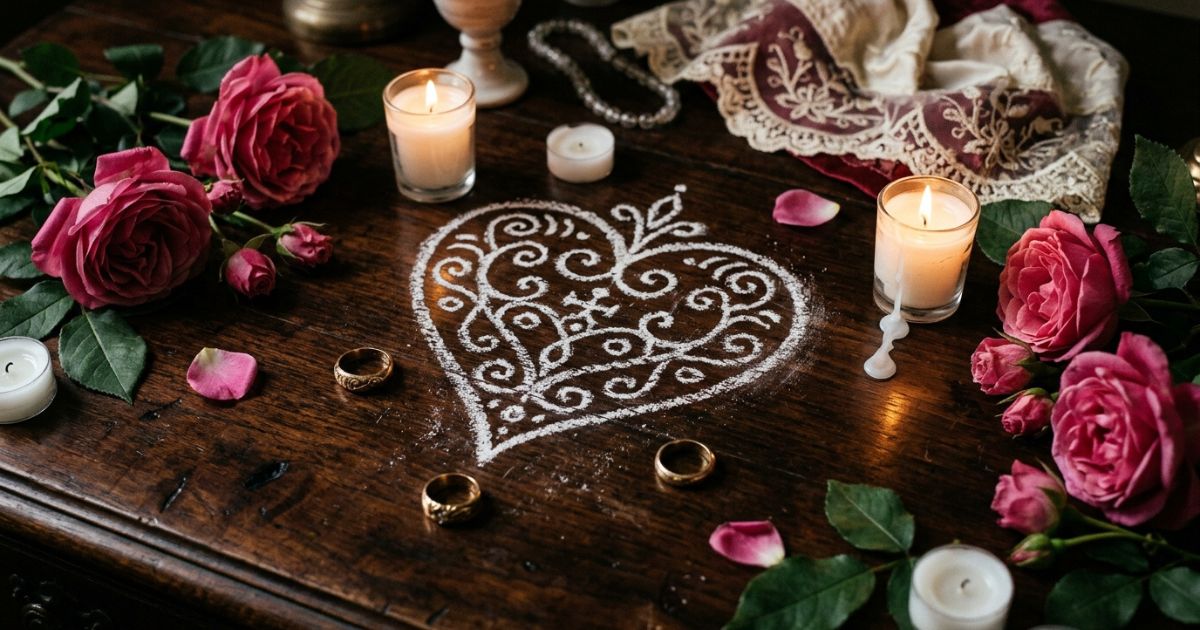
As a voodoo symbol for love, her veve does not promise romance will be easy. It promises that love will be felt fully. That beauty will be genuinely seen. That the grief that comes with loving in an imperfect world is as sacred as the joy.
In her Petro aspect — Erzulie Dantor — she becomes fiercer, more protective, more willing to fight for what she loves. A single mother who defends her children with everything she has. This dual nature makes Erzulie one of the most complete symbols of feminine power in any spiritual tradition: tender and fierce, idealistic and battle-ready, beautiful and entirely serious about what beauty requires.
3. Baron Samedi — The Symbol That Faces Death Without Flinching
Baron Samedi is perhaps the most recognizable figure in popular Vodou imagery — and the most misunderstood.
His veve combines a cross with coffin imagery and skull motifs. Hollywood used this as shorthand for horror. The actual tradition is considerably more interesting.
Baron Samedi is the master of death — but he is also the master of life, because he is the only Lwa who can decide whether someone will die. If he chooses not to dig a grave, the person cannot die, regardless of illness or injury. He is simultaneously the lord of death and the last line of defense against it.
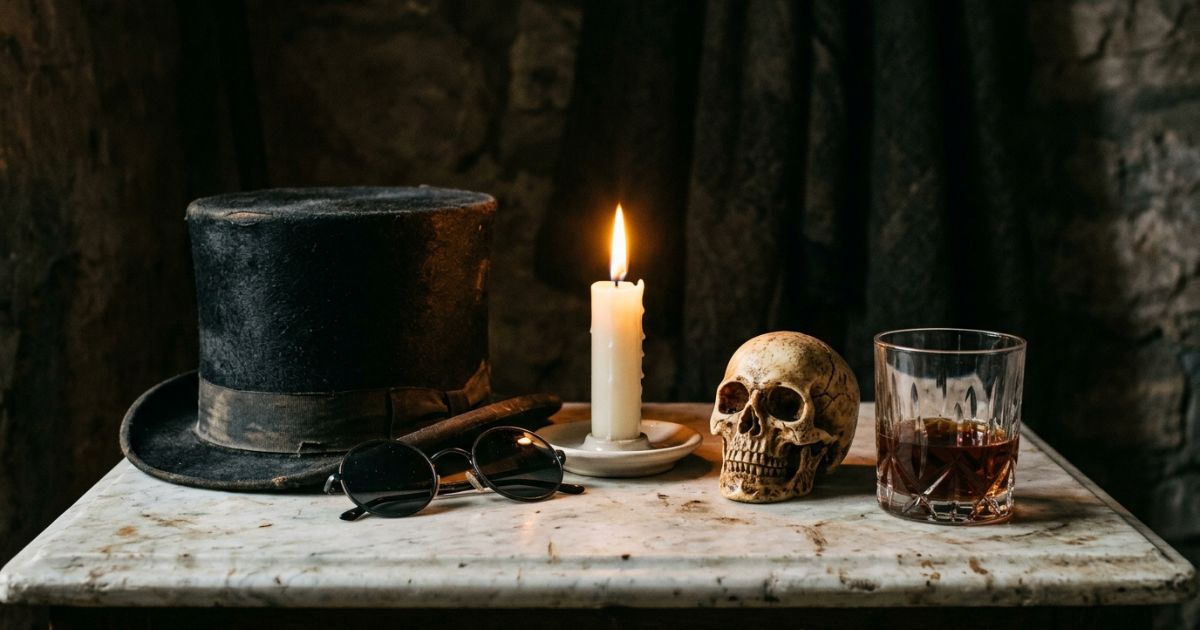
And crucially — Baron Samedi has an extraordinary sense of humor. He appears at ceremonies in a top hat and dark glasses, drinking rum, telling obscene jokes, making people laugh at the very moment they are confronting their mortality. His humor is not disrespect. It is wisdom: the recognition that death is real and inevitable, that terror of it is understandable, and that laughter in the face of that truth is one of the most human and most sacred responses available.
As a voodoo symbol, Baron Samedi’s veve represents the specific courage of acknowledging mortality without being destroyed by the acknowledgment. The cross in his veve is not the Christian symbol of suffering — it is the crossroads again, the place where life and death meet, where every human must eventually stand.
4. Damballa — The Serpent of Creation
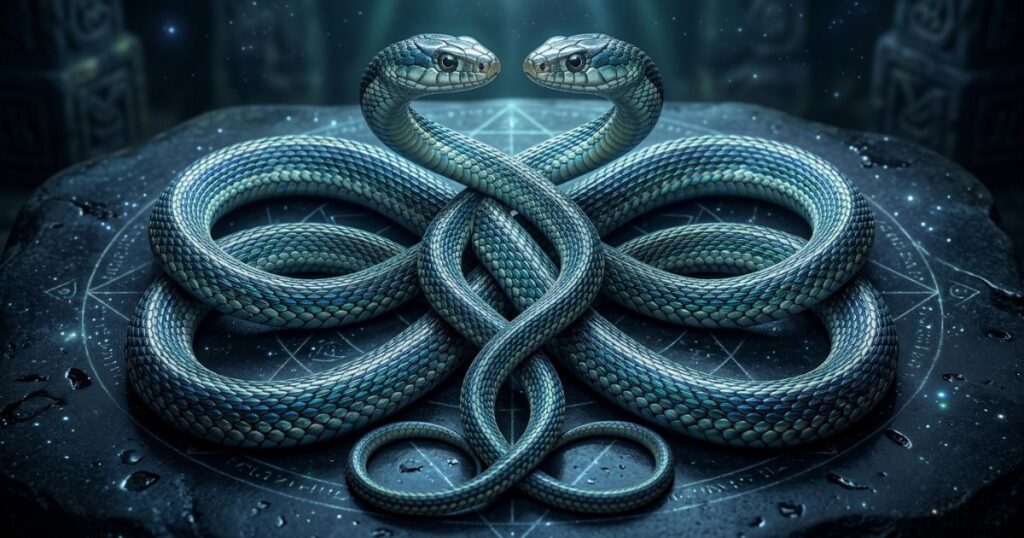
Damballa is one of the most ancient of all Lwa, and his veve — two intertwined serpents in flowing curves — is one of the most visually striking in the Vodou tradition.
In Haitian Vodou, the serpent is not evil. It carries none of the Edenic weight that Western Christianity attached to it. Damballa is associated with creation, purity, cosmic wisdom, and the life force that runs through everything. He is often imagined as the great serpent who wraps around the universe, whose movements create the pattern of existence itself.
His veve’s two intertwined serpents immediately recall the caduceus — the medical symbol of intertwined snakes — and scholars have noted that this convergence across cultures reflects something deep in human visual understanding of life force, healing, and the dual nature of energy.
Damballa rarely speaks in human language during possession ceremonies. He moves. He glides. He communicates through motion rather than words — reflecting the understanding that the most fundamental cosmic forces operate below language.
5. Ogou — The Warrior’s Sacred Mark
Ogou is the Lwa of war, iron, strength, and justice — and his veve reflects all of this: a machete or sword, combined with precise geometric lines that radiate authority and force.
But Ogou is not a symbol of violence for its own sake. He is the protector of the vulnerable, the fighter who takes action when action is the only moral response. His domain is iron — tools and weapons — and his energy is the energy of someone who acts from principle, who does what must be done, who does not flinch from necessary confrontation.
In the context of Haitian history, Ogou’s significance cannot be overstated. The Haitian Revolution — the only successful slave revolution in history, which produced the world’s first Black republic in 1804 — was accompanied by extensive Vodou ceremony. According to tradition, the ceremony at Bois Caïman in 1791, which marked the beginning of the revolution, invoked Ogou among other Lwa. Whether this account is historically precise or mythologically layered, the symbolic truth is clear: when enslaved Haitians chose to fight for their freedom, they drew on Ogou’s energy of principled, courageous action.
As a voodoo symbol, Ogou’s veve represents the specific courage of fighting for what is right — not reckless aggression, but righteous force directed by justice.
6. Agwe — The Lord of the Sea
Agwe rules the ocean — in a culture descended from people who crossed the ocean in chains, this is not a minor domain.
His veve shows a ship with oars, surrounded by wave imagery, sometimes with fish and maritime symbols. As the Lwa of the sea, Agwe protects sailors, fishermen, and all who depend on the ocean for survival. He is called upon for protection during maritime journeys and for abundance from the sea’s resources.
But for the descendants of the enslaved, the ocean carries additional weight. It is the Middle Passage. It is the water that swallowed the bodies of those who did not survive the crossing. Agwe’s domain includes all of that — the ocean as both the path of devastation and the space of ongoing life, of fishing and travel and commerce.
His veve holds that history without resolving it — because the ocean holds it.
7. Ayizan — The Symbol of Sacred Healing
Ayizan is among the oldest and most respected of all Lwa — the spirit of the marketplace, of healing, and of the priesthood itself. Her veve features a palm frond design with geometric precision at its base.
She represents the specific authority of the healer and the priest — those who hold sacred knowledge in service of the community. Markets in West African tradition were not simply commercial spaces. They were centers of community life, of information exchange, of healing and ritual. Ayizan’s domain encompasses all of this.
In the ceremony, Ayizan is often invoked in connection with initiation — the transformation of a practitioner into a full priest or priestess. Her symbol marks the moment when someone takes on the responsibility of serving as a channel for sacred energy.
8. La Sirene — The Mystery of the Ocean’s Depths
La Sirene is the Lwa of the sea’s surface and depths — the mermaid spirit whose beauty conceals extraordinary power. Her veve combines mermaid imagery with wave patterns and mirrors, reflecting her association with both the visible surface of things and the hidden depths beneath.
She is associated with music, beauty, vanity, and the kind of allure that draws people toward what they do not fully understand. She can grant extraordinary gifts — musical ability, beauty, insight — but she can also pull people into depths they were not prepared to navigate.
As a voodoo symbol, La Sirene represents the truth that what is most beautiful is often also most powerful and most dangerous — and that approaching the sacred requires humility, not just fascination.
Voodoo Symbols Across Cultures — From West Africa to New Orleans
Voodoo symbols did not emerge in Haiti. They traveled there — carried in human memory through one of history’s greatest atrocities and preserved through extraordinary spiritual resilience.
West Africa — Particularly the Fon and Ewe peoples of modern Benin and Togo practiced Vodun as a complete religious system honoring spirits who governed all aspects of natural and social life. The visual language of their ceremonies included sacred symbols drawn on the ground, on walls, and on the bodies of initiates. These traditions were old, sophisticated, and deeply embedded in daily life before the slave trade began.
Haiti — The Middle Passage scattered Africans from dozens of different ethnic and linguistic groups onto Caribbean plantations where they could not communicate in their original languages. Vodou emerged partly as a unifying spiritual language — drawing from multiple West African traditions, adapting Catholic iconography as protective camouflage, and developing the veve system into the highly structured visual language it became. The miracle of Haitian Vodou is that it preserved spiritual continuity under conditions designed to make continuity impossible.
Louisiana Voodoo — In New Orleans, a parallel tradition developed with influences from Haitian immigrants, French and Spanish colonialism, and Native American healing traditions. Marie Laveau, the legendary Voodoo Queen of New Orleans, became the most famous practitioner of this tradition — blending African spiritual practice, Catholicism, and folk healing into a public spiritual authority that drew clients from every level of society.
Cuba and Brazil — Related traditions — Santería in Cuba, Candomblé in Brazil — developed from similar roots, using comparable visual languages to connect practitioners with Orishas (related to Lwa) through sacred ceremony. The core principle is identical: symbols channel divine energy into human experience.
Why Voodoo Symbols Were an Act of Survival
This is the history that most guides to voodoo symbols skip, and it is the most important context for understanding why these symbols carry the power they do.
During slavery in Haiti, the practice of African religion was illegal. Gatherings were controlled. Drums were banned at various points. The language, culture, and spiritual traditions of enslaved Africans were systematically attacked as tools of dehumanization — because a person who is fully human, with a complete spiritual life, is harder to enslave than a person who has been stripped of identity.
The veve survived because it could be drawn in cornmeal and dissolved. It left no permanent evidence. A ceremony could be conducted, the sacred space opened, the Lwa honored, the community held together in spiritual solidarity — and then the powder dispersed and nothing remained to be found.
Every voodoo symbol drawn in powder is an artifact of that survival. Every line carries the memory of people who understood that their spiritual life was the last domain that could not be fully colonized — and who protected it with extraordinary ingenuity and courage.
When Hollywood reduced these symbols to horror movie props, it continued a tradition of misrepresentation that began with colonial authorities who needed African spirituality to seem dangerous rather than beautiful, powerful rather than meaningful, threatening rather than human.
Understanding voodoo symbols honestly means understanding this context. The symbols were not hiding darkness. They were preserving light.
The Psychology of Voodoo Symbols
Why do voodoo symbols produce such powerful psychological responses — even in people with no connection to Vodou tradition?
The answer comes from the structure of the symbols themselves. Veves combine elements that the human brain processes as deeply meaningful: sacred geometry — precise symmetry and proportion that activates the mind’s pattern-recognition systems; repeated motifs that create a hypnotic visual rhythm; intersecting lines that suggest connection between separate elements; and bilateral symmetry that activates feelings of completeness and order.
Carl Jung identified the crossroads as one of humanity’s universal archetypes — an image so deeply embedded in collective human experience that it carries emotional charge before conscious interpretation. The crossroads appears in Papa Legba’s veve, in Baron Samedi’s domain, in the general Vodou understanding of the boundary between worlds. It resonates globally because human beings have always understood threshold moments — the places where choices must be made and worlds change — as sacred.
The veve’s use of flowing curves (in Damballa’s serpents, in Erzulie’s heart, in Agwe’s waves) alongside precise geometric structure mirrors the brain’s experience of the world itself: organic movement within patterned order. This visual combination is experienced as alive — not static like a purely geometric symbol, not random like pure organic form, but dynamically patterned in the way that living systems are.
Voodoo Symbols in Tattoos, Art, and Modern Culture
The contemporary engagement with voodoo symbols spans a wide range of contexts — from deeply traditional spiritual practice to art world exhibitions to tattoo studios in cities worldwide.
In tattoos, voodoo symbols are chosen for several different reasons. Some are chosen by practitioners of Vodou or related traditions who want to carry sacred connection with them permanently. Others are chosen for their visual beauty and mystique. And some are chosen specifically as acts of cultural reclamation — by Haitian and Afro-Caribbean people asserting pride in a tradition that was systematically denigrated.
Most meaningful choices:
- Papa Legba’s crossroads — chosen for transition moments, new beginnings, major life changes
- Erzulie Freda’s heart — for love that has cost something real, beauty that survived difficulty
- Baron Samedi’s cross — for survivors of serious illness, for those who have faced death and chosen life
- Damballa’s serpents — for healing, transformation, and connection to ancient wisdom
In art, contemporary Haitian painters like Hector Hyppolite and later generations have used veve imagery to create work that is simultaneously traditional and modern — honoring the sacred visual language while placing it in dialogue with art world conversations about identity, diaspora, and spiritual intelligence.
In music and film, the misrepresentation has been significant — from James Bond’s Baron Samedi to countless horror movie stereotypes. But counter-representations are growing. Beyoncé’s Lemonade drew extensively on Vodou imagery with genuine cultural engagement. The Serpent and the Rainbow (for all its flaws) at least tried to engage with actual Haitian tradition.
How to Approach Voodoo Symbols Respectfully
This section does not exist in most guides to voodoo symbols, but it should.
Haitian Vodou is a living religion with millions of active practitioners. Its symbols are not public domain aesthetic resources — they are sacred objects belonging to a specific cultural and spiritual tradition that has survived extraordinary persecution.
Several principles for respectful engagement:
Learn before you use. Understanding what a veve represents — which Lwa it honors, what that Lwa’s domain and personality include — is the minimum baseline before using any voodoo symbol in art, tattoo, or spiritual practice.
Acknowledge the source. Vodou comes from Haiti. Its roots are in West Africa. That history — including the colonial violence and the extraordinary spiritual resilience it produced — is inseparable from the symbols.
Distinguish between learning and appropriation. Genuine curiosity, respectful study, and appreciation for the visual and spiritual intelligence of Vodou tradition are welcomed by most practitioners. Extracting aesthetic elements while dismissing or ignoring the tradition they come from is not.
Support authentic voices. Haitian artists, scholars, and practitioners are the primary authorities on their own tradition. Reading, purchasing from, and amplifying their work is the most direct form of respectful engagement.
Read More: 65+ Mysterious Filipino Symbols and Their Hidden Meanings You’ve Never Noticed
Conclusion
The most important thing to understand about voodoo symbols is also the simplest: they survived.
They survived the Middle Passage. They survived plantation slavery. They survived colonial religious prohibition. They survived Hollywood’s decades of misrepresentation. And they survive today — drawn in cornmeal on ceremony floors in Haiti, tattooed on the arms of diaspora Haitians in Brooklyn and Montreal and Paris, painted by contemporary artists, studied by scholars, honored by practitioners who have transmitted this tradition person to person across more than two centuries of pressure to abandon it.
That survival is the deepest meaning of every voodoo symbol. Each veve is a line drawn by people who refused to be erased. Every curve of the serpent, every crossroads intersection, every adorned heart is evidence of spiritual resilience so profound and so sustained that it cannot be explained by any conventional narrative about power and its limits.

Muhammad Shoaib is a passionate content writer and symbolism researcher at TrendyMegzine.com, where he explores the hidden meanings behind symbols, spiritual signs, ancient traditions, dream interpretations, and cultural symbolism.