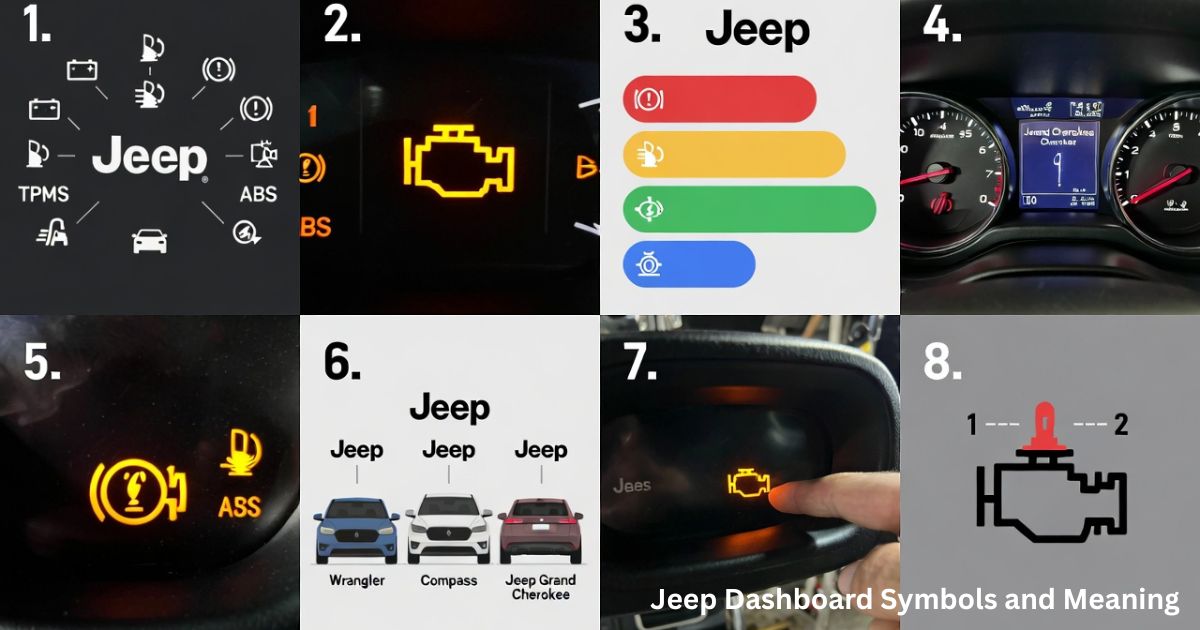
Jeep Dashboard Symbols and Meanings — Complete 2026 Guide
Quick Answer Box — Jeep Warning Light Colors
What does each color mean on your Jeep dashboard?
- 🔴 Red — STOP immediately. Serious danger to engine or safety
- 🟡 Yellow / Amber — Caution. Get it checked soon
- 🟢 Green — System is active and working normally
- 🔵 Blue — Information only (e.g. high beams are on)
- ⚪ White — Feature is active or a reminder
Most urgent lights to never ignore:
- Red oil can (oil pressure) → Stop driving NOW
- Red thermometer (overheating) → Pull over immediately
- Red battery icon → Charging system failing
- Flashing check engine light → Serious engine fault
- Red brake symbol → Brake system problem
That little light just turned on — and now your stomach dropped.
You are driving your Jeep, everything feels fine, and then a symbol appears on your dashboard. Is it serious? Can you keep driving? Do you need to call a tow truck right now?
Jeep dashboard symbols and meanings are something every Jeep owner must understand. These lights are your vehicle’s way of talking to you. They do not appear randomly. Each one carries a specific message about what is happening inside your vehicle at that exact moment.
In this complete guide, you will learn what every Jeep dashboard symbol means, which ones are emergencies, which ones are just information, and exactly what to do when each one appears. This guide covers Jeep Wrangler, Jeep Grand Cherokee, Jeep Compass, Jeep Cherokee, Jeep Gladiator, and older models.
By the end, you will never feel confused or scared by a dashboard light again.
What Are Jeep Dashboard Symbols and Meanings?
Jeep dashboard symbols are small glowing icons on the instrument panel — the screen directly behind your steering wheel.
Each symbol represents a specific vehicle system. When that system needs attention, the icon lights up. Some lights tell you everything is working correctly. Others warn you about a problem.
Think of your Jeep’s dashboard like a doctor’s vital sign monitor. The doctor does not describe everything in long sentences. Instead, a screen shows simple icons and numbers. You glance at them and instantly know the situation.
Your Jeep does the same thing. Instead of reading pages of technical data, you see one small symbol. That symbol carries a specific message — and knowing what it means could save your engine, your safety, or your life.
Three types of Jeep dashboard symbols exist:
- Warning symbols — tell you something is wrong and needs attention
- Indicator symbols — tell you a system is currently active (like 4WD engaged)
- Reminder symbols — remind you about maintenance or minor issues
All Jeep models — Wrangler, Grand Cherokee, Compass, Cherokee, Gladiator, Avenger, Patriot, and Liberty — use a combination of these three types. Most follow international automotive standards, so the basic symbols look the same across all models.
History and Origin of Dashboard Warning Lights
Dashboard warning lights have an interesting history. Understanding where they came from helps you understand why they exist today.
Early Cars Had No Warnings (1900s–1930s)
The first cars were simple machines. Drivers could see, hear, and smell most problems directly. If the engine overheated, steam rose from the hood. If oil was low, you felt it in engine performance. There were no electronic sensors — just a driver’s senses.
The First Gauges Appear (1930s–1950s)
As engines became more complex, manufacturers added physical gauges — dials that showed oil pressure, water temperature, and fuel level. These were always visible but required the driver to actively read them.
The problem: most drivers did not pay close attention to gauges. By the time a needle moved into the danger zone, serious damage had often already begun.
Warning Lights Replace Gauges (1960s–1970s)
Engineers realized that a flashing light grabbed attention faster than a moving needle. The check engine light appeared in the 1960s. Red oil pressure lights and temperature warnings followed.
These lights were binary — either on or off. Simple and impossible to miss.
Electronic Systems and OBD (1980s–1996)
In 1996, the United States required all vehicles to include an On-Board Diagnostics system — called OBD-II. This system connects every electronic sensor in the vehicle to a central computer. When any sensor detects a problem, the computer triggers the matching dashboard light.
This is why you can today take your Jeep to any auto shop and have a technician plug in a small device to read exactly what triggered your check engine light. The OBD-II system stores error codes.
Modern Digital Dashboards (2000s–Present)
Today’s Jeeps — especially the Grand Cherokee, Compass, and newer Wranglers — have full digital instrument clusters. These can display text messages alongside icons, giving even more specific information about what is happening.
The Jeep Wrangler 4xe (plug-in hybrid) has a completely new set of battery and charging icons that did not exist 10 years ago.
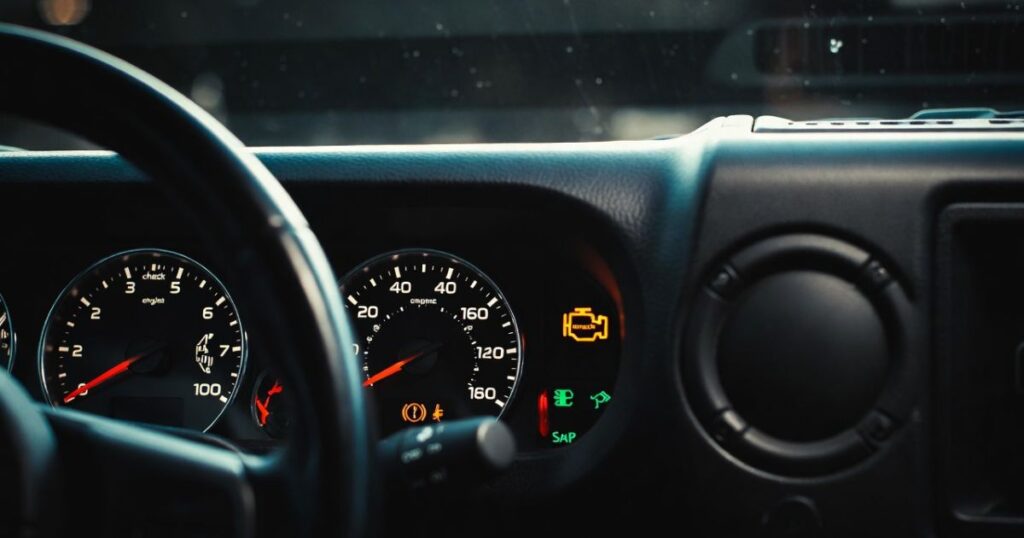
Complete Guide: 40+ Jeep Dashboard Symbols and Meanings
Here is every important Jeep dashboard symbol, what it looks like, and exactly what to do.
🔴 RED WARNING LIGHTS — Act Immediately
These lights require you to stop driving as soon as it is safe to do so.
1. Check Engine Light (MIL — Malfunction Indicator Lamp)
What it looks like: An outline of a car engine
Color: Amber/Yellow (steady) or Red (flashing)
What it means:
- Steady amber: A sensor in the engine or emissions system has detected a fault. Could be minor (loose gas cap) or serious (failing catalytic converter). Drive cautiously and get it diagnosed soon.
- Flashing amber/red: Active engine misfire. This can damage your catalytic converter in minutes. Stop driving safely and call for help.
What to do: Do not ignore it. A steady light — you can drive cautiously to a mechanic. A flashing light — stop as soon as safely possible.
Common causes on Jeeps: Loose fuel cap, faulty oxygen sensor, failing spark plugs, catalytic converter issues.
2. Oil Pressure Warning Light
What it looks like: A small oil can with a drop falling from its spout
Color: Red
What it means: Engine oil pressure has dropped to a dangerously low level. Your engine is not getting the lubrication it needs to run without damage.
What to do: Pull over immediately and turn off the engine. Check your oil level with the dipstick. If oil is low, add oil. If oil level is normal but the light stays on, do NOT restart the engine — call a tow truck. Driving even one mile with this light on can destroy your engine completely.
Cost of ignoring it: Engine replacement can cost $4,000–$10,000. A quart of oil costs $10.
3. Engine Temperature Warning Light
What it looks like: A thermometer sitting in liquid (wavy lines beneath it)
Color: Red
What it means: Your engine is overheating. Engine coolant — the liquid that keeps your engine cool — is either low or not circulating properly.
What to do: Pull over immediately. Turn off the engine. Do NOT open the radiator cap while the engine is hot — hot coolant under pressure can cause severe burns. Wait 30 minutes for the engine to cool, then check coolant level. Call a mechanic.
Common causes: Low coolant, coolant leak, broken water pump, stuck thermostat, blocked radiator.
4. Battery Charge Warning Light
What it looks like: A rectangle (battery) with a plus sign on one end and minus sign on the other
Color: Red
What it means: The vehicle’s charging system is failing. The alternator — which recharges the battery while driving — is not working correctly. Your battery is draining.
What to do: Turn off all non-essential electrical systems (radio, AC, phone charger). Drive directly to a mechanic or auto parts store. Your vehicle may shut down completely within 30–60 minutes if the alternator has completely failed.
5. Brake Warning Light
What it looks like: A circle with an exclamation mark inside, sometimes the letter “P” inside a circle
Color: Red
What it means:
- If parking brake is ON: Release your parking brake. This is the most common reason.
- If parking brake is OFF and light stays on: Brake fluid is low, or there is a serious brake system fault.
What to do: First check that your parking brake is fully released. If the light stays on with the brake off, stop driving and call a mechanic. Brakes are your most critical safety system.
6. Airbag / SRS Warning Light
What it looks like: A seated person with a large circle (the inflated airbag) in front of them
Color: Red or Amber
What it means: The Supplemental Restraint System (SRS) — your airbags and seatbelt pretensioners — has detected a fault. If this light is on, your airbags may NOT deploy in a crash, or they may deploy unexpectedly.
What to do: Get this diagnosed immediately. Do not sit in your Jeep with this light on any longer than necessary. Airbag system faults are a serious safety risk.
7. Power Steering Warning Light
What it looks like: A steering wheel with an exclamation mark
Color: Red or Amber
What it means: Electric power steering has failed. Your steering wheel will feel extremely heavy and difficult to turn.
What to do: You can still steer, but it requires much more physical effort. Drive slowly and carefully to a mechanic.
8. Door Ajar Warning Light
What it looks like: A top-view car outline with one or more doors open
Color: Red
What it means: One or more doors, the hood, or the trunk/tailgate is not fully closed.
What to do: Pull over safely and check all doors, hood, and tailgate. Make sure each one clicks shut completely.
🟡 YELLOW / AMBER WARNING LIGHTS — Get Checked Soon
These lights mean something needs attention, but you are not in immediate danger.
9. Tire Pressure Monitoring System (TPMS) Light
What it looks like: A horseshoe shape (cross-section of a tire) with an exclamation mark inside
Color: Amber/Yellow
What it means: One or more tires has pressure that is too low (or sometimes too high). Jeep Wranglers are especially known for triggering TPMS lights after off-road driving when tire pressure is deliberately adjusted.
What to do: Check all four tire pressures with a gauge. Standard Jeep tire pressure is usually 32–36 PSI — check your driver’s door sticker for the exact number. Inflate or deflate as needed.
Why it comes on with no visible problem: Temperature drops cause tire pressure to decrease. A 10-degree Fahrenheit drop in temperature lowers tire pressure by about 1 PSI.
10. Traction Control Light
What it looks like: A car with squiggly lines beneath the rear tires (representing skidding)
Color: Amber/Yellow
What it means:
- Flashing: Traction control is actively working right now — your tires are slipping and the system is correcting it. This is normal in snow, mud, or on loose gravel.
- Steady: Traction control system has been disabled or has a fault.
What to do: If flashing — slow down. If steady — check if you accidentally pressed the traction control button. If you did not, get it diagnosed.
11. Electronic Stability Control (ESC) Light
What it looks like: Same as traction control — car with squiggly lines, sometimes with “ESC OFF” text
Color: Amber
What it means: Stability control is either working (flashing) or turned off/faulty (steady).
What to do: Same as traction control above.
12. Low Fuel Warning Light
What it looks like: A gas pump icon, sometimes with an arrow pointing left or right (indicating which side your fuel cap is on)
Color: Amber or White
What it means: Fuel level is low. On most Jeeps, this triggers when you have approximately 30–50 miles of fuel remaining, depending on the model.
What to do: Find a fuel station soon. Running completely out of fuel can damage fuel pumps and fuel injectors.
13. Loose Fuel Cap / Gas Cap Warning
What it looks like: A fuel cap icon, or sometimes just text saying “Gas Cap”
Color: Amber
What it means: The fuel cap is not tightened properly, or the seal is damaged. This causes the evaporative emissions system to detect a pressure leak — which also triggers the check engine light in many cases.
What to do: Stop at a safe place. Remove the fuel cap and retighten it firmly until you hear it click. The light may take 1–2 drive cycles to turn off.
14. Transmission Temperature Warning
What it looks like: A gear with a thermometer or wavy lines
Color: Amber or Red
What it means: Transmission fluid is overheating. This often happens when towing heavy loads, driving in very hot weather, or driving aggressively on steep hills.
What to do: If amber — pull over and let the transmission cool for 15–20 minutes. If red — stop immediately. Overheated transmission fluid breaks down and stops lubricating properly, causing expensive damage.
15. Service Required / Maintenance Due Reminder
What it looks like: A wrench icon, or text saying “Service Due” or “Oil Change Required”
Color: Amber or White
What it means: Your Jeep has calculated that it is time for routine maintenance — usually an oil change. This is based on miles driven or time elapsed since last service.
What to do: Schedule an oil change or service appointment. This is not an emergency, but do not delay too long.
🟢 GREEN INDICATOR LIGHTS — Systems Active
These lights tell you a feature is currently turned on and working. They are not warnings.
16. 4WD Engaged Indicator
What it looks like: An axle diagram showing front and rear wheels connected, or text like “4WD HI” or “4WD LO”
Color: Green or Amber
What it means: Four-wheel drive is engaged. This is expected when you have switched to 4WD mode.
For Jeep Wrangler and Gladiator: 4WD HIGH is for slippery roads and mild off-road. 4WD LOW is for serious off-road, rock crawling, and very steep inclines.
17. Cruise Control Indicator
What it looks like: A speedometer with an arrow or “CRUISE” text
Color: Green
What it means: Cruise control is set and active. Your Jeep is maintaining the set speed automatically.
18. Turn Signal Indicators
What it looks like: Green arrow pointing left or right, flashing
Color: Green
What it means: Your turn signal is active. If it flashes twice as fast as normal, one of your turn signal bulbs has burned out.
19. High Beam Indicator
What it looks like: A headlight symbol with lines pointing straight forward
Color: Blue
What it means: Your high beam headlights are on. Dim them when approaching oncoming traffic.
20. Seatbelt Reminder
What it looks like: A person with a diagonal line across their chest (the seatbelt)
Color: Red
What it means: Someone in the vehicle has not fastened their seatbelt.
What to do: Buckle up. Every time. Seatbelts reduce the risk of death in a crash by 45%.
21. Auto Start-Stop System — The “A” Symbol
What it looks like: The letter “A” with a circular arrow around it
Color: Green (system working) or Amber (system has a fault)
What it means: This is one of the most frequently asked-about Jeep dashboard symbols. The Auto Start-Stop system automatically shuts off your engine when you stop at a traffic light and restarts it when you press the gas pedal. It saves fuel.
- Green “A” — system is active and working
- Amber “A” with exclamation mark — system has a fault or is temporarily unavailable (often happens when battery is low or engine is still warming up)
What to do: If green — nothing needed, this is normal. If amber — the system has temporarily disabled itself. This often happens in cold weather or when the battery is slightly weak. If it stays amber consistently, have the battery and system checked.
22. Electronic Throttle Control (ETC) Warning
What it looks like: A lightning bolt inside a throttle body outline
Color: Amber or Red
What it means: The electronic throttle control system — which controls how much air enters the engine when you press the gas pedal — has a fault.
What to do: Reduce speed and drive carefully. Your throttle response may feel sluggish or unpredictable. Get it diagnosed as soon as possible.
23. ABS Warning Light
What it looks like: The letters “ABS” inside a circle, sometimes with brackets around the circle
Color: Amber
What it means: The Anti-lock Braking System has a fault. ABS prevents your wheels from locking during emergency braking — which allows you to steer while braking hard.
What to do: Your regular brakes still work. But your stopping ability in emergencies is reduced. Drive more carefully and increase following distance until repaired.
24. Stability Control OFF Indicator
What it looks like: A car with squiggly lines and “OFF” text
Color: Amber
What it means: You have turned off electronic stability control. Many Jeep drivers turn this off intentionally for off-road driving.
What to do: If you turned it off on purpose — nothing needed. If it came on by itself — check if the stability control button was accidentally pressed.
25. Hill Descent Control (HDC) Indicator
What it looks like: A car on a downhill slope with a speed indicator
Color: Green or Amber
What it means: Hill Descent Control is active. This system automatically controls your braking speed on steep downhill terrain. Common on Jeep Grand Cherokee and Wrangler.
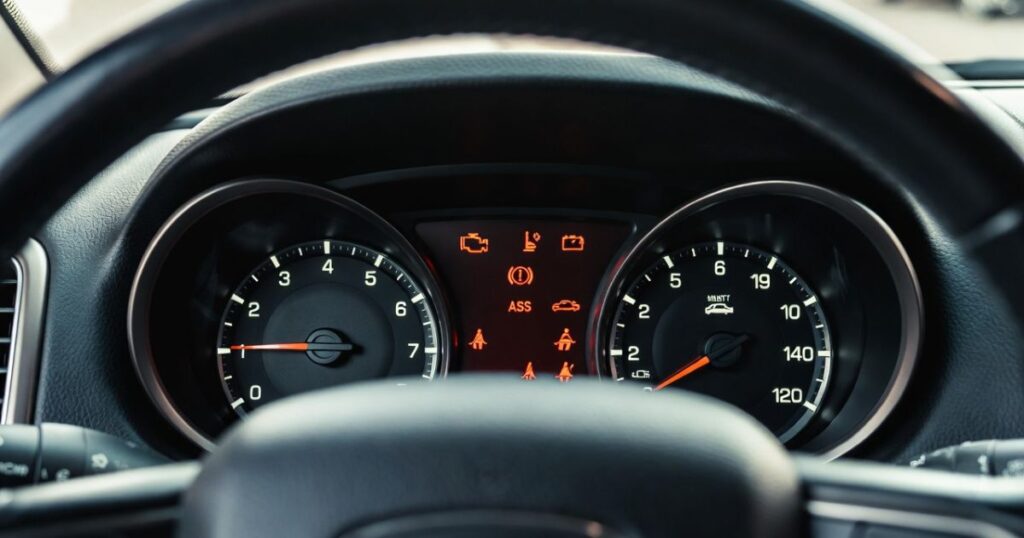
JEEP-SPECIFIC SYMBOLS
26. Rock Mode / Terrain Mode Indicator
What it looks like: A mountain or rock icon, sometimes with mode text
Color: Green or Amber
What it means: Your Jeep is in a specific terrain mode — like Rock, Sand, Snow, or Auto. Found on Jeep models with Selec-Terrain system.
27. Selec-Speed Control Indicator (Wrangler/Gladiator)
What it looks like: Mountain with downward arrow and speed indicator
Color: Green
What it means: Selec-Speed Control is active — maintaining a controlled low speed on steep terrain without the driver pressing the brake.
28. Electric Vehicle / Hybrid System Indicators (Jeep 4xe)
What they look like: Battery with lightning bolt, plug icon, regenerative braking symbol
Color: Green, Blue, or Amber
What they mean: Battery charge level, charging status, and electric mode status for the Jeep Wrangler 4xe and Grand Cherokee 4xe plug-in hybrids.
Jeep Dashboard Symbols by Model
Different Jeep models have slightly different symbol sets. Here is a quick comparison:
| Symbol | Wrangler | Grand Cherokee | Compass | Cherokee | Gladiator |
| 4WD Indicator | ✅ Always | ✅ | Some trims | Some trims | ✅ Always |
| Hill Descent Control | ✅ Rubicon | ✅ Trailhawk | Some trims | Some trims | ✅ Rubicon |
| Rock Mode | ✅ Rubicon | ✅ Trailhawk | ❌ | ❌ | ✅ Rubicon |
| Auto Start-Stop (A) | ✅ 2018+ | ✅ | ✅ | ✅ | ✅ |
| Hybrid/EV Symbols | ✅ 4xe only | ✅ 4xe only | ❌ | ❌ | ❌ |
| Lane Departure Warning | Some trims | ✅ | ✅ | ✅ | Some trims |
| Adaptive Cruise | Some trims | ✅ | ✅ | ✅ | Some trims |
| Check Engine | ✅ All | ✅ All | ✅ All | ✅ All | ✅ All |
| TPMS | ✅ All | ✅ All | ✅ All | ✅ All | ✅ All |
Jeep Dashboard Warning Light Colors — What Each Color Means
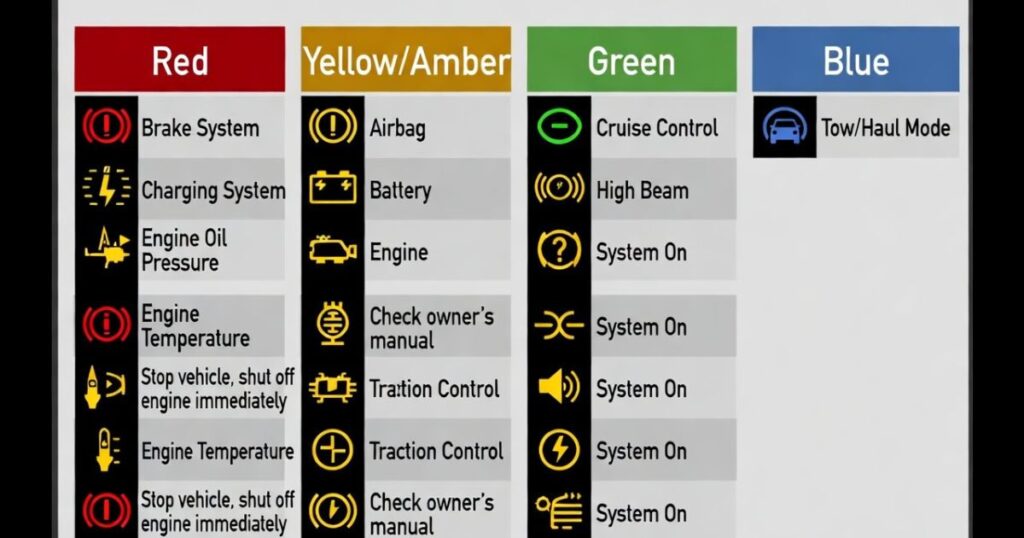
Color is the fastest way to understand urgency. Here is the complete color system:
| Color | Urgency Level | What It Means | Action Required |
| 🔴 Red | CRITICAL | Immediate danger to safety or engine | Stop driving NOW |
| 🟡 Amber/Yellow | CAUTION | Problem detected, needs attention | Get checked within days |
| 🟢 Green | INFORMATION | System is active and working | No action needed |
| 🔵 Blue | INFORMATION | Feature active (like high beams) | No action needed |
| ⚪ White | REMINDER | Minor notification or feature active | Note and address soon |
The most important rule: Red lights are always emergencies. Never ignore a red dashboard light.
Jeep Dashboard Symbols — Common Myths vs Real Facts
| Myth | Real Fact |
| “If my Jeep drives fine, I can ignore the check engine light” | False. Many serious faults cause no noticeable driving changes — until they cause complete failure. |
| “The check engine light means my engine is about to explode” | False. Most check engine light causes are minor. But all need diagnosis. |
| “TPMS light means I have a flat tire” | False. TPMS just means pressure is outside the ideal range. Tires can look perfectly fine visually. |
| “Once a warning light turns off by itself, the problem is fixed” | False. Some lights cycle on and off as conditions change. The fault code stays stored in your OBD system. |
| “Jeep dashboard symbols are the same as other car brands” | Mostly true for basic symbols (oil, battery, temp). But Jeep-specific features like 4WD modes have unique icons. |
| “A green dashboard light means something good is about to happen” | Not exactly. Green means a system is currently ON. It is informational, not celebratory. |
| “You need a dealer to read dashboard warning codes” | False. Any auto parts store (AutoZone, O’Reilly, etc.) will scan your OBD-II codes for free. |
| “All Jeep models have the same dashboard symbols” | False. Advanced models like the Grand Cherokee have many symbols the basic Compass does not. |
What to Do When a Jeep Warning Light Comes On
Follow these steps every time a new dashboard symbol appears:
Step 1: Note the Color Red = pull over when safe. Amber = drive carefully. Green/Blue = no action needed.
Step 2: Check if the Light is Steady or Flashing A flashing light is always more urgent than a steady one. A flashing check engine light means stop as soon as safely possible.
Step 3: Note Any Other Symptoms Does the car feel different? Hear new noises? Smell something unusual? Report all of this to your mechanic — it helps diagnosis.
Step 4: Check the Simple Things First Before assuming a major problem, check: Is your fuel cap tight? Is your parking brake released? Are all doors closed? Many warning lights have simple causes.
Step 5: Get an OBD-II Scan Any auto parts store will scan your vehicle’s computer for free. The scan reads the error code stored by your Jeep’s computer and tells you exactly what triggered the light.
Step 6: Do Not Clear the Code Without Fixing the Problem Some people clear the code so the light goes out. This does not fix the problem — it just hides the symptom. The light will return.
Step 7: Visit a Qualified Mechanic For any red light, or any amber light that persists, take your Jeep to a qualified mechanic. Bring the OBD-II code with you to save time and money on diagnosis.
FAQ — Jeep Dashboard Symbols and Meanings
Q1: What are the icons on my Jeep dashboard?
Jeep dashboard icons are small illuminated symbols that appear on your instrument cluster. They represent different vehicle systems — engine, brakes, oil, battery, tires, safety systems, and more. Red icons indicate emergencies. Amber/yellow icons mean caution. Green and blue icons show that a system is currently active. This guide covers 40+ of the most common Jeep dashboard icons and what each one means.
Q2: Do Jeeps have secret symbols?
Not exactly “secret” — but some Jeep-specific symbols are unique to the brand and not found on other vehicles. The most notable are the 4WD system indicators (4WD HI, 4WD LO, NEUTRAL), terrain mode symbols (Rock, Sand, Snow, Auto), and the Selec-Speed Control indicator found on Wrangler Rubicon and Gladiator models. These are covered in your owner’s manual under the dashboard section.
Q3: What does an “A” with an exclamation mark mean on a Jeep Compass?
This is the Auto Start-Stop system fault indicator. The letter “A” with a circular arrow represents the Auto Start-Stop feature. When an exclamation mark appears with it, the system has detected a fault or has disabled itself temporarily. Common reasons include a weak battery, cold engine temperature, or the driver intentionally pressing the Auto Start-Stop disable button. If it stays on consistently, have your battery and electrical system checked.
Q4: What does a circle with an exclamation mark mean on a Jeep dashboard?
A circle with an exclamation mark is most commonly the Tire Pressure Monitoring System (TPMS) light — showing that one or more tires has low pressure. However, it can also appear as part of the brake warning light. Check the color: amber usually means TPMS, red usually means brakes. Check your tire pressures and your brake system accordingly.
Q5: Can I drive my Jeep with the check engine light on?
If the check engine light is steady amber: yes, but get it diagnosed within a few days. Reduce driving to essential trips. If the check engine light is flashing: stop driving as soon as safely possible. A flashing light means active engine misfires, which can damage the catalytic converter within minutes of continued driving.
Q6: Why does my Jeep Wrangler TPMS light keep coming on?
The Wrangler TPMS light is especially common because many Wrangler owners air down their tires for off-road driving (lowering tire pressure for better grip on rocks and sand). When you return to road driving, the TPMS triggers because pressure is still low. Simply reinflate your tires to the recommended PSI — usually 35–37 PSI for standard Wrangler tires. Also, in cold weather, pressure drops naturally, causing the light to trigger even with correctly inflated tires.
Q7: What is the most serious Jeep dashboard symbol?
The three most serious Jeep dashboard symbols are the red oil pressure warning (oil can icon), the red engine temperature warning (thermometer icon), and the flashing check engine light. These three require you to stop driving immediately. Continuing to drive with any of these active can result in catastrophic engine damage costing thousands of dollars to repair.
Q8: How do I reset Jeep dashboard warning lights?
First, fix the underlying problem. Then: for most lights, once the problem is repaired, the light turns off automatically within 1–3 drive cycles (start, drive, stop sequences). For the TPMS light — inflate tires to correct pressure and drive above 15 mph for a few minutes. For the service reminder — your mechanic resets it after completing service. Never just disconnect the battery to clear lights — this erases all stored diagnostic codes and creates additional problems.
Read More: 90+ Sanskrit Symbols & Their Deep Meanings Explained 2026
Conclusion
Jeep dashboard symbols and meanings are your vehicle’s way of keeping you safe.
Every symbol exists for a reason. Every color means something specific. And every warning — whether red, amber, or a simple reminder — is your Jeep communicating with you in the clearest language it knows.
The most important thing you can take from this guide: red lights are emergencies. Never ignore them. Amber lights need attention within days. Green and blue lights are just information.
Keep this guide saved on your phone. Share it with anyone who drives a Jeep. And the next time a light appears on your dashboard, you will know exactly what to do.
Want to learn more? Read our complete guides on Jeep Wrangler off-road tips, Jeep Grand Cherokee maintenance schedules, and what every car warning symbol means across all vehicle brands

Muhammad Shoaib is a passionate content writer and symbolism researcher at TrendyMegzine.com, where he explores the hidden meanings behind symbols, spiritual signs, ancient traditions, dream interpretations, and cultural symbolism.